Astrology Journal
Acronychal Rising in Astrology: Meaning and Timing
Acronychal rising describes a celestial body rising near sunset, commonly around opposition to the Sun. It is an evening horizon event, not heliacal rising.
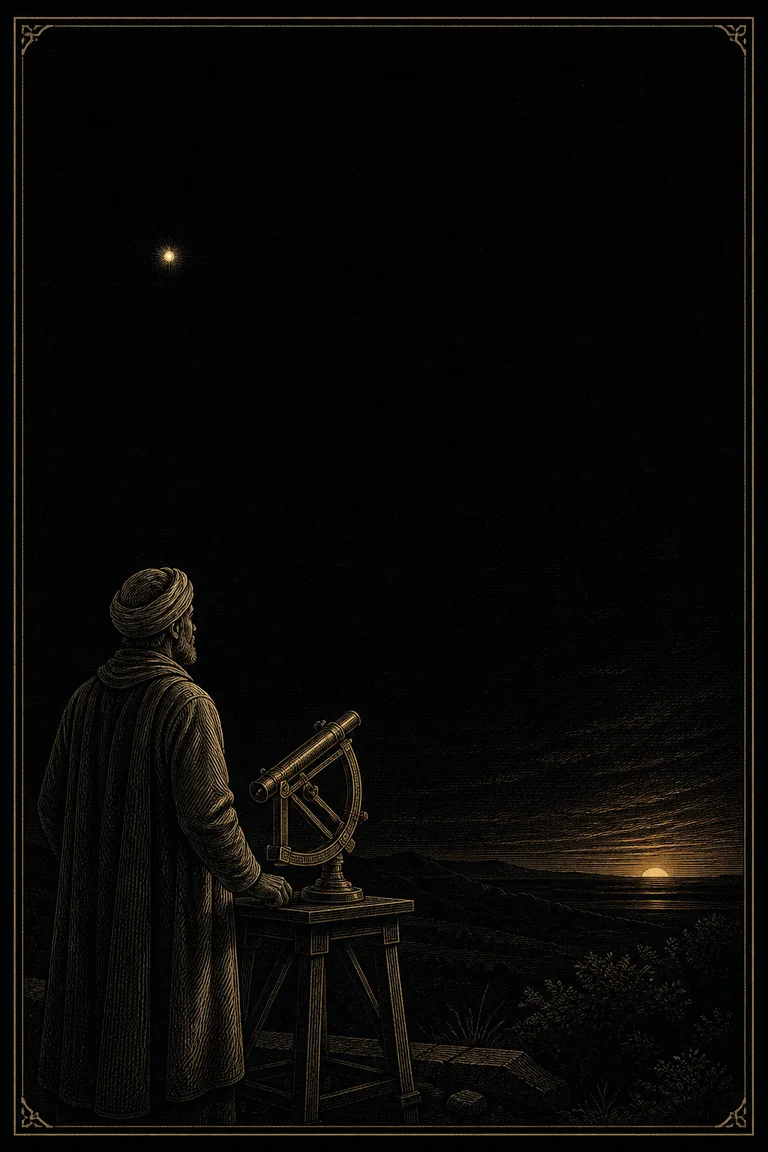
In astronomy and historical astrology, acronychal rising occurs when a star or planet rises in the east around the time the Sun sets in the west. The body is opposite or broadly opposite the Sun in the sky, remains visible through much of the night, and reaches its highest point around midnight when the geometry is close to exact opposition.
The label needs a declared convention. Some sources require an observed horizon event at sunset, while others use an idealized solar opposition or a seasonal date associated with it. Location, horizon, latitude, brightness, refraction, and the chosen twilight threshold can move the observable date. Do not confuse acronychal rising with first morning visibility after solar concealment.
Take the next insight with you
Explore personalized Astrology guidance in Veritas, available for iOS and Android.
 Scan with your phone
What is acronychal rising?
The word is used for rising at the close of day. In its clearest observational sense, the Sun is setting on the western horizon while the other body is rising on the eastern horizon. For a planet, exact opposition places the two about 180 degrees apart in geocentric longitude, but an observed simultaneous rise and set also depends on latitude, declination, refraction, and the local horizon.
Record the event before interpreting it
Use Veritas to save the location, date, sunset and rising times, elongation, visibility assumptions, source convention, and interpretive scope.
Acronychal rising versus heliacal rising
The opposition geometry
At exact geocentric opposition, a superior planet such as Mars, Jupiter, or Saturn lies opposite the Sun in ecliptic longitude. It generally rises around sunset, culminates around local midnight, and sets around sunrise. “Around” matters. Declination and observer latitude change the horizon timings, and local terrain can delay visible rising even when the calculated body is above an ideal horizon.
How to determine an acronychal rising
- Name the body and convention
State whether you are testing a planet, star, exact opposition, simultaneous horizon event, or a date from a historical table.
- Fix the observer
Use the intended location, date, time zone, elevation, and a known eastern and western horizon where observation matters.
- Calculate sunset and rising
Compare the Sun's setting time with the body's apparent rising time using the same atmospheric assumptions.
- Check solar elongation
For opposition-based usage, confirm the angular separation and note whether it is applying, exact, or separating.
- Assess visibility
Consider brightness, twilight, extinction, weather, Moon light, and horizon obstruction separately from geometry.
- Preserve uncertainty
Record the tolerance used instead of converting a gradual observational window into one universal minute.
Which planets can rise acronychally?
Mars, Jupiter, Saturn, Uranus, Neptune, Pluto, and other bodies that can reach opposition may rise around sunset. Mercury and Venus remain close to the Sun as seen from Earth and do not reach opposition, so they do not have the same acronychal opposition phase. Their familiar appearances are morning-star and evening-star cycles nearer the Sun.
What about fixed stars?
A fixed star can have an annual acronychal rising date when it rises around sunset. Precession slowly changes seasonal alignment across centuries, while latitude and horizon alter local observation. Historical calendars may use a conventional date rather than a modern computed first visible event. When studying an old source, preserve its place, epoch, calendar, and definition before translating the date into a present chart.
Acronychal and cosmic terminology
Older texts and modern translations do not always use horizon terms consistently. “Cosmic rising,” “cosmical rising,” and “acronychal setting” can be defined differently across authors, sometimes by rising or setting with the Sun and sometimes by the opposite horizon at dawn or dusk. Quote or paraphrase the author's operational rule instead of relying on the English label alone.
Traditional interpretive use
An astrologer may treat a body near opposition and visible through the night as emphatic, externally apparent, or brought into full confrontation with solar themes. Those meanings are symbolic and tradition-dependent. The condition does not automatically make a planet benefic, malefic, dignified, angular, swift, or dominant. Sign, house, rulership, sect, aspects, speed, and the chart question remain separate testimonies.
Example: Jupiter near opposition
Suppose Jupiter rises shortly after local sunset and is 178 degrees from the Sun. A source that allows a small observational window may call the phase acronychal; a strict exact-opposition table may reserve its marked date for later. In a natal or event chart, the astrologer can note strong nocturnal visibility and an opposition phase without claiming that Jupiter guarantees recognition, wealth, protection, or success.
Acronychal rising in natal astrology
For a natal chart, confirm that the technique belongs to the method you are using. A planet close to the eastern horizon at sunset may also be near the Ascendant and opposite the Sun, so several conditions overlap. Interpret the horizon angle, solar aspect, visibility phase, dignity, and house rulership separately before synthesis. Do not attribute every effect of angularity or opposition to the acronychal label.
Acronychal rising in mundane and seasonal work
Historical observers used stellar risings and settings to organize seasons, agriculture, navigation, ritual calendars, and weather lore. Such associations belong to a specific climate, era, and cultural record. Moving a seasonal rule to another latitude or century without recalculation can break the observational basis. It should not be treated as a universal forecast of weather or public events.
Keep geometry and symbolism in separate fields
In Veritas, note the computed event, observation conditions, historical source, chart role, interpretation, and evidence that would change your conclusion.
Why software may disagree
One program may flag exact longitude opposition, another may calculate apparent altitude at civil sunset, and a third may use a fixed orb or historical table. Topocentric versus geocentric positions, refraction models, elevation, twilight definition, and time rounding can all shift a result. Compare raw times and coordinates before treating one label as an error.
Common mistakes
Do not call every evening-visible planet acronychal. Do not confuse rising at sunset with setting after sunset. Do not use heliacal rising for a body returning before dawn and acronychal rising as interchangeable terms. Do not assume exact opposition guarantees simultaneous horizon contact for every latitude. Finally, do not infer character or fate from visibility language alone.
Limits of the technique
Acronychal rising is an astronomical or historical phase description with symbolic uses in astrology. Astrology is not a scientifically validated prediction system. This condition cannot establish personality, health, morality, relationship outcomes, financial results, weather, or public events. Precise observation improves historical and technical accuracy, but it does not validate a deterministic claim.