Astrology Journal
Oriental and Occidental Planets in Astrology
A planet is oriental of the Sun when it rises before the Sun and occidental when it follows the Sun into the evening sky. The terms describe solar phase, not personality rank.
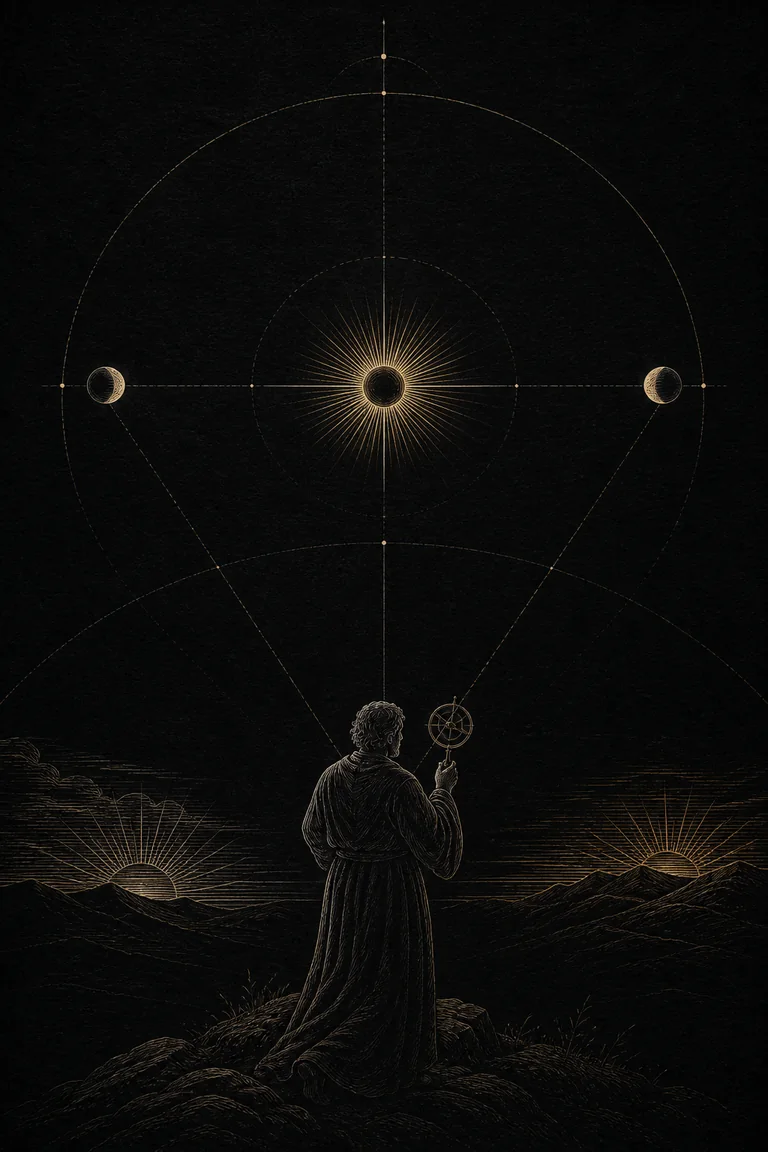
In the practical traditional definition, an oriental planet rises before the Sun and belongs to the morning side of the solar cycle. An occidental planet sets after the Sun and belongs to the evening side. The words come from east and west, but they refer to the planet's relationship with the Sun rather than simply its house or left-right position on a chart wheel.
The terminology becomes confusing because authors and software can use different zodiacal rules for Mercury, Venus, the Moon, and the superior planets. Start with the observable question: which body rises first? Then record the convention, longitudes, date, location, motion, and visibility conditions before interpreting the label.
Take the next insight with you
Explore personalized Astrology guidance in Veritas, available for iOS and Android.
 Scan with your phone
Oriental and occidental in plain language
Why east and west sound reversed
A morning planet is seen in the eastern sky before sunrise, yet it is commonly west of the Sun in ecliptic longitude. An evening planet appears in the western sky after sunset while commonly lying east of the Sun. Oriental and occidental describe the horizon appearance and rising or setting order, not a simple instruction to choose the higher or lower longitude without considering the cycle.
A reliable way to determine the condition
- Fix the chart data
Use the correct date, time, time zone, and location, especially when comparing actual rising or setting times.
- Name the reference frame
Confirm geocentric tropical or sidereal longitude and whether the software reports solar phase or chart quadrant.
- Compare rising order
If the planet rises before the Sun, call it oriental under the practical phase definition; if it follows the Sun, call it occidental.
- Check motion and elongation
Direct or retrograde motion and angular distance show where the planet sits in its synodic cycle.
- Assess actual visibility separately
Under the beams, combustion, latitude, brightness, and the local horizon may prevent a morning or evening planet from being seen.
- Record the source rule
Preserve the author, table, or software setting so another reader can reproduce the label.
Mercury and Venus as morning or evening stars
Mercury and Venus never travel far from the Sun as seen from Earth. When they rise before sunrise, they are morning stars and oriental in the common practical sense. When they set after sunset, they are evening stars and occidental. Near conjunction they may be too close to the Sun to see, so the phase label does not prove visibility. Retrograde loops also mean that longitude alone must be read within the current cycle.
Mars, Jupiter, and Saturn
For the traditional superior planets, the half-cycle from conjunction toward opposition differs from the half-cycle returning from opposition toward conjunction. Rising times shift throughout that synodic cycle. A simple before-or-after sign comparison can fail near the zodiac wrap or when a source defines the halves differently, so use calculated rising order or a documented traditional rule rather than guessing from the chart picture.
What about the Moon?
Some traditional texts apply oriental and occidental to the Moon, while other teaching systems reserve the condition mainly for planets. The waning Moon from full toward new generally rises before the Sun, while the waxing Moon from new toward full follows it. State whether your method includes the Moon and do not replace the familiar waxing and waning distinction with an unexplained label.
Orientality is not heliacal rising
Oriental describes the morning side of a phase. Heliacal rising is the first observable morning appearance after solar concealment and depends on location, date, atmosphere, brightness, and horizon. A planet can be oriental yet still hidden under the Sun's beams. Likewise, heliacal setting refers to last visibility before concealment, not every ordinary transition to an evening condition.
Traditional interpretation
Many traditional astrologers associate an oriental planet with a more initiating, prompt, or outward mode and an occidental planet with a more responsive, consolidating, or delayed mode. These are interpretive tendencies, not universal personality statements. The preference can also depend on the planet and named tradition. Do not turn morning into good and evening into bad.
Planet, sect, and phase
Some systems combine solar phase with sect and describe preferred conditions for particular planets. That judgment requires a day or night chart, the planet's sect, and the author's rule. Orientality alone does not replace sect, triplicity, essential dignity, house strength, reception, aspects, or speed. Preserve each testimony separately before weighing them together.
Example: morning-star Venus
Suppose Venus rises before the Sun and has enough elongation to appear before dawn. The phase can support language of initiating contact, naming values early, or bringing Venusian topics forward. Its sign, house, rulerships, aspects, speed, and real relationship context still decide what that language could mean. It cannot prove attractiveness, fidelity, marriage, or romantic success.
Example: evening-star Mercury
If Mercury follows the Sun into the evening sky, an astrologer might explore reflection, revision, response, or communication that develops after experience. That does not diagnose slow thinking or dishonesty. A direct, dignified, angular Mercury can be strong in other ways, while an evening phase simply adds one condition to the full chart judgment.
Document the phase before interpreting it
Use Veritas to save the software convention, Sun and planet longitudes, rising order, visibility, speed, sect, and the planet's actual chart role.
Why astrology software may disagree
One program may classify by longitude, another by rising order, and another by a traditional table that treats planetary groups separately. Terms such as morning star, evening star, matutine, vespertine, oriental by figure, and oriental of the Sun may also be mixed. Compare the raw chart data and documentation before deciding that one result is wrong.
Common mistakes
Do not infer solar phase from whether a planet is drawn on the left or right side of a wheel. Do not treat east or west house placement as the same condition. Do not assume oriental means visible, direct, swift, dignified, or benefic. Finally, do not copy a rule for Mercury and Venus onto every body without checking the source's treatment of superior planets and the Moon.
Limits of the technique
Oriental and occidental conditions cannot establish character, intelligence, morality, health, relationship fate, career success, or public events. Astrology is a symbolic interpretive practice rather than a scientifically validated prediction system. Accurate phase language improves method, but it does not turn symbolism into evidence.