Astrology Journal
Acronychal Setting in Astrology: Meaning and Timing
Acronychal setting describes a body setting near sunrise, usually around opposition to the Sun. The exact label depends on the historical or software convention.
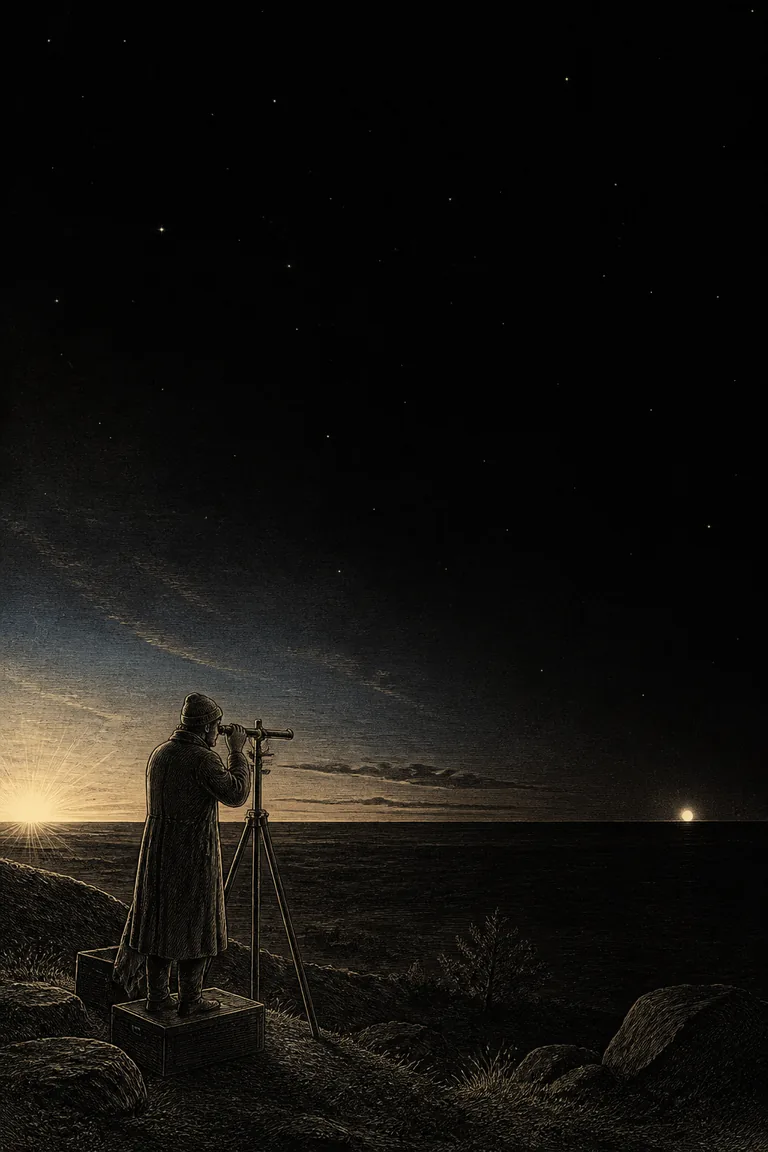
Acronychal setting is the western-horizon partner of acronychal rising: a star or outer planet sets around the time the Sun rises on the opposite horizon. Near exact solar opposition, the body has been visible through the night, rises around sunset, culminates around midnight, and sets around sunrise.
The term is not standardized across every historical text, translation, or astrology program. Some authors use acronychal for the opposition phase generally, some require an observed horizon event, and some attach rising or setting labels differently. Always preserve the source's operational definition, observer location, epoch, and visibility rule before interpreting the event.
Take the next insight with you
Explore personalized Astrology guidance in Veritas, available for iOS and Android.
 Scan with your phone
What is acronychal setting?
In a clear observational definition, a celestial body descends through the western horizon close to sunrise while the Sun approaches the eastern horizon. For a superior planet near geocentric opposition, this is the end of an all-night visibility interval. Exact simultaneity is not guaranteed by 180-degree longitude separation because latitude, declination, refraction, elevation, and the local horizon change rise and set times.
Record the horizon event first
Use Veritas to save the source convention, location, sunrise, set time, elongation, visibility threshold, and interpretation in separate fields.
How acronychal rising and setting form a pair
Near opposition, the body rises in the east as evening begins, remains above the horizon during much of the night, and sets in the west as morning begins. Acronychal rising names the evening entry; acronychal setting names the morning exit under the convention used here. Both describe one opposition-side phase, but they are different horizon events and require different local times.
Acronychal setting versus similar terms
The opposition geometry
At exact geocentric opposition, the Sun and a superior planet differ by about 180 degrees in ecliptic longitude. The planet is generally highest around local midnight and is favorably placed for observation. Horizon contact depends on equatorial coordinates and the observer, so longitude opposition is a phase marker rather than a universal promise that sunrise and setting share one minute.
How to calculate an acronychal setting
- Name the source rule
State whether the source means exact opposition, a setting at sunrise, a fixed tolerance, or a historical calendar date.
- Fix place and time
Use the intended latitude, longitude, elevation, date, time zone, and historical calendar.
- Calculate local sunrise
Declare whether sunrise uses the standard apparent upper-limb definition or another altitude threshold.
- Calculate the body's setting
Use the same observer, atmospheric model, time scale, and horizon assumptions.
- Check solar elongation
Record angular separation and whether opposition is applying, exact, or separating.
- Assess visibility separately
Consider brightness, extinction, twilight, weather, Moon light, and western-horizon obstruction.
Which planets can set acronychally?
Mars, Jupiter, Saturn, Uranus, Neptune, Pluto, and other bodies capable of opposition can participate in this geometry. Mercury and Venus never reach opposition as seen from Earth, so their morning and evening visibility cycles use different phase relationships. A software flag should therefore be checked against the body's actual elongation instead of applied to every planet.
Fixed stars, latitude, and epoch
A fixed star can have an annual date on which it sets near sunrise. Latitude and horizon altitude change the observed event, while precession shifts the seasonal relation across centuries. A date recorded for an ancient Mediterranean location cannot be transferred unchanged to a modern observer elsewhere. Preserve place, epoch, calendar, and the source's visibility assumptions.
Example: Saturn near opposition
Suppose Saturn is 179 degrees from the Sun, sets six minutes before the calculated sunrise, and remains bright enough to observe above a clear western horizon. A source allowing a small time or elongation window may call this acronychal setting. Another program may wait for exact opposition or use a different refraction model. The raw geometry can agree even when the labels or dates differ.
Traditional astrological interpretation
A traditional astrologer may treat a body near opposition and visible all night as emphatic or fully exposed in its solar phase. The morning setting can also be read as the closing horizon moment of that phase. These are symbolic testimonies, not automatic strength scores. Sign, house, rulership, sect, speed, angularity, aspects, and the chart topic remain independent factors.
Acronychal setting in natal charts
In a natal chart, verify that the technique belongs to the chosen tradition and that the birth time is accurate enough for a horizon event. A planet setting near sunrise may also be near the Descendant and opposite the Sun. Interpret the angle, opposition, visibility phase, dignity, and house rulership separately before synthesis. Do not attribute every angular or opposition theme to one phase label.
Historical calendar and mundane uses
Risings and settings of bright stars supported seasonal calendars, navigation, agricultural observation, and local weather lore. Those uses depend on a particular climate, horizon, culture, and era. Recalculation can recover an observation, but it does not validate a universal forecast of weather, politics, harvests, or public events.
Keep the source rule attached to the result
In Veritas, pair every acronychal-setting label with the quoted or paraphrased rule, raw times, coordinates, tolerance, and evidence that could revise it.
Why astrology software may disagree
One program may flag longitude opposition, another may compare apparent altitude at sunrise, and a historical module may follow a table. Topocentric versus geocentric positions, refraction, elevation, solar-limb choice, time rounding, twilight definitions, and spelling variants can shift the result. Compare raw coordinates and times before assuming one program is wrong.
Common mistakes
Do not confuse setting near sunrise with a last evening visibility. Do not call any dawn setting acronychal without checking opposition or the source convention. Do not infer exact horizon simultaneity from longitude alone. Do not transfer a fixed-star date across latitude or century without recalculation. Finally, do not convert favorable observing geometry into a promise of status, protection, danger, or success.
Limits of the technique
Acronychal setting is an astronomical and historical phase description with tradition-dependent symbolic uses. Astrology is not a scientifically validated prediction system. The phase cannot establish personality, morality, health, relationship outcomes, financial results, weather, or public events, and precise calculations do not make deterministic claims reliable.