Astrology Journal
Almuten in Astrology: Meaning and Calculation
An almuten is the planet receiving the highest declared essential-dignity score at a zodiacal degree. The result is useful only when the table, triplicity scheme, scoring weights, and tie rules remain visible.
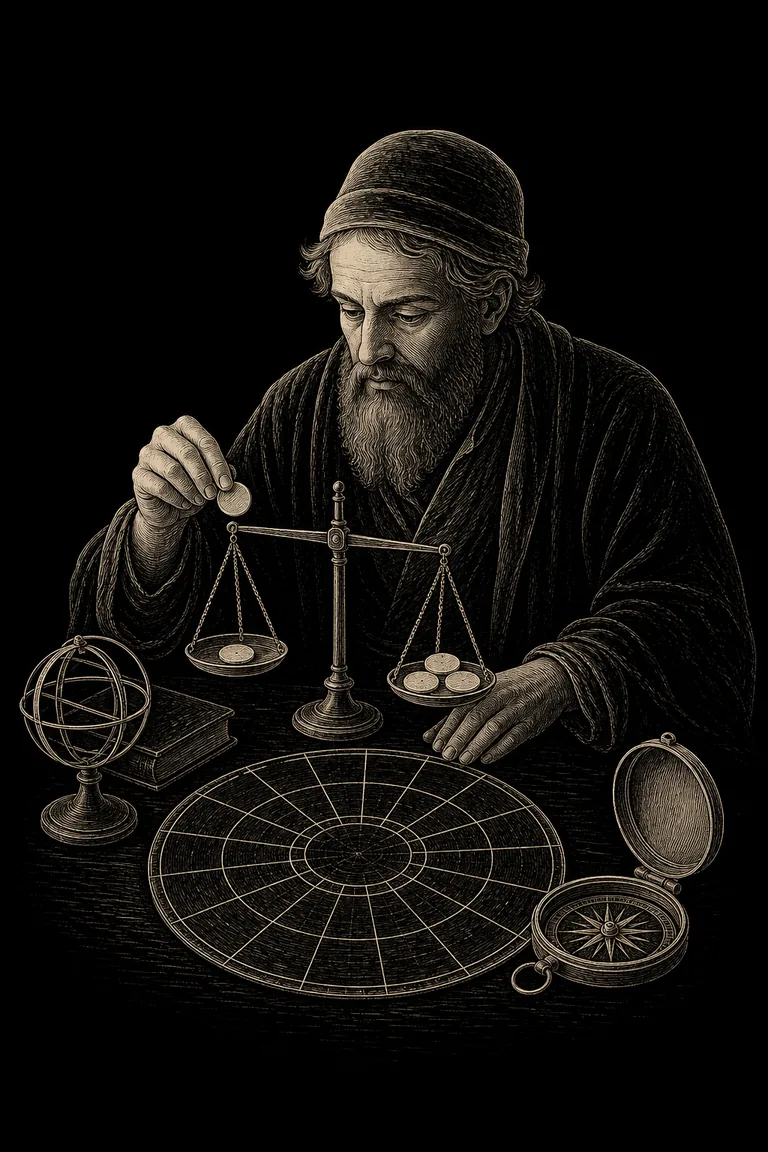
In traditional astrology, the almuten of a degree is the planet that collects the greatest total of selected essential dignities at that exact location. A common method scores domicile, exaltation, triplicity, bound or term, and face or decan. Because several planets can hold different dignities at one degree, the highest combined score may belong to a planet other than the sign ruler.
Almuten calculation is method-dependent. Authors and software may use different triplicity rulers, day and night rules, bound tables, face tables, point values, and tie procedures. Record those choices before interpreting the result. An almuten is not automatically the chart ruler, dispositor, strongest planet, or Lord of the Geniture, and it does not replace the planet's house, aspects, sect, motion, or solar condition.
Take the next insight with you
Explore personalized Astrology guidance in Veritas, available for iOS and Android.
 Scan with your phone
Almuten meaning at a glance
What does almuten mean?
The word is used for a planet that has the greatest claim by dignity over a particular degree or set of points. For one degree, calculation is compact: identify every dignity holder, assign the declared values, and total them by planet. Broader techniques may score several chart points and add accidental factors, but those procedures are not interchangeable. When someone names the almuten of the Ascendant, Sun, or another point, ask which exact calculation produced it.
Tables and scoring you need
A widely taught weighting gives five points for domicile, four for exaltation, three for triplicity, two for bound, and one for face. Treat this as one convention, not a law. You also need a consistent rulership table, the exact longitude, a chosen triplicity system that accounts for sect, a bound table such as Egyptian terms, and a decan or face table. If software offers several traditions, export or note the selected options so another reader can reproduce the result.
How to calculate the almuten of a degree
- Record the exact degree
Use the sign, whole degree, minutes, and seconds available from a reliable chart calculation.
- Declare the method
Name the dignity tables, triplicity scheme, sect rule, weights, and how you handle boundary degrees.
- Find each dignity ruler
Identify domicile, exaltation, triplicity, bound, and face rulers for that location.
- Assign and total points
Credit each ruler under the chosen weights, then add points held by the same planet.
- Report the result honestly
Name the highest total, preserve any tie, and keep the score sheet with the interpretation.
A transparent worked example
Suppose a daytime point falls at 12 degrees Aries and your declared tables assign Mars the domicile, the Sun the exaltation, the Sun the day triplicity, Venus the Egyptian bound, and the Sun the face. Under weights of 5, 4, 3, 2, and 1, Mars receives 5 points, Venus receives 2, and the Sun receives 8 because it holds exaltation, day triplicity, and face. The Sun is therefore the almuten of that degree under this method. Change the degree, sect, table, or weighting and the result may change.
What to do with a tie
A tie is a valid result, not an error that must be hidden. Some methods break ties through additional dignity, house placement, aspect to the degree, sect status, or other accidental testimony. Others preserve co-almutens. State the rule before applying it, because choosing a tie-breaker after seeing the planets creates a result-driven method. If two planets remain tied, compare how each can support the topic and where their testimonies diverge.
Almuten versus dispositor and chart ruler
A dispositor is the ruler of the sign occupied by a planet or point. The chart ruler is the domicile ruler of the Ascendant. The almuten can differ because it totals several dignities at the exact degree. For example, Mars always rules an Aries placement by domicile, but another planet may accumulate more points through exaltation, triplicity, bound, and face. One planet may hold all three roles, yet the labels still describe different calculations and should not be collapsed.
Almuten versus Lord of the Geniture
Lord of the Geniture is a broader traditional judgment for a nativity, and historical or modern practitioners do not all calculate it the same way. Some approaches begin with essential dignity across important points, then weigh accidental strength and condition. Others use a different hierarchy. Calling a single-degree almuten the Lord of the Geniture skips those additional decisions. Name the source and procedure whenever making a chart-wide claim.
How to interpret an almuten
Interpret the almuten as a planet with a strong dignity-based claim over the specific degree or topic you calculated. Then inspect what that planet signifies, which houses it rules and occupies, its aspects, motion, sect, visibility, and other conditions. A high essential score does not guarantee easy outcomes or moral virtue. A planet may possess authority yet lack freedom to act, or it may coordinate a topic through demanding circumstances. Keep the claim proportional to the calculation.
Sect and accidental condition still matter
Sect can change the triplicity ruler used in the score and also informs how a planet operates in a day or night chart. Accidental condition asks whether the planet has practical capacity through houses, motion, aspects, visibility, and other situational factors. Essential dignity describes a kind of recognized standing; accidental dignity describes circumstances of action. Neither should be reduced to a single good-or-bad label, and neither cancels the other.
Keep the calculation auditable
Use Veritas to record the exact degree, sect, dignity tables, weights, rulers, totals, ties, and the chart evidence that supports or limits your interpretation.
A practical almuten audit
- Name the target
Specify whether you are calculating one degree, several points, or a chart-wide method.
- Freeze the rules
Write the source tables, weights, sect treatment, and tie rule before looking at the winner.
- Show the arithmetic
List each dignity holder and subtotal so another reader can reproduce the result.
- Judge the planet
Add houses, rulerships, aspects, speed, visibility, sect, and relevant context.
- Test one modest statement
Describe the planet's likely role in one topic without turning a symbolic score into certainty.
Common almuten mistakes
Do not mix Egyptian and Ptolemaic bounds inside one calculation, switch triplicity systems without notice, round away a boundary degree, or force a tie-breaker after seeing the result. Do not assume the almuten is the strongest or most beneficial planet in the entire chart. Astrology is a symbolic interpretive practice, not scientific proof of personality, health, compatibility, money, or future events. Transparent rules make disagreement useful and prevent false precision.