Astrology Journal
Bounds in Astrology: Egyptian Terms Explained
Bounds, also called terms, divide every zodiac sign into five unequal degree ranges ruled by Mercury, Venus, Mars, Jupiter, or Saturn. They add a precise but limited testimony to traditional chart judgment.
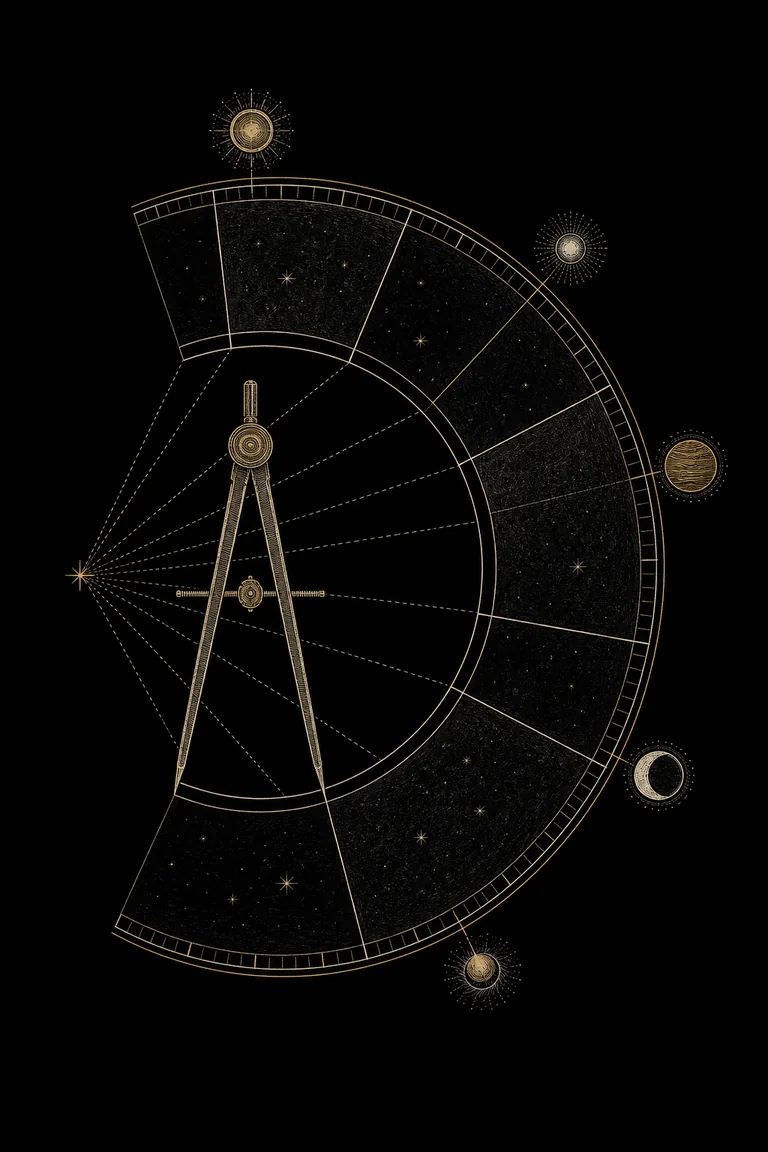
In traditional astrology, bounds or terms are unequal subdivisions of each 30-degree zodiac sign. Each subdivision belongs to one of the five traditional non-luminary planets: Mercury, Venus, Mars, Jupiter, or Saturn. The Sun and Moon do not rule bounds.
To use them, name a table, locate a planet's exact zodiacal degree, and identify the ruler of that degree range. This guide uses the Egyptian bounds as its working table. A planet in its own bounds has a modest essential dignity, while another planet in that range operates within the bound ruler's jurisdiction. The testimony refines a reading but never settles it alone.
Take the next insight with you
Explore personalized Astrology guidance in Veritas, available for iOS and Android.
 Scan with your phone
What are bounds or terms in astrology?
The two English names refer to the same technique. A sign is partitioned into five contiguous ranges of unequal length, and each range has a planetary ruler. Every zodiacal degree therefore falls inside one bound. The technique is finer than sign rulership and less uniform than a decan, because its boundaries and planetary order change from sign to sign.
Why are the ranges unequal?
The surviving traditional tables do not follow one simple five-part geometry. Egyptian, Ptolemaic, and Chaldean arrangements transmit different sequences and lengths. Their histories and rationales are debated, so the honest practice is to name the table rather than present one list as a natural property of the zodiac. This guide uses the Egyptian table because it is widely attested in Hellenistic practice and common in current traditional work.
Start with the exact degree
Open your chart in Veritas, record the planet's sign and degree, then compare it with one named bounds table before interpreting the ruler.
The five planets that rule bounds
Mercury, Venus, Mars, Jupiter, and Saturn receive bounds. The luminaries are excluded from this scheme even when the Sun or Moon rules the sign by domicile. This creates layered authority. In Leo, for example, the Sun owns the sign, but each degree also falls under one of the five bound rulers. The bound ruler does not replace the Sun. It describes a narrower set of operating conditions inside the solar sign.
Egyptian bounds table
Read each range from its starting degree up to, but not including, the next boundary. Aries: Jupiter 0-6, Venus 6-12, Mercury 12-20, Mars 20-25, Saturn 25-30. Taurus: Venus 0-8, Mercury 8-14, Jupiter 14-22, Saturn 22-27, Mars 27-30. Gemini: Mercury 0-6, Jupiter 6-12, Venus 12-17, Mars 17-24, Saturn 24-30.
Cancer: Mars 0-7, Venus 7-13, Mercury 13-19, Jupiter 19-26, Saturn 26-30. Leo: Jupiter 0-6, Venus 6-11, Saturn 11-18, Mercury 18-24, Mars 24-30. Virgo: Mercury 0-7, Venus 7-17, Jupiter 17-21, Mars 21-28, Saturn 28-30.
Libra: Saturn 0-6, Mercury 6-14, Jupiter 14-21, Venus 21-28, Mars 28-30. Scorpio: Mars 0-7, Venus 7-11, Mercury 11-19, Jupiter 19-24, Saturn 24-30. Sagittarius: Jupiter 0-12, Venus 12-17, Mercury 17-21, Saturn 21-26, Mars 26-30.
Capricorn: Mercury 0-7, Jupiter 7-14, Venus 14-22, Saturn 22-26, Mars 26-30. Aquarius: Mercury 0-7, Venus 7-13, Jupiter 13-20, Mars 20-25, Saturn 25-30. Pisces: Venus 0-12, Jupiter 12-16, Mercury 16-19, Mars 19-28, Saturn 28-30.
How to read an exact boundary
At 5 degrees 59 minutes Aries, the degree remains in Jupiter's bound. At exactly 6 degrees 00 minutes Aries, it enters Venus's bound. Software may display rounded degrees, so inspect minutes and seconds when a placement appears close to a boundary. A recorded birth time error can move the Ascendant or Moon across a bound quickly, while slower planets are usually less sensitive within the same date.
What does the bound ruler mean?
The bound ruler can be read as a local administrator, host, or rule-maker for the degree. It suggests the type of resources, procedures, permissions, pressures, or negotiations through which the occupying planet acts. Mercury may emphasize exchange and technical mediation; Venus, agreement and proportion; Mars, separation and force; Jupiter, authorization and enlargement; Saturn, limits and durability. These are starting questions, not fixed outcomes.
A planet in its own bounds
When a planet occupies a degree it rules by bound, traditional scoring systems often assign minor essential dignity. This suggests some capacity to set local terms even when the planet does not own the entire sign. Mercury at 15 degrees Aries is in Mercury's Egyptian bound, for example. Mars still owns Aries by domicile, and Mercury's house, motion, visibility, aspects, reception, and sect continue to matter.
Bounds versus domicile and exaltation
Domicile applies to a whole sign and usually carries greater authority. Exaltation is another sign-wide dignity with its own traditional logic. Bounds apply only to an unequal degree range and offer a smaller testimony. A planet can be in detriment by sign yet in its own bound, giving it limited local resources inside a more difficult overall environment. Preserve both facts instead of cancelling one with the other.
Bounds versus triplicity and decans
Triplicity connects a planet with an elemental group and often changes its primary ruler by chart sect. A decan or face is one of three equal ten-degree sections of a sign. Bounds use five unequal sections and exclude the Sun and Moon from rulership. A placement can have support by triplicity, fall in another planet's bound, and occupy a third planet's face at the same time. Each layer answers a different question.
Worked example: Mercury at 15 degrees Aries
In the Egyptian table, 12 through 20 degrees Aries belongs to Mercury, so Mercury at 15 Aries is in its own bound. It has limited authority over the immediate degree range while Mars remains the domicile ruler of Aries. If Mercury is direct, visible, and placed in an angular house, the local competence may be easy to use. If combust and cadent, the dignity remains present but may have less access or visibility.
Worked example: Venus at 23 degrees Capricorn
Twenty-three degrees Capricorn lies in Saturn's Egyptian bound, which runs from 22 to 26 degrees. Venus therefore works under Saturn's local terms. The interpretation might ask how affection, alliance, aesthetics, or resources are shaped by limits, duration, duty, or formal structure. Then inspect Saturn itself. A well-placed Saturn and a close applying aspect to Venus tell a different story from a debilitated, hidden, or disconnected Saturn.
The condition of the bound ruler
After finding the ruler, assess its sign, house, angularity, speed, direction, visibility, sect, aspects, reception, and the houses it rules. A capable bound ruler may provide usable procedures or access. A constrained ruler can describe conditions that are slow, costly, indirect, contested, or dependent on another party. The ruler's label alone does not predict whether an event is good, bad, successful, or inevitable.
Bounds in horary and electional work
Traditional horary and electional methods may use bounds to refine the condition of significators, angles, or the Moon. Because these practices have their own rules, do not import a dignity score as a yes-or-no answer. The radicality of the chart, relevant house rulers, applications, receptions, prohibitions, and real-world constraints still require judgment. For legal, medical, financial, or safety decisions, use qualified evidence and advice.
Bounds in timing techniques
Some directing and releasing procedures move a point through successive bounds and treat each bound ruler as a time lord. The exact calculation depends on the technique, zodiac, direction rate, and source tradition. A changed bound can mark a shift in administration or emphasis, but it does not identify a guaranteed event. Record the method and test it against dated history before using it prospectively.
Egyptian versus Ptolemaic terms
The two tables can assign different rulers to the same degree. Neither difference should be hidden behind software defaults. Select the table that belongs to the historical method you are using, label it in notes, and keep it stable across comparison charts. Mixing a favorable Egyptian ruler in one case with a favorable Ptolemaic ruler in another makes the method impossible to evaluate.
A practical bounds workflow
- Name the table
Choose Egyptian, Ptolemaic, or another documented arrangement before looking for the ruler.
- Verify the degree
Record sign, degree, minutes, zodiac type, and any birth-time uncertainty.
- Find the range
Use inclusive starts and exclusive ends so a boundary degree is assigned once.
- Identify self-dignity
Note separately whether the occupying planet is also the bound ruler.
- Judge the ruler
Assess its full condition, house topics, aspects, and reception.
- Limit the conclusion
State one specific refinement and preserve stronger, conflicting, or uncertain testimonies.
Keep degree-level judgment auditable
Use Veritas to save the exact degree, selected bounds table, ruler, ruler condition, competing dignities, and the narrow claim you are testing.
Common bounds and terms mistakes
Avoid dividing every sign into five equal six-degree pieces, assigning bounds to the Sun or Moon, overlooking minutes at a boundary, or switching tables without disclosure. Do not treat a minor dignity as a complete verdict or interpret the bound ruler without checking its condition. Bounds are most useful when they add precision to a layered judgment and least useful when a precise degree is used to manufacture false certainty.