Astrology Journal
North Node Conjunct Sedna Transit: Timing and Meaning
North Node conjunct Sedna transit can frame a long-horizon threshold review, but responsible use begins with object 90377, fixed settings, every pass, both nodes, evidence, consent, return terms, and exit.
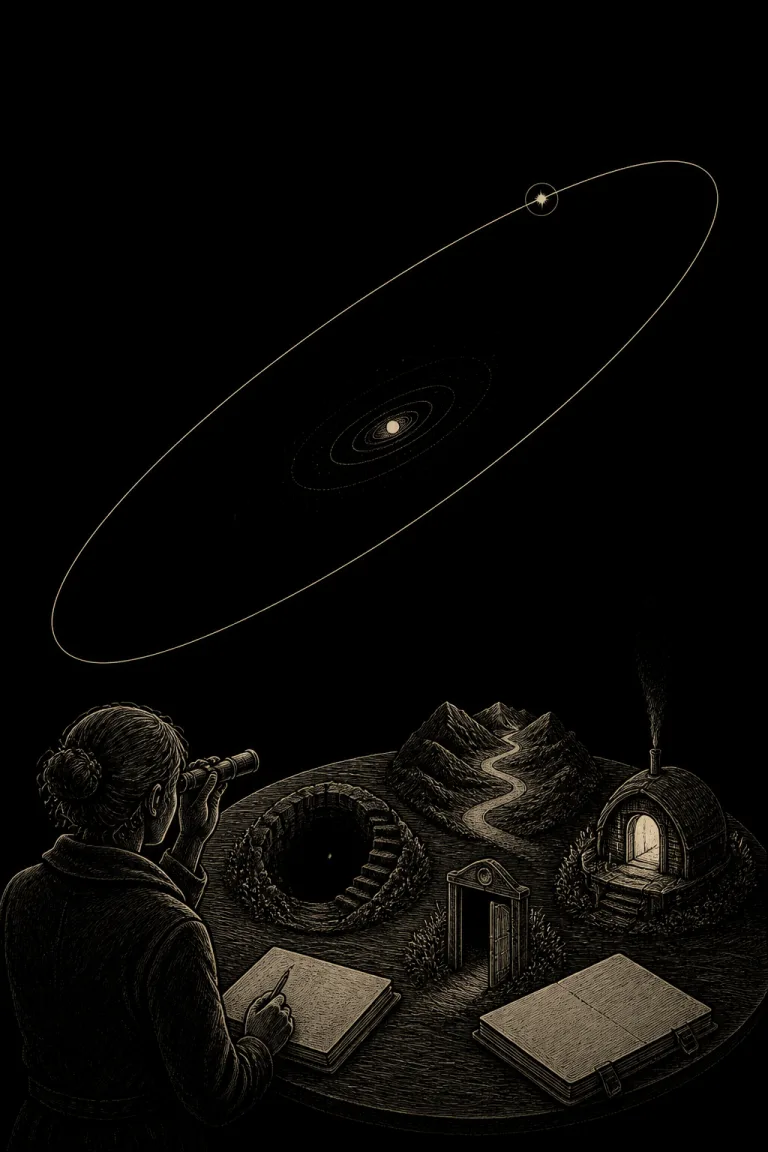
North Node conjunct Sedna transit occurs when the transiting North Node reaches the zodiac longitude of natal trans-Neptunian object 90377 Sedna. A careful symbolic reading can examine very long commitments, distant consequences, thresholds, exclusion and return, shelter, survival strategies, and the difference between necessary distance and avoidant withdrawal. It cannot prove that a loss is destined, that someone must return, or that hardship gives a person special authority.
Calculate the contact with one saved node model, zodiac, ephemeris, object identifier, and orb. Record every exact pass and keep the simultaneous South Node opposition visible. Then map the real situation outside astrology: time horizon, affected people, threshold, access, resources, consent, safety, maintenance, return conditions, alternatives, evidence, and exit. The transit can organize inquiry, while observable facts and accountable decisions determine what should continue.
Take the next insight with you
Explore personalized Astrology guidance in Veritas, available for iOS and Android.
 Scan with your phone
Sedna transit at a glance
Verify object 90377 before interpretation
Use numbered object 90377 Sedna and save its identifier with the chart. NASA JPL lists the provisional designation 2003 VB12 and classifies the orbit as trans-Neptunian. NASA describes an unusually distant, elongated path that stays well beyond Neptune. These astronomical facts establish a physical object and calculated orbit. They do not measure isolation, endurance, betrayal, healing, personality, or astrological effects. A mythic name or similarly named software point is not a substitute for the verified object.
Freeze node, zodiac, ephemeris, and orb
Choose mean or true node, tropical or sidereal zodiac, ayanamsha when relevant, ephemeris, time zone, and orb before searching dates. Save the natal Sedna longitude and calculation source. Changing settings after learning an event can manufacture a preferred match. The lunar nodes guide explains the axis, while the aspect guide keeps conjunction rules explicit.
Record every exact pass
The chosen nodal longitude may cross a natal target more than once around a contact window. Search the full interval and record every exact timestamp, residual, orb entry, and orb exit. Preserve quiet passes and dates that contradict the story. Do not move an event to the nearest hit or call an entire season exact. The transits guide provides a reproducible timing method that separates calculation from interpretation.
Keep the South Node opposition visible
When the North Node conjoins natal Sedna, the South Node is simultaneously opposite it in the same zodiac and node model. Treat this as one axis. Symbolically, the conjunction may frame a developing relationship with distance, thresholds, shelter, or long consequences, while the opposition can review inherited withdrawal, automatic endurance, old exclusions, or return patterns. This is an interpretive lens, not an astronomical force or proof that repetition must continue.
Birth time controls houses and angles
Sedna moves slowly, so a date-only chart may support an approximate natal longitude for many users, but houses and angles require a reliable birth time. If the recorded time is rounded, unknown, or disputed, omit house claims and angle contacts. The birth chart without a birth time guide explains what remains usable. Precise transit timing cannot repair uncertain natal data or establish an event.
Map the long horizon in ordinary units
Name the actual horizon: days, months, years, a contract term, a care period, an infrastructure life, or a generation. Then record what must remain true across that span, what can be revised, and which assumptions cannot be tested yet. Sedna's distant orbit may inspire a long-horizon metaphor, but symbolic scale is not a reason to make permanent decisions. Long commitments require stronger evidence, maintenance funding, succession, review, and a lawful exit.
Distance can protect or conceal
Distance may create safety, perspective, rest, confidentiality, or room to think. It may also hide information, delay care, weaken accountability, increase cost, or prevent affected people from participating. Measure the distance involved: physical location, time delay, communication gap, institutional layer, emotional boundary, or technical separation. Ask who benefits, who carries the burden, what contact remains possible, and which signal requires closer review. The transit does not decide whether distance is healthy.
A threshold needs clear access rules
Define what someone is entering, leaving, or being denied: a home, relationship, team, service, archive, community, medical process, financial arrangement, or private space. Record who controls access, which criteria apply, what notice is given, what accommodation exists, how exceptions are handled, and who hears an appeal. A symbolic threshold cannot grant admission, justify exclusion, remove due process, or waive another person's consent, privacy, property, or safety.
Shelter should not become control
Shelter can mean a safe room, reliable income, protected data, emotional distance, legal support, predictable routines, or a trusted person. It must still preserve agency. Ask who defines safety, whose risks are centered, what information is shared, what obligations attach, and whether a person may leave without retaliation. Protection language can conceal surveillance, isolation, financial control, dependency, or exclusion. The transit cannot certify a protector or prove that a controlling arrangement is necessary.
Return requires explicit terms
A long orbit may suggest return as a symbolic theme, but no person, opportunity, relationship, job, or resource is promised to come back. If return is a real option, write the conditions: who may request it, what evidence is required, which harms need repair, what capacity exists, who decides, what changes after return, and how consent can be withdrawn. A return can be partial, conditional, delayed, declined, or impossible. Hope should not replace current planning.
Survival language needs evidence and care
Do not infer trauma, abuse, neglect, illness, danger, or exceptional resilience from Sedna symbolism. Ask only what a person has chosen to disclose, and do not pressure them to fit a myth. Immediate safety concerns belong with appropriate services and qualified professionals. Ordinary strain also deserves proportionate support without dramatic labels. The chart cannot identify a perpetrator, certify a survivor, recover memories, determine custody, or replace medical, legal, safeguarding, or mental-health assessment.
A seven-step Sedna transit method
- Verify
Save 90377 Sedna, natal longitude, node model, zodiac, ephemeris, time zone, and orb.
- Time
Record every exact pass, residual, orb entry, orb exit, and the simultaneous South Node opposition.
- Bound
Define the real situation, time horizon, affected people, threshold, resources, and uncertainty.
- Measure distance
Identify the physical, temporal, emotional, institutional, or technical separation and its burden.
- Set terms
Write access, shelter, consent, maintenance, return, appeal, and exit conditions.
- Test
Use observable evidence, alternatives, counterexamples, and proportionate safeguards.
- Review
Compare every pass with outcomes and revise or close the interpretation at a declared date.
Worked relationship example
A person notices the contact while considering renewed communication after a long separation. The reading does not predict reunion. They verify the transit, list every pass, and define the real threshold: one written message, no surprise visit, no demand for response, and no use of mutual friends as intermediaries. They review prior boundaries, consent, safety, and current capacity. A return happens only if both people choose it under explicit terms. Silence remains a complete answer.
Worked work example
An organization considers restoring an archived service for remote users. The Sedna lens prompts a long-horizon audit: who still needs the service, which data remain valid, what maintenance was neglected, who controls access, what support exists, and how the service can close again. The team pilots read-only access, documents exceptions, funds support, and sets failure thresholds. User research, security review, budget, and policy decide whether restoration proceeds.
Compare this transit with nearby guides
The Sedna in astrology guide owns natal sign, house, aspect, and myth-source interpretation. This page owns the transiting North Node conjunction to natal Sedna with fixed settings and all exact passes. North Node conjunct Quaoar focuses on repeatable system design and governance. Saturn and Pluto guides address different bodies and should not be used as interchangeable intensity labels.
Use a disconfirmation plan
Before reviewing events, write what would count against the interpretation. A quiet pass, a shorter horizon, safe closeness, a fair exclusion, a return without drama, or a successful ordinary process may contradict the first story. Compare transit windows with control periods and record non-events. Do not search private information, contact someone against a boundary, or reinterpret refusal as hidden destiny. An honest symbolic method permits the transit to be irrelevant.
Do not turn remoteness into spiritual rank
Sedna's unusual orbit does not make its symbolism more powerful, evolved, rare, or authoritative. A person with a close aspect is not chosen, ancient, uniquely wounded, unusually protected, or qualified to direct others. Skill comes from training, evidence, ethics, accountability, and review. The chart cannot grant access to another person's history or make private intuition equal to consent.
Save the horizon, threshold, and return terms
Use Veritas to log object 90377, calculation settings, every pass, both nodes, time horizon, distance, threshold, affected people, shelter, consent, resources, return terms, alternatives, exit, evidence, and review date.
Responsible limits
North Node conjunct Sedna transit is an astrological reflection framework, not scientific evidence of destiny, trauma, abandonment, danger, survival, reunion, protection, authority, diagnosis, legal truth, financial outcome, or another person's intention. Visit the <a href="/astrology">Astrology journal hub</a>. Use consent, records, qualified guidance, and real safety procedures for consequential decisions.