Astrology Journal
Astrology Transits: How the Current Sky Meets Your Birth Chart
Astrology transits compare the planets moving through the current sky with the fixed positions in a natal chart. They describe symbolic timing, not guaranteed events.
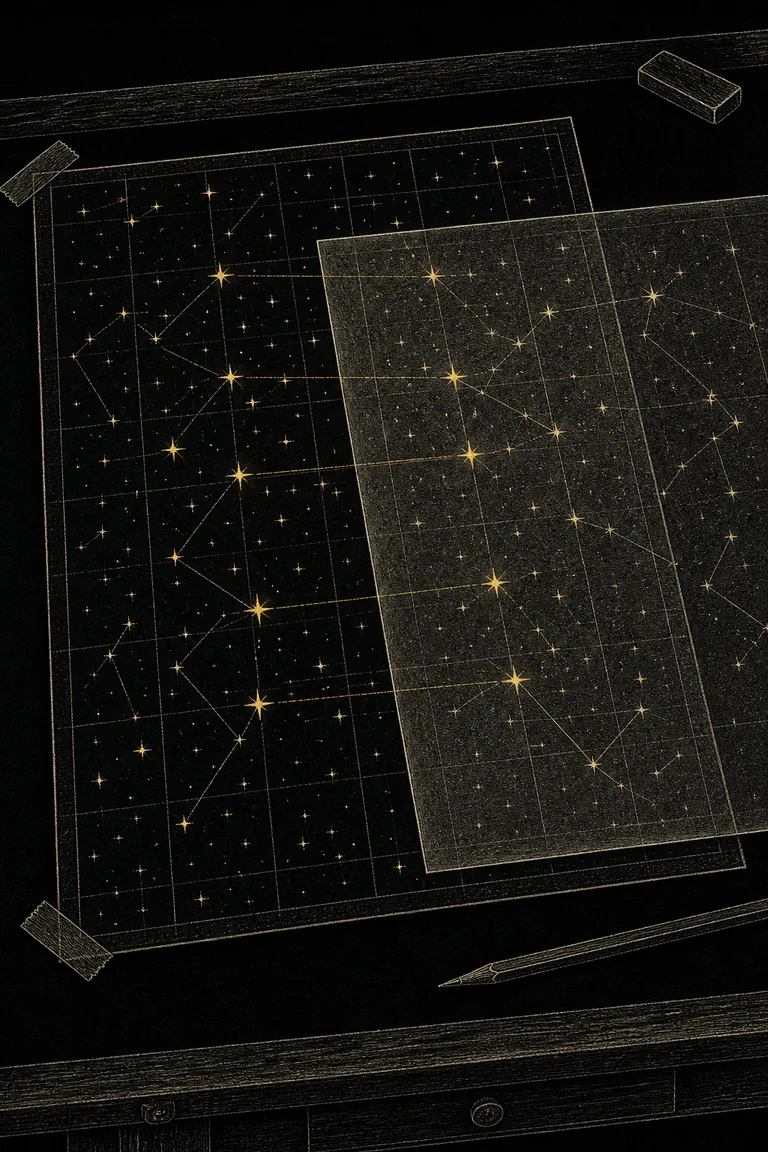
Your birth chart is a map for one moment. Transits show how current planetary positions form aspects to that natal map over time. When transiting Saturn squares a natal planet, or Jupiter crosses a natal angle, astrologers study the contact as a period when certain themes may become more visible.
A transit does not replace the natal chart or force a specific outcome. The transiting planet describes the kind of pressure or opportunity, the natal planet describes the function being contacted, the aspect describes the relationship, and the natal house shows the life area involved.
Take the next insight with you
Explore personalized Astrology guidance in Veritas, available for iOS and Android.
 Scan with your phone
What is an astrology transit?
A transit is the changing angular relationship between a current planet and a natal placement or angle. The natal chart stays fixed while the sky keeps moving. Transit software calculates when a planet enters an orb, reaches the exact aspect, and separates from it.
See where the current sky meets your chart
Create your natal chart in Veritas, identify the degree and house of the placement you are studying, and track one transit at a time with real dates and context.
Read a transit in five parts
Transiting planet
The moving function bringing change, focus, growth, pressure, or review.
Natal target
The fixed planet or angle whose established chart role is activated.
Aspect
The geometry describing concentration, tension, polarity, flow, or opportunity.
House
The natal life area through which the moving planet is currently traveling.
Timing
The approach, exact contact, retrograde return, and final separation.
Start with the natal promise
A transit activates a natal placement; it does not invent a completely unrelated life. Read the natal planet’s sign, house, aspects, and rulership first. Saturn contacting natal Venus will be shaped by how Venus and Saturn already function in that particular chart and life.
Fast and slow transits
The Moon, Sun, Mercury, Venus, and Mars move quickly and describe shorter rhythms, triggers, or activation. Jupiter and Saturn frame longer developmental periods. Uranus, Neptune, and Pluto can remain within orb for months or years, often working through several exact contacts.
Conjunctions, squares, and oppositions
A conjunction concentrates two functions. A square creates pressure that demands adjustment or work. An opposition brings polarity, awareness, and negotiation across competing positions. None is automatically good or bad; difficulty and opportunity depend on the planets, natal context, and response.
Trines and sextiles
Trines often describe flow, reinforcement, and resources that operate with less friction. Sextiles suggest openings that become more useful through participation. Easy aspects can pass quietly or maintain an existing pattern, so they should not be treated as automatic rewards.
Applying and separating phases
An applying transit is moving toward exactness and may correspond with growing awareness or pressure. The exact aspect is a peak in symbolic precision, not necessarily the date of an event. The separating phase can bring integration, consequence, and clearer perspective.
Why retrogrades create several passes
A planet may contact the same natal degree, turn retrograde, cross it again, and make a final direct pass. The first contact can introduce a theme, the retrograde pass can review or complicate it, and the final pass can support implementation. Real timelines rarely follow this sequence perfectly.
Choose an orb deliberately
An orb is the distance from an exact aspect. Slow planets and contacts to the Sun, Moon, or angles are often felt across wider periods, but excessively wide orbs create noise. Begin close, note the first recognizable development, and use the same rule consistently when reviewing.
Transits through natal houses
The house a planet travels through describes the area receiving sustained attention even when no exact aspect is present. Saturn through the sixth may emphasize routines, labor, or health responsibilities; Jupiter through the ninth may broaden study or perspective. Reliable houses require an accurate birth time.
Example: Saturn square natal Sun
This transit can symbolize tests of structure, authority, energy, responsibility, and self-definition. One person may formalize a demanding role; another may confront limits in an existing plan. It does not predict failure. Ask what needs stronger form, a realistic boundary, or patient rebuilding.
Example: Jupiter trine natal Mercury
Jupiter contacting Mercury may support wider learning, publication, travel-related thinking, or confidence in communication. A trine can create usable ease, but exaggeration and overcommitment remain possible. The natal houses and actual opportunities show where expansion has substance.
Track transits without living by them
Keep a dated journal of the aspect, orb, observed circumstances, decisions, and later outcomes. Avoid checking every minor transit before ordinary actions. One or two major themes provide more learning than a constant stream of alerts that can make normal uncertainty feel ominous.
What transits cannot predict
A transit cannot guarantee marriage, death, pregnancy, illness, job loss, wealth, or another person’s behavior. The same symbolism can appear through many events and internal processes. Use evidence, professional guidance, and direct communication for decisions with real consequences.
Astrology is a symbolic interpretive tradition, not a scientifically validated forecasting system. Transits cannot diagnose conditions, establish consent, determine safety, or replace medical, legal, financial, or mental health guidance.