Astrology Journal
Chiron Return Chart: Timing and Interpretation
A Chiron return occurs when transiting Chiron reaches its natal geocentric longitude, usually near age 50. Exact timing requires an ephemeris and may include several crossings.
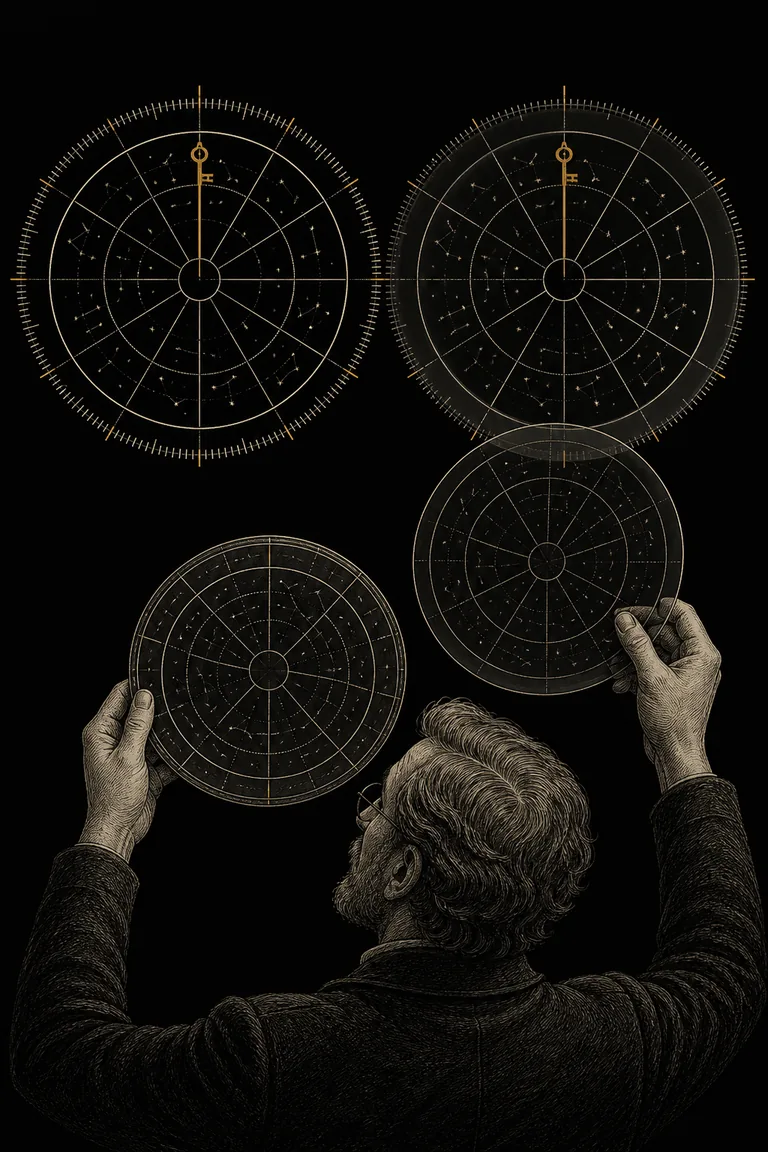
A Chiron return is the moment transiting Chiron reaches the same zodiacal longitude it occupied at birth. Because Chiron takes roughly half a century to circle the Sun and moves through an eccentric orbit, the first return usually occurs around age 49 to 51 rather than on one universal birthday.
Astrologers often use the return as a structured review of long-practiced adaptations, teaching, care, vulnerability, and boundaries. That symbolism is interpretive. The calculation itself should be reproducible: preserve the natal longitude, zodiac, reference frame, exact timestamps, motion status, location, and chart settings, and save every crossing created by retrograde motion.
Take the next insight with you
Explore personalized Astrology guidance in Veritas, available for iOS and Android.
 Scan with your phone
Chiron return at a glance
What returns in a Chiron return?
The returning quantity is longitude, not a vague age band. If natal Chiron is at 17°42' Aries in a tropical geocentric chart, the return occurs when transiting Chiron reaches that same longitude in the same zodiac and reference frame. The natal Chiron meaning guide explains the symbolic vocabulary of placement by sign, house, and aspect. The return article owns the separate timing and calculation intent.
Why the age varies
Chiron's orbital period is commonly summarized as about 50 years, but its speed through zodiacal longitude is uneven. It travels faster near perihelion, slower near aphelion, and appears retrograde from Earth during parts of the cycle. Two people born a few years apart can therefore reach the return at noticeably different ages. Use an ephemeris rather than adding a fixed number of years to the birth date.
How to calculate a Chiron return
- Save natal Chiron
Record its exact longitude, zodiac, geocentric reference frame, and the ephemeris or software version.
- Search the age window
Scan approximately ages 48 through 52 for intervals where transiting Chiron crosses the natal longitude.
- Bracket each crossing
Find timestamps on opposite sides of the target longitude while tracking signed motion across 0° if necessary.
- Refine the timestamp
Interpolate for a first estimate, then use a finer ephemeris or solver until the requested precision is reached.
- Keep every pass
If a station creates direct, retrograde, and direct crossings, save all of them rather than selecting the most convenient date.
- Cast and document
Record UTC, display timezone, place, house system, aspect set, orb, node choice, and any other chart settings.
A checkable interpolation example
Suppose natal Chiron is 17°42'00\" Aries. In one direct-motion bracket, the ephemeris shows 17°40'00\" at 00:00 UTC and 17°44'00\" at 24:00 UTC. The target is 2 arcminutes into a 4-arcminute interval, so the fraction is 2 ÷ 4 = 0.5. The first estimate = 12:00 UTC. This linear estimate is only a starting point because apparent speed changes; refine it with smaller intervals.
Illustrative first estimate before ephemeris refinement
Target offset = 2 arcminutes; full bracket = 4 arcminutes
(2 ÷ 4) × 24 hours = 12 hours
first estimate = 12:00 UTC
One return or three?
A return near a retrograde loop may occur three times: first in direct motion, again while Chiron moves retrograde, and a final time after it stations direct. Treat the sequence as one return season with several exact timestamps. Do not call only the first or last pass the real return unless you clearly state that convention. Compare the full timeline with the method used for other astrology transits.
What the return chart contains
A return chart places Chiron at its natal longitude while the Sun, Moon, planets, angles, and houses reflect the return moment and chosen place. The Chiron conjunction is guaranteed by definition; everything else is contingent. Start with Chiron's return house, its natal house, the rulers of those houses, and close aspects. Avoid treating every loose aspect as equally important.
Birth time and location
Natal Chiron moves slowly enough that modest birth-time uncertainty usually changes its longitude very little, but houses and angles can change substantially. A return timestamp can be calculated without pretending an uncertain Ascendant is exact. If birth time is unknown, follow the birth chart without birth time guide: omit or qualify natal houses and angles, and separate them from reliable planetary positions.
Which location should you use?
Some astrologers cast the return for the physical location at the exact moment; others inspect a chart for birthplace or current residence. Longitude timing does not change with Earth location, but houses and angles do. State the place and rationale so another reader can reproduce the chart. Do not relocate a chart solely to manufacture favorable angles and then hide that choice.
Interpreting the return without a wound script
Chiron is often summarized through the language of wounds and healing, but that phrase can become overly dramatic. A more useful review asks what a person has learned to manage, teach, repair, request, or decline over decades. The return may frame a reassessment of expertise, care roles, recurring sensitivities, and boundaries. It does not prove that suffering had a purpose or that pain must become service.
Houses, signs, and aspects
The sign describes a style of response; the house identifies the return chart area where circumstances are organized; aspects describe relationships with other placements. Use declared orbs and distinguish applying from separating contacts. The aspects guide helps keep conjunctions, squares, trines, and oppositions specific instead of treating any contact as a crisis.
Save the complete return season
Use Veritas to record natal longitude, every exact crossing, motion status, location, chart settings, close aspects, observations, and a dated review.
A practical review protocol
Choose a window around all exact passes. Record recurring responsibilities, skills that now feel mature, support that is missing, and roles you no longer consent to hold. Select one bounded experiment, such as changing a referral process, asking for accommodation, ending unpaid emotional labor, or documenting a method for others. Review the result after the final pass rather than attributing every event in the year to Chiron.
Common calculation mistakes
Frequent errors include matching only the zodiac sign, adding exactly 50 years, mixing tropical and sidereal positions, comparing geocentric with heliocentric longitude, ignoring retrograde crossings, losing UTC during timezone conversion, and rounding natal longitude too early. A chart screenshot without settings is not a reproducible calculation.
Common interpretation mistakes
Avoid predicting illness, injury, bereavement, trauma disclosure, professional destiny, or a compulsory healer identity. Do not infer another person's motives from the return. Do not label ordinary midlife change as pathology or insist that a difficult event is spiritually necessary. Compare the symbolic reading with age, work, relationships, finances, health care, and other ordinary evidence.
Limits and responsible use
Astrology is an interpretive tradition, not a scientifically validated forecasting or diagnostic method. A Chiron return cannot diagnose illness, identify trauma, establish causation, guarantee healing, certify a vocation, or determine when a crisis will occur. Seek qualified medical, mental health, legal, or financial support for high-stakes decisions. Use the return as a documented reflection window and remain willing to revise the interpretation.