Astrology Journal
Composite Chart Meaning: Reading the Relationship Itself
A composite chart uses the midpoints between two natal charts to describe the relationship as a shared pattern. It complements synastry but answers a different question.
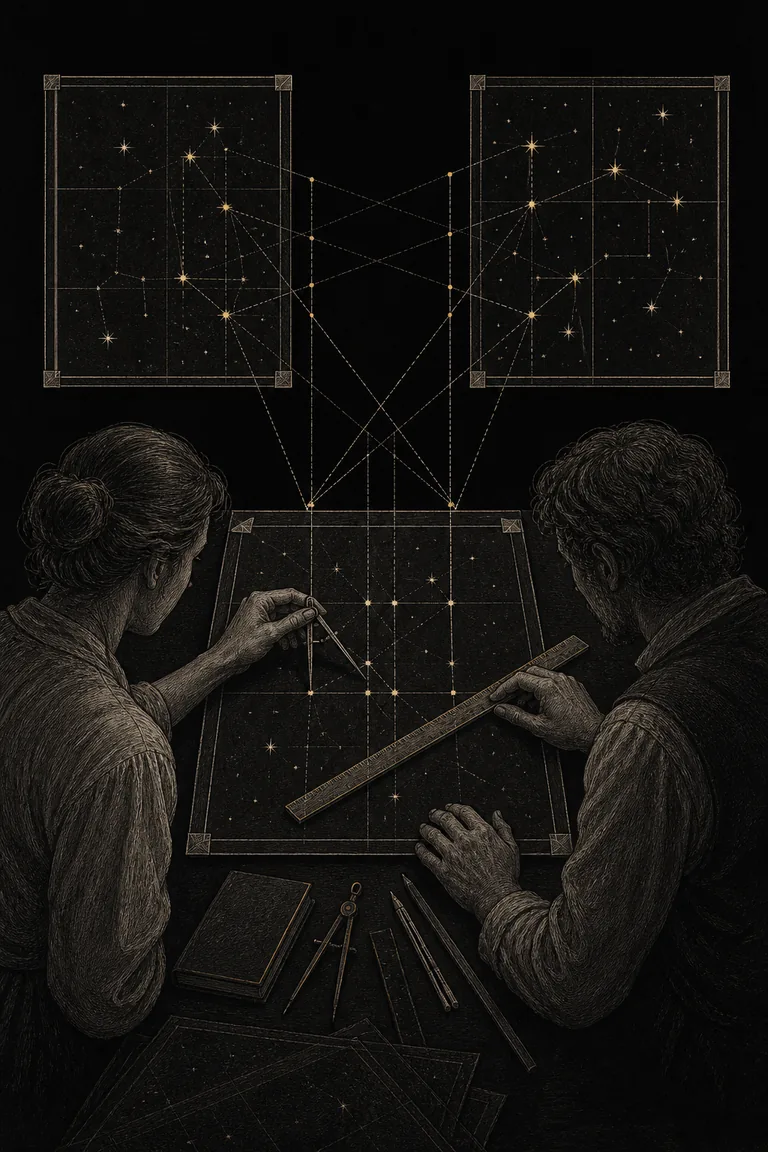
A composite chart is calculated by finding the midpoint between each matching pair of planets and chart points in two natal charts. The composite Sun sits halfway between the two natal Suns, the composite Moon between the natal Moons, and the same method continues through the chart.
Astrologers read the result as a symbolic picture of what the relationship creates and requires when the two people operate together. It is not a third person, a compatibility score, or proof that a bond will last. Read both natal charts and synastry first so the composite does not erase the individuals.
Take the next insight with you
Explore personalized Astrology guidance in Veritas, available for iOS and Android.
 Scan with your phone
How a composite chart is calculated
Each composite placement is the zodiacal midpoint of the same placement in two charts. Because a circle has two midpoints, software follows a consistent convention and usually selects the shorter arc. Reliable software also calculates composite angles, houses, nodes, and aspects without manual wraparound errors.
Understand the two charts before the shared chart
Create both natal charts in Veritas, review each person’s core placements and synastry contacts, then use a composite chart to study the pattern they form together.
Composite chart versus synastry
Synastry compares Person A’s planets directly with Person B’s planets and describes contact between two people. A composite combines corresponding placements into midpoint positions and describes the relationship’s shared center. Synastry may show how communication lands; the composite may show the communication culture the pair develops.
Composite chart versus Davison chart
A Davison relationship chart uses the midpoint in actual time and geographic space between two births, producing a chart for a derived date, time, and place. A composite chart averages zodiacal positions. They may resemble each other, but they are calculated differently and should not be treated as interchangeable.
Why exact birth times matter
Birth-time uncertainty affects natal angles and houses, then carries into the composite Ascendant, Midheaven, and house cusps. The Moon also moves quickly. If either time is unreliable, focus on stable planetary positions and aspects, state the uncertainty, and avoid precise house or angle claims.
Start with the composite Sun, Moon, and Ascendant
Composite Sun
The central purpose, vitality, visibility, and organizing principle of the relationship.
Composite Moon
The shared emotional climate, habits, care patterns, and need for belonging or regulation.
Composite Ascendant
How the relationship approaches situations and is encountered from the outside when times are reliable.
Read the composite Sun by house
The Sun’s house shows where shared purpose asks for attention. In the third house, conversation, learning, movement, or local connections may organize the bond. In the tenth, public contribution, reputation, or common goals may matter. House expression depends on the Sun’s sign, aspects, and actual relationship context.
Read the composite Moon as a daily pattern
The Moon often describes what makes the relationship feel familiar and how the pair responds under stress. A well-supported Moon does not guarantee emotional skill, and a challenged Moon does not prohibit care. Ask who notices needs, how comfort is requested, and whether routines allow both people to recover.
Venus and Mars in the composite
Composite Venus describes shared values, pleasure, reciprocity, and the style of appreciation. Composite Mars describes collective initiative, conflict, desire, and how energy is mobilized. These placements apply to friendships, families, and work partnerships as well as romantic relationships; context determines the language.
Saturn and the shape of responsibility
Composite Saturn can show durability, commitment, boundaries, fear, delay, or the work required to maintain form. A strong Saturn is not automatic permanence. Look for explicit expectations, fair distribution of duty, and whether structure supports both people rather than keeping them in an unhealthy pattern.
Prioritize close composite aspects
Aspects describe how functions within the shared pattern cooperate or strain. Sun square Moon may highlight tension between purpose and emotional rhythm; Venus trine Saturn may support steady investment. Use close aspects first and interpret the planets, signs, houses, and observable behavior together.
The chart ruler and repeated themes
When the composite Ascendant is reliable, its ruling planet can connect the chart’s presentation with a key house and set of aspects. Repetition matters: if the chart ruler, Sun, and several planets emphasize one house or element, that theme deserves more weight than an isolated dramatic placement.
Composite transits and timing
Some astrologers track current transits to the composite chart to describe periods when shared themes become more visible. Start with slow planets contacting the composite Sun, Moon, angles, or rulers, and compare the same period with each person’s natal transits. Timing does not guarantee a specific event.
A first composite reading in five questions
Ask what the relationship is organized around, what emotional rhythm it creates, how affection and conflict are handled, where responsibility concentrates, and which repeated theme requires conscious participation. Finish by naming one shared strength, one strain, and one agreement that can be observed in practice.
What a composite chart cannot tell you
It cannot prove love, consent, loyalty, safety, permanence, or a soulmate bond. It also cannot show which individual performs a composite pattern without returning to the natal charts and real behavior. A compelling chart never outweighs direct evidence about how people treat one another.
Astrology is a symbolic interpretive tradition, not a scientifically validated measure of relationship outcomes. Composite charts cannot diagnose people, reveal private motives, establish consent, or replace medical, legal, safety, or therapeutic support.