Astrology Journal
Dexter and Sinister Aspects in Astrology
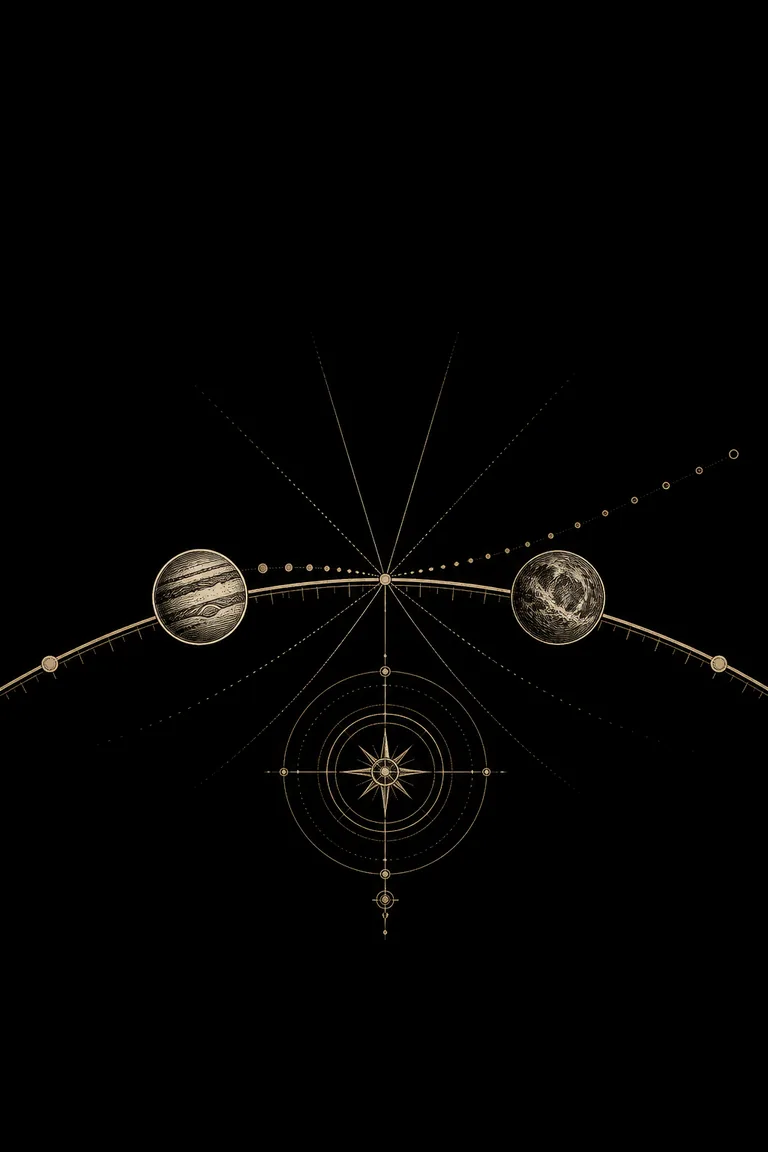
A dexter aspect is cast backward against zodiacal sign order from a named reference planet. A sinister aspect is cast forward with sign order. The label is directional, so the casting planet must be stated.
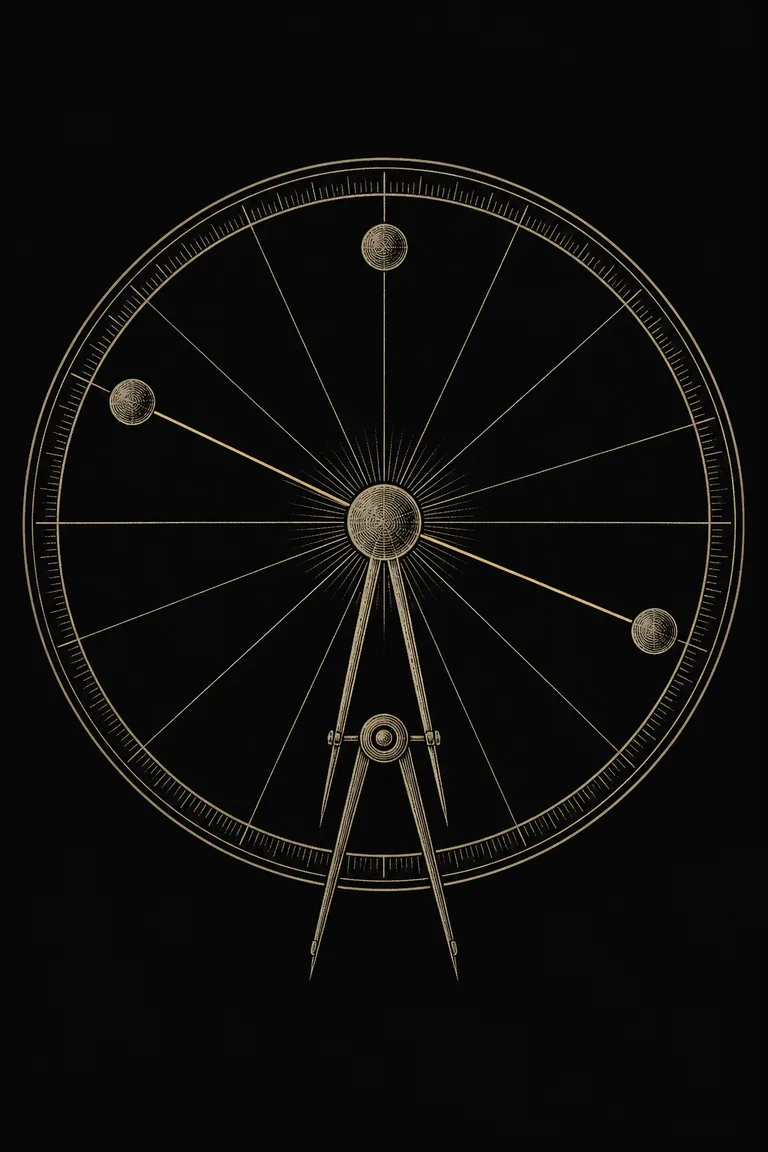
In traditional astrology, dexter and sinister distinguish the two directions in which a planet can cast the same aspect. From the casting planet, count backward against the order Aries to Taurus to Gemini to find the dexter ray. Count forward with that sign order to find the sinister ray.
The distinction is not another name for applying and separating, and it is not fully defined until you name which planet casts the aspect. Traditional authors often gave dexter aspects more force, but that is a doctrine within astrology rather than an established physical effect. Calculate direction first and interpret it only within a declared method.
Take the next insight with you
Explore personalized Astrology guidance in Veritas, available for iOS and Android.
 Scan with your phone
What are dexter and sinister aspects?
Dexter means right-hand and sinister means left-hand in the Latin terminology inherited by traditional astrology. On a conventional zodiac wheel, the practical rule is more reliable than screen orientation: dexter rays go backward through the signs, while sinister rays go forward through them. This allows a square, trine, or sextile to be classified by direction from its casting planet.
Why the casting planet matters
Aspect geometry is reciprocal, but ray casting is directional. Mars 90 degrees from Saturn forms a square either way. Saying Mars casts a dexter square to Saturn is not the same statement as saying Saturn casts a ray back to Mars. Traditional methods may choose the faster planet, the planet that applies, the planet whose testimony is being judged, or another explicitly defined reference. Do not let software choose silently.
How to calculate the direction
Measure from the casting planet to the receiving planet
Forward distance = (receiver longitude - caster longitude + 360 degrees) modulo 360 degrees
Forward distance near the aspect angle = sinister
Forward distance near 360 degrees minus the aspect angle = dexter
Use the same declared orb around both directional targets.Worked example: dexter square
Put the casting planet at 15 degrees Aries, or 15 degrees zodiac longitude, and the receiver at 15 degrees Capricorn, or 285 degrees. The forward distance is 270 degrees. For a square, 270 equals 360 minus 90, so the ray travels backward against sign order. This is a dexter square from the Aries planet to the Capricorn planet.
Worked example: sinister square
Keep the casting planet at 15 degrees Aries and put the receiver at 15 degrees Cancer, or 105 degrees. The forward distance is 90 degrees, the square angle itself. The ray travels forward from Aries through Taurus and Gemini to Cancer, with zodiacal sign order. This is a sinister square from the Aries planet to the Cancer planet.
Directional targets by aspect
Dexter is not the same as waxing
Waxing and waning describe where a faster and slower body sit in their conjunction cycle. Dexter and sinister describe the direction of a ray from a named caster. The classifications can correlate under a particular faster-body convention, but they answer different questions. Keep cycle phase, ray direction, aspect angle, and motion around exactness in separate fields.
Dexter is not the same as applying
Applying means the distance from an exact target is shrinking; separating means it is growing. A dexter square can apply or separate, and a sinister square can apply or separate. Retrograde motion and stations make memorized shortcuts especially unreliable. Use signed speeds or a second timestamp to classify motion after you have calculated direction.
What traditional strength claims mean
Traditional writers often described dexter aspects as more forceful or effective than sinister aspects and related the distinction to the daily motion of the heavens. Treat this as a historical interpretive rule within a specific astrological tradition. It does not mean right is morally good, left is bad, or a dexter malefic contact guarantees a stronger event. Whole-chart context remains necessary.
Choosing who casts the ray
For a simple learning exercise, declare the first named planet as caster. In a traditional judgment, follow the author or school you are using, which may privilege an applying planet or a significator. In transit work, you may choose the transiting planet as caster for a specific analytic question. The key is not one universal hierarchy but a stable, disclosed reference.
Handling orbs
Direction comes from which target angle is approached, while orb measures distance from that target. A forward distance of 268 degrees is two degrees from a dexter square target at 270. A forward distance of 92 degrees is two degrees from a sinister square target at 90. Use the same coordinate system, precision, and stated orb rule for both sides.
Why chart orientation can confuse the labels
Software may rotate the wheel, place the Ascendant at a different screen position, or reverse visual orientation for a chart style. Right and left on the display can therefore mislead. Work from zodiacal order and numerical longitude. Forward follows Aries, Taurus, Gemini, and onward; backward moves in the opposite sequence.
Why software may disagree
Programs may omit the technique, select a caster automatically, round longitudes, or conflate dexter with waxing. Some educational sources also switch the reference planet midway through an example. Verify raw positions and calculate both directed distances. A label without the casting planet, coordinates, orb, and timestamp is incomplete.
Make direction reproducible
In Veritas, save casting and receiving planets, both longitudes, forward distance, target angle, dexter or sinister label, orb, applying or separating status, source convention, and timestamp.
A reliable workflow
- Name the casting planet
State the rule used to choose it before calculating direction.
- Convert both positions
Express longitude on one 0 through 360 degree zodiac.
- Calculate forward distance
Use modulo 360 so the Aries boundary does not reverse the result.
- Compare both targets
Test the aspect angle and 360 minus that angle with one declared orb.
- Classify direction
Forward with sign order is sinister; backward against sign order is dexter.
- Calculate motion separately
Use signed speed or a second timestamp for applying and separating.
- Save the convention
Record source, zodiac, coordinates, precision, orb, and time.
Interpretive limits
Dexter and sinister are directional classifications used in traditional astrological interpretation. They do not demonstrate a physical ray, prove personality, rank one side of the body, or guarantee event strength. Use the technique only inside a declared chart method, and do not substitute it for medical, legal, financial, or mental health guidance.