Astrology Journal
Waxing and Waning Aspects in Astrology
Waxing and waning describe where two planets are in their full conjunction-to-conjunction cycle. Applying and separating describe whether the current aspect is moving toward or away from exactness. Those are separate measurements.
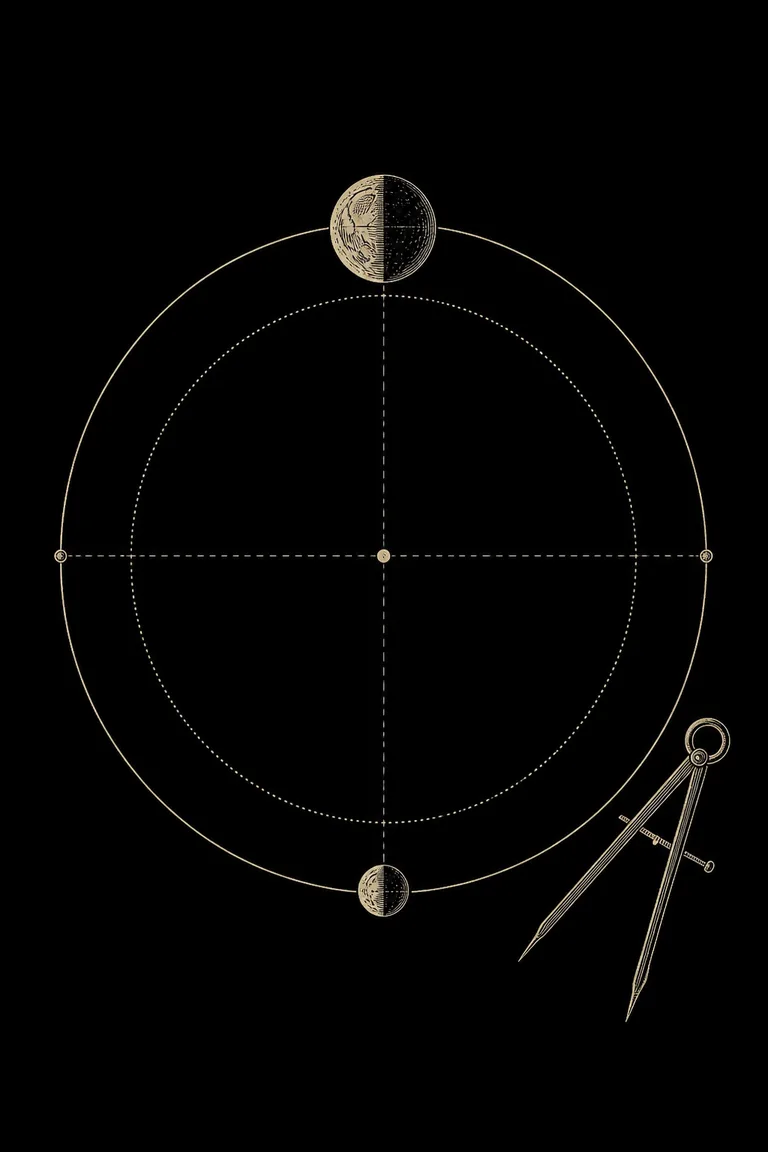
A waxing aspect occurs during the opening half of a synodic cycle, after conjunction and before opposition. A waning aspect occurs during the closing half, after opposition and before the next conjunction. The label is based on directed angular separation around the zodiac, not simply on whether an aspect is getting tighter.
This is why a waxing square can be either applying or separating, and a waning square can also be either applying or separating. Waxing and waning describe cycle phase. Applying and separating describe changing orb around one exact aspect. Calculate and record them in separate fields.
Take the next insight with you
Explore personalized Astrology guidance in Veritas, available for iOS and Android.
 Scan with your phone
What are waxing and waning aspects?
Imagine the faster planet meeting the slower planet at conjunction. As the faster body moves ahead through the zodiac, their directed separation grows from 0 to 180 degrees. This is the waxing or opening half. After opposition, the directed separation continues from 180 toward 360 degrees until the next conjunction. This is the waning or closing half. At 360 degrees the cycle resets to 0.
The synodic cycle behind the labels
A synodic cycle is measured from one conjunction of two bodies to their next conjunction as seen in the selected coordinate system. The opposition divides that cycle into opening and closing halves. Intermediate aspects such as sextiles, squares, and trines occur once in the waxing half and once in the waning half. Their aspect angle may be the same, but their position in the cycle differs.
How to calculate directed elongation
Measure from the slower planet to the faster planet
Directed elongation = (faster longitude - slower longitude + 360 degrees) modulo 360 degrees
More than 0 and less than 180 degrees = waxing
More than 180 and less than 360 degrees = waning
Conjunction and opposition are boundary moments; state the exactness convention used there.Worked example: a waxing square
Suppose the slower body is at 12 degrees Taurus, which is 42 degrees of zodiac longitude, and the faster body is at 13 degrees Leo, which is 133 degrees. Directed elongation is 133 - 42 = 91 degrees. The faster body is in the opening half of the cycle, so the square is waxing. Its orb from an exact 90-degree square is 1 degree. Whether it applies or separates depends on the next moment of motion.
Worked example: a waning square
Keep the slower body at 12 degrees Taurus, or 42 degrees. Put the faster body at 11 degrees Aquarius, or 311 degrees. Directed elongation is 311 - 42 = 269 degrees. That lies in the closing half, so this is a waning square. Its distance from the closing square at 270 degrees is 1 degree. Again, actual motion decides whether the orb is shrinking or growing.
Waxing is not the same as applying
Why memorizing zodiac order can fail
A shortcut that looks only at which sign comes later can fail near 0 degrees Aries, with retrograde motion, or when the wrong planet is treated as the moving reference. Convert both positions to 0 to 360 degree longitude, identify the selected faster and slower bodies, and use modulo arithmetic. Then inspect signed speeds if you also need applying or separating status.
What if a planet is retrograde?
Retrograde motion can temporarily reverse the usual change in directed elongation. The cycle phase still comes from the current directed separation, while applying or separating comes from how the distance to the target aspect changes. Near repeated contacts, a pair may approach, separate, and approach again without crossing opposition or conjunction. Save both positions and speeds rather than assuming the faster mean-motion planet is currently moving forward.
What happens at conjunction and opposition?
Exact conjunction is the cycle reset and exact opposition is the turning boundary between opening and closing halves. Very near either point, rounding can flip the label. Record more decimal precision and the timestamp. Some astrologers describe an exact conjunction as neither waxing nor waning until separation is established, and treat exact opposition as the boundary rather than assigning a side. State your convention.
Which planet counts as faster?
Many methods use the planet with the shorter average orbital period as the faster body for phase orientation. Actual geocentric speed can differ temporarily because of stations and retrogrades. Software may use a fixed planet hierarchy, current signed speed, or a specialized lunation convention. For reproducibility, name the bodies, the reference rule, coordinate system, and ephemeris source.
Waxing and waning in natal astrology
Natal astrologers often interpret waxing aspects as developing, building, differentiating, or moving outward from a shared beginning. Waning aspects are often framed as evaluating, distributing, revising, releasing, or returning experience toward closure. These are symbolic phase metaphors, not measurements of maturity, virtue, success, or psychological health. Sign, house, rulership, sect, dignity, and the whole chart can change emphasis.
The opening and closing square
The waxing square near 90 degrees is commonly called an opening square and may symbolize pressure to establish an independent form. The waning square near 270 degrees is commonly called a closing square and may symbolize pressure to revise or distribute what the cycle produced. Both can describe conflict, work, decision, or adjustment. The phase does not determine whether events are good or bad.
Use in transits and synastry
For transits, phase language can show where a transiting pair sits in its own cycle, but it does not replace the natal contact being studied. In synastry, two natal planets do not continue one shared post-birth cycle in the same simple way, so phase interpretation depends on the school used. Do not apply a natal-cycle metaphor to relationship compatibility without explaining the method and its limits.
Why software may disagree
Programs may select different faster-body rules, round longitudes, use tropical or sidereal coordinates, include or exclude retrograde reversal, or label applying and waxing as if they were synonyms. Check the raw longitudes rather than relying only on a symbol. A one-minute difference near conjunction or opposition can move a boundary case to the other phase.
Keep phase and exactness separate
In Veritas, save both longitudes, the chosen faster and slower bodies, directed elongation, waxing or waning phase, target aspect, orb, applying or separating status, timestamp, and ephemeris source.
A reproducible workflow
- Set the coordinate system
Use the same geocentric tropical or sidereal longitude basis for both bodies.
- Record exact longitudes
Convert sign positions to 0 to 360 degrees without rounding too early.
- Choose the phase reference
Name which body is treated as faster and why.
- Calculate directed elongation
Use modulo 360 so positions across Aries remain correctly ordered.
- Assign waxing or waning
Use the 180-degree opposition boundary and disclose how exact boundary cases are handled.
- Calculate the current aspect orb
Measure distance from the correct opening or closing aspect angle.
- Check motion separately
Use a second timestamp or signed speeds to classify applying or separating.
- Save source and time
Record ephemeris, zodiac, coordinates, and timestamp so another reader can reproduce the result.
Interpretive limits
Waxing and waning are astronomical phase classifications used symbolically in astrology. They do not prove personality traits, relationship outcomes, fate, readiness, or event timing by themselves. Use them as one chart factor and keep the calculation distinct from interpretation. Astrology is not a substitute for medical, legal, financial, or mental health guidance.