Astrology Journal
Firdaria in Astrology: Planetary Periods Explained
Firdaria assign fixed planetary periods and smaller subperiods from the sect light, creating a 75-year symbolic timeline with an important nocturnal node-order fork.
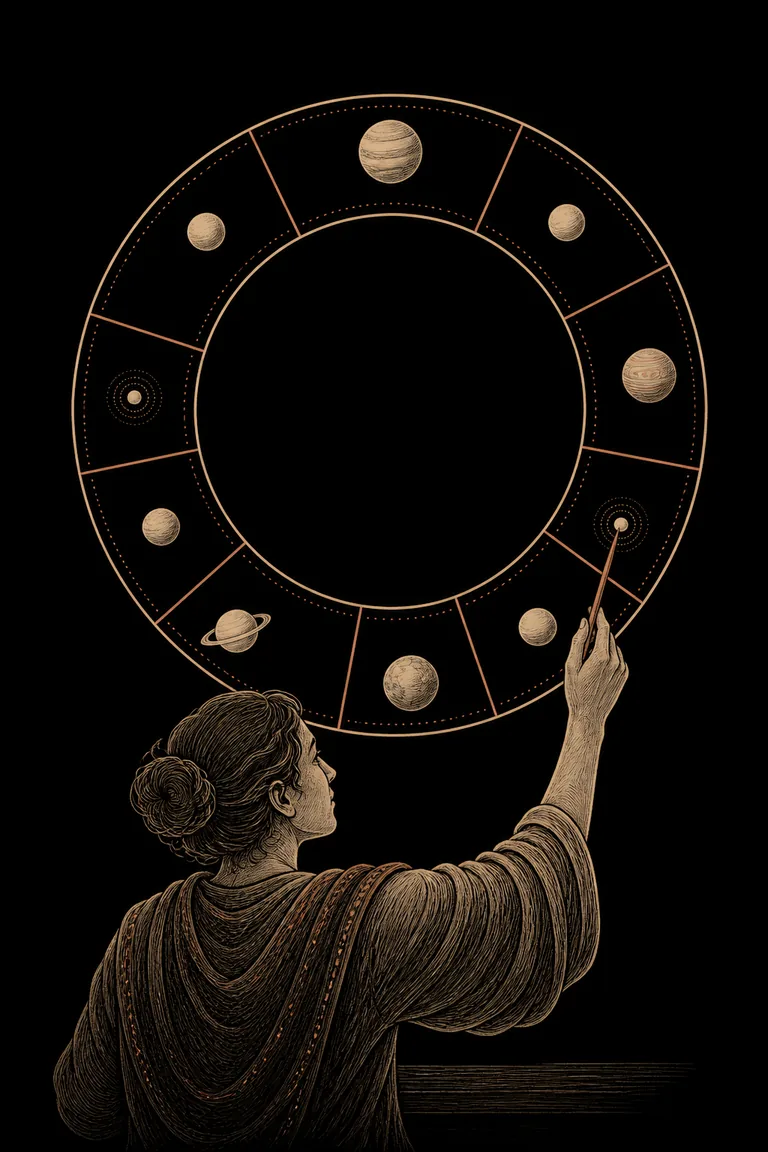
Firdaria are a medieval Perso-Arabic astrology timing technique that divide a life into major periods ruled by the seven traditional planets and the lunar nodes. A day chart begins with the Sun; a night chart begins with the Moon. Each planet has a fixed number of years, and planetary majors divide into seven equal subperiods.
The system can organize long chapters for comparison with natal placements and dated experience, but it does not prove that a planet caused an event or reveal lifespan. Historical and modern sources disagree about where the nodes belong in the night sequence, so a responsible calculation names its source and settings before interpreting dates.
Take the next insight with you
Explore personalized Astrology guidance in Veritas, available for iOS and Android.
 Scan with your phone
Firdaria at a glance
Determine whether the chart is day or night
A chart is diurnal when the Sun is above the local horizon and nocturnal when it is below. This is a geometric sect test, not a clock rule. Near sunrise or sunset, a small birth-time error can move the Sun across the horizon and change the entire firdaria sequence. Confirm location, time zone, daylight-saving treatment, and horizon position before trusting dates.
The fixed firdaria periods
The seven planetary periods total 70 years. Adding the North Node and South Node periods produces a 75-year cycle. These values are period assignments inside the technique, not astronomical orbital periods and not estimates of how long a person will live.
Day-chart sequence
For a day birth, the major sequence is Sun, Venus, Mercury, Moon, Saturn, Jupiter, Mars, North Node, then South Node. The Sun rules ages 0 to 10, Venus 10 to 18, Mercury 18 to 31, Moon 31 to 40, Saturn 40 to 51, Jupiter 51 to 63, Mars 63 to 70, North Node 70 to 73, and South Node 73 to 75. The sequence then repeats under the chosen convention.
Night-chart sequence and the node fork
The seven-planet night sequence begins Moon, Saturn, Jupiter, Mars, Sun, Venus, Mercury. In the Abu Ma'shar reconstruction, the North and South Nodes follow Mercury at ages 70 to 75. A widely used Bonatti-derived software convention inserts the nodes after Mars, before the Sun. This changes every later night-chart boundary. Neither setting should remain hidden. Record the source or software option and do not compare two timelines until their node order matches.
How planetary subperiods work
Each planetary major period divides into seven equal subperiods. The first subperiod repeats the major ruler; the remaining rulers follow the same traditional planetary order from that starting point. A 10-year Sun major therefore has seven subperiods of about 1.43 years each, beginning Sun, then Venus, Mercury, Moon, Saturn, Jupiter, and Mars. Nodal majors are commonly left undivided. Save exact date rules because software can differ slightly in year length and rounding.
A worked day-chart example
Consider a diurnal birth at age 24. The Sun major covers the first 10 years and Venus the next 8, so Mercury begins at age 18 and continues for 13 years to age 31. The active major ruler is Mercury. Each Mercury subperiod lasts 13 divided by 7, about 1.86 years. Six years into the major falls in its fourth subdivision, but exact calendar dates should be calculated from the birth moment rather than rounded ages.
Interpret the major ruler first
The major ruler describes the broad symbolic chapter. Return it to its natal sign, house, sect status, essential dignity, aspects, visibility, and topics ruled. A Venus period is not automatically romantic or pleasant, and a Saturn period is not automatically a punishment. The natal planet provides the established topics; the active period makes those topics available for closer observation.
Add the subperiod ruler as a modifier
The subperiod ruler narrows the background rather than replacing it. During a Mercury major and Mars subperiod, examine both natal planets, their houses and rulerships, and any relationship between them. State the hypothesis before reviewing events. Otherwise nearly any argument, trip, task, message, or expense can be retrofitted to Mercury and Mars.
Firdaria versus annual profections
Annual profections advance one house or sign for each year of life and identify a yearly time lord. Firdaria use fixed multi-year planetary chapters and shorter subdivisions chosen by sect. The techniques can overlap in ruler or topic, but they do not calculate the same thing. Keep separate worksheets and note convergence only after each timeline has been calculated independently.
Firdaria versus zodiacal releasing
Zodiacal releasing begins from the sign of the Lot of Fortune or Spirit and uses sign periods based on planetary years. Firdaria begin from the sect light at birth and move through a fixed planetary order. Releasing creates nested sign timelines; firdaria create planetary major and subperiod rulers. Similar language about chapters or time lords should not blur the distinct starting points and calculations.
Audit a calculator before interpreting it
- Verify the birth data
Confirm date, local time, time zone, daylight-saving rule, and coordinates.
- Check sect visually
Confirm whether the Sun is above or below the actual horizon in the chart.
- Name the night-node convention
Record whether nodes follow Mercury or appear after Mars in nocturnal charts.
- Check one major boundary
Add the fixed years from birth and verify the active major ruler.
- Check one subdivision
Divide the major period by seven and confirm the starting subperiod ruler.
Keep the timing method visible
Use Veritas to record sect, source convention, node order, year length, major and subperiod dates, natal ruler condition, observed evidence, misses, and uncertainty.
Limits and responsible use
Firdaria cannot determine lifespan, diagnose illness, predict death, guarantee marriage, pregnancy, employment, wealth, or legal outcomes, or prove that a planet caused an event. A birth-time error near the horizon and a hidden node-order setting can materially change the timeline. Use medical care, contracts, budgets, safety planning, and qualified advice for consequential decisions. Treat the periods as a historical symbolic framework for structured review.