Astrology Journal
The First House: Identity, Presence, and New Beginnings
The first house describes the way you enter experience: your orientation, embodied presence, immediate responses, and the beginning of personal action.
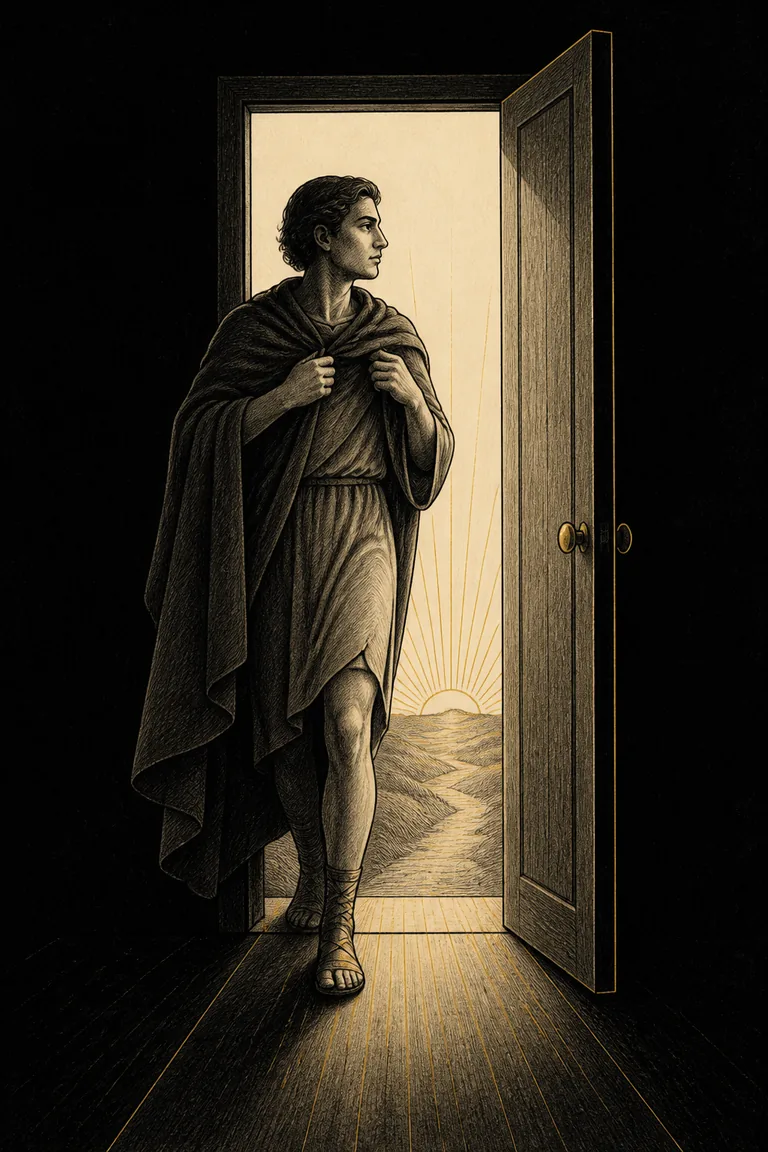
The first house begins at the Ascendant, the zodiac degree rising on the eastern horizon at birth. Astrologers connect it with approach, self-presentation, vitality, physical presence, and the way a person meets unfamiliar situations. It is the starting point of the house system, not a complete definition of identity.
A reliable interpretation combines the rising sign, its planetary ruler, planets in the first house, aspects to the Ascendant, and accurate birth data. It avoids reducing appearance, health, personality, gender, or character to one sign or placement.
Take the next insight with you
Explore personalized Astrology guidance in Veritas, available for iOS and Android.
 Scan with your phone
First house astrology at a glance
The first house concerns beginnings, orientation, embodiment, immediate response, self-presentation, and the way you take up space. It often describes what others encounter quickly, but it does not reveal the whole person or fix someone into a visible stereotype.
Start with the Ascendant and its ruler
Open your birth chart in Veritas and compare the first-house sign, chart ruler, resident planets, and aspects as one connected pattern.
Why the Ascendant starts the first house
The Ascendant marks the eastern horizon at the recorded moment and place of birth. It changes quickly, which is why birth time matters. Symbolically, it describes emergence into a particular environment and the first style of engagement before later houses develop the story.
A reliable order for reading the first house
Ascendant sign
The mode used to approach new situations, orient attention, and begin.
Chart ruler
Its house, sign, condition, and aspects show where first-house momentum is directed.
Resident planets
Planets in the first house make particular functions more immediate or visible.
Aspects and context
Contacts to the Ascendant and lived experience refine the interpretation.
The sign on the first-house cusp
The rising sign describes style, not moral worth. Fire signs may enter through action and visibility, earth through practical orientation, air through exchange and observation, and water through sensitivity to atmosphere. The whole chart can reinforce, redirect, or complicate that first impression.
The chart ruler carries the story forward
The planet ruling the Ascendant is called the chart ruler. Its house shows a life area that repeatedly receives attention from the way you initiate. Its sign and aspects describe how that planet operates. Read this connection before relying on a generic rising-sign description.
Planets in the first house
The Sun may emphasize visible purpose; the Moon, responsive feeling; Mercury, speech and curiosity; Venus, social attunement; Mars, direct action; Jupiter, expansion; Saturn, restraint and responsibility. Every planet has constructive and difficult expressions that depend on condition and context.
What an empty first house means
An empty first house does not mean weak identity, low vitality, or invisibility. Most charts contain empty houses. The Ascendant sign and chart ruler still provide a complete route for interpretation, while transits can temporarily activate the house.
First impressions are not the whole self
The first house can describe what appears quickly because it concerns entry and orientation. Familiarity reveals the Sun, Moon, Mercury, relationship houses, and many other chart factors. A first impression can also be shaped by culture, disability, safety, role, and the observer’s own expectations.
Appearance and body stereotypes
Some traditions associate rising signs or first-house planets with physical traits. These descriptions are inconsistent and often reproduce narrow assumptions about race, gender, beauty, health, and body type. Use the house to discuss embodied experience without claiming that a chart can verify appearance or identity.
Health and vitality require careful limits
The first house has historical associations with the body and vitality, but a placement cannot diagnose disease, predict lifespan, or replace clinical assessment. Symptoms require appropriate healthcare. Astrology may help someone reflect on routines or self-perception only after factual needs are addressed.
Transits through the first house
A transit through the first house can coincide with a period of changed priorities, presentation, energy, or initiative. Track the transiting planet, exact dates, and aspects. The transit describes a symbolic emphasis, not a guaranteed event or personality replacement.
Birth-time accuracy and house systems
Because the Ascendant moves quickly, an uncertain time can change the rising sign or first-house degree. Different house systems may move planets across a cusp, though the Ascendant degree remains the same when the birth data is fixed. Record the source and uncertainty instead of forcing precision.
A first-house interpretation example
Suppose Gemini rises and Mercury is in the sixth house with a close Saturn aspect. The entry style may be observant and verbal, while attention repeatedly moves toward work, routines, or skill. Saturn can make communication careful or self-conscious. Experience determines which expression is active.
A question the first house asks
Ask: “How do I enter a new situation, what do people encounter first, and where does my chart ruler direct that momentum?” Compare the answer with recent examples. Keep what improves observation and revise anything that depends on stereotype.
Astrology is a symbolic interpretive practice, not a scientifically validated forecasting method. The first house cannot diagnose health, determine appearance or identity, prove character, or replace medical, mental health, legal, career, or safety guidance.