Astrology Journal
Retrograde Planets in a Natal Chart: Meaning Without Panic
A natal retrograde planet appeared to move backward when you were born. Learn what that means astronomically and how to interpret it without fear.
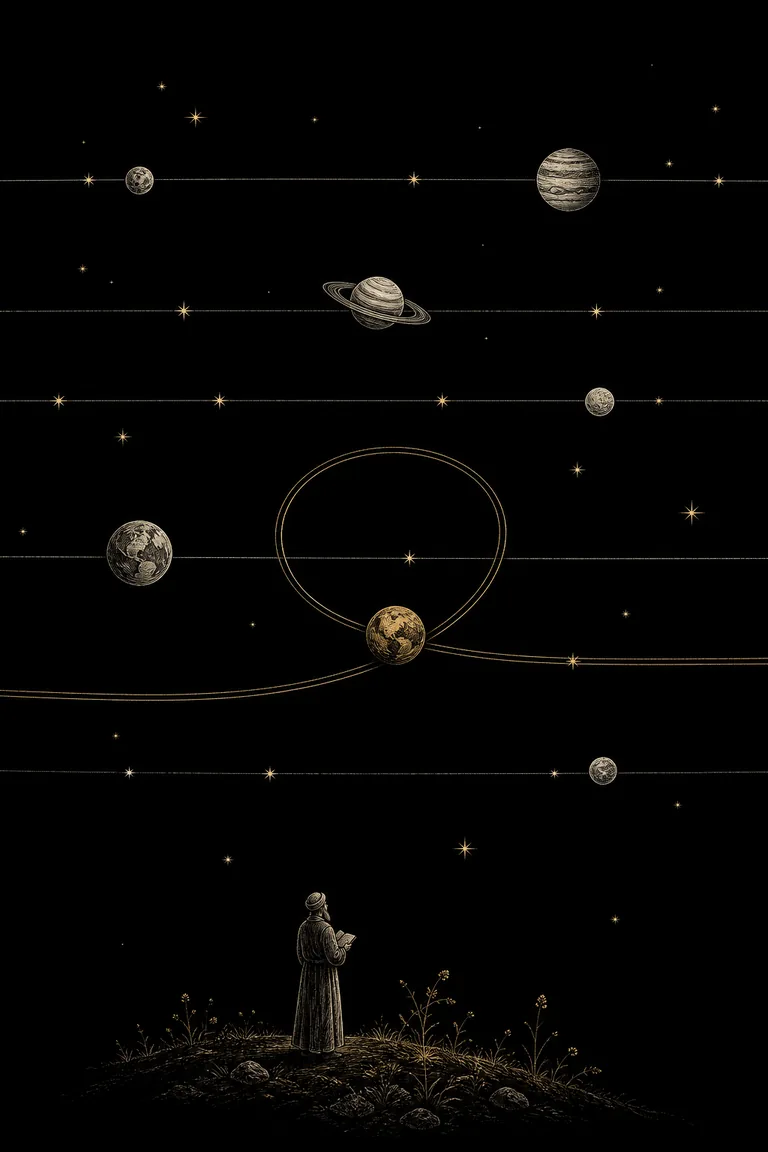
A retrograde planet in a natal chart is marked because, from Earth, it appeared to reverse direction against the zodiac when you were born. The planet did not physically travel backward. Apparent retrograde motion comes from changing orbital positions and viewing perspective.
In astrology, natal retrogrades are often read as planetary functions that require review, internal processing, revision, or a less conventional route of expression. They are not broken planets, punishments, or guarantees that the related life area will fail.
Take the next insight with you
Explore personalized Astrology guidance in Veritas, available for iOS and Android.
 Scan with your phone
What retrograde motion actually is
Because Earth and the other planets orbit the Sun at different speeds, a planet can appear to slow, stop, move backward, and later resume direct motion against the background stars. The visual effect is similar to passing a slower vehicle and seeing it drift backward relative to the horizon.
The Sun and Moon are never retrograde in standard geocentric astrology. Lunar nodes are usually listed as retrograde because of how their calculated motion works, which is different from a planet’s apparent loop.
Natal retrograde versus current retrograde
Natal retrograde
A permanent feature of the birth chart describing a recurring style of processing a planetary function.
Transiting retrograde
A temporary period in the current sky that can revisit themes for everyone and contact individual natal placements.
Progressed station
A timing technique in which a progressed planet changes direction, often treated as a long developmental shift.
See which planets were retrograde at birth
Create your birth chart in Veritas and read each retrograde through its planet, sign, house, aspects, and actual role in your life.
How to interpret a natal retrograde
- Name the planetary function
Mercury concerns thought and communication; Venus concerns values and relationship; Mars concerns action and assertion.
- Add the sign
The sign describes the style through which the function reviews, revises, or turns inward.
- Locate the house
The house shows where the retrograde pattern repeatedly becomes visible in lived experience.
- Check aspects and rulerships
Other planets may support, pressure, or provide an outlet for the retrograde function.
- Compare with evidence
Use actual habits and choices rather than assuming the symbol must produce a problem.
Personal planets retrograde
Mercury retrograde at birth can describe a reflective, nonlinear, or revision-heavy relationship with language and learning. Venus retrograde may develop values and attachment through private reconsideration rather than easy social scripts. Mars retrograde may direct anger, pursuit, or competition inward before action becomes clear.
These patterns can become skills. Careful revision can strengthen communication. Independent values can support honest relationships. Delayed action can become strategy. Difficulties depend on sign, house, aspects, environment, and learned support.
Social planets retrograde
Jupiter retrograde may question inherited beliefs and develop meaning through personal inquiry. Saturn retrograde may internalize standards, authority, or fear of failure, requiring a consciously chosen structure. Since both planets retrograde for months, many people share these placements.
Outer planets retrograde
Uranus, Neptune, and Pluto spend a large part of each year retrograde, so their direction alone is less individually distinctive. House placement, close aspects to personal planets or angles, and generational context carry more interpretive weight.
Stationary planets
A planet near the point where it changes direction appears to move very slowly and is called stationary. Many astrologers treat a station as more concentrated than ordinary retrograde motion. Exact speed and station dates are better evidence than a chart glyph alone.
Does natal Mercury retrograde mean bad communication?
No. It may describe a mind that revisits, translates internally, or develops an unconventional process. Communication skill depends on practice, education, language, health, context, and the rest of the chart. A retrograde marker cannot diagnose learning or speech conditions.
Retrograde rulers matter
If a retrograde planet rules the Ascendant, Midheaven, or several occupied houses, its process can organize more of the chart. Follow the ruler to see which life areas feed into its cycle of reflection and action. Prominence is not the same as damage.
Common retrograde myths
Avoid claims that retrograde planets prove karmic punishment, make relationships impossible, or require waiting forever. Also avoid treating every delay during a transit as caused by Mercury. Retrogrades are one symbolic and timing factor among many practical causes.
Astrology is a symbolic interpretive tradition, not a scientifically validated method for predicting personality or events. Use retrograde placements as reflection prompts, not as diagnoses or reasons to postpone medical, legal, financial, or relationship decisions.