Astrology Journal
Nodal Return in Astrology: Timing and Calculation
A nodal return occurs when the transiting lunar node returns to its natal zodiacal longitude, about every 18.6 years. Exact work must preserve mean or true node settings and every crossing.
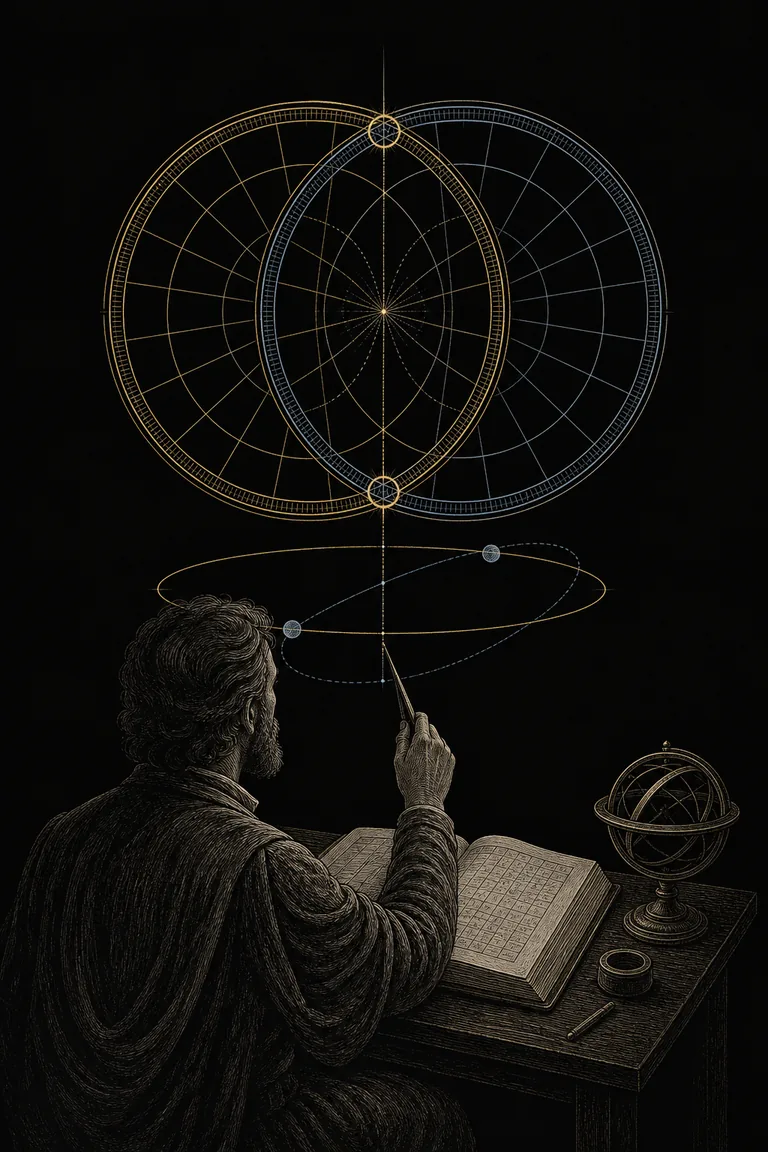
A nodal return in astrology occurs when the transiting North Node reaches the same geocentric zodiacal longitude as the natal North Node. The South Node is always opposite, so the entire nodal axis returns at the same time. The first return is usually near age 18 or 19, followed by returns near 37, 56, 74, and later ages.
Those ages are search windows, not exact dates. A reproducible calculation records whether the chart uses the mean or true node, the zodiac, reference frame, natal longitude, exact timestamps, and any repeated crossings. Astrological interpretations often frame the cycle as a review of direction, familiarity, participation, and release, but the return does not guarantee a turning point or reveal a predetermined life path.
Take the next insight with you
Explore personalized Astrology guidance in Veritas, available for iOS and Android.
 Scan with your phone
Nodal return at a glance
What are the lunar nodes?
Astronomically, the nodes are the two points where the Moon's orbital plane crosses the ecliptic. The ascending crossing is called the North Node and the descending crossing the South Node. They are geometric points, not planets or physical objects. The North Node and South Node guide covers their natal symbolism; this article owns the separate return timing intent.
Why the whole axis returns
The South Node is defined exactly 180 degrees from the North Node. When the transiting North Node matches its natal longitude, the transiting South Node simultaneously matches the natal South Node. Calculate one end of the axis and verify the opposition rather than treating the two returns as separate events.
How often does a nodal return happen?
The nodal cycle is commonly rounded to about 18.6 years. Multiplying that estimate produces useful search windows near ages 18.6, 37.2, 55.8, 74.4, and 93. Exact age varies with the ephemeris convention and the node's apparent motion. Do not add a fixed number of calendar years and call the resulting birthday exact.
Mean node versus true node
The mean node smooths short-period variation and moves retrograde continuously. The true node models the oscillation more closely and can briefly move direct. Neither setting should be silently substituted for the other. Record the chosen node in both natal and transit charts. If comparing results from two programs, confirm this setting before assuming either date is wrong.
How to calculate a nodal return
- Save the natal target
Record North Node longitude, mean or true setting, tropical or sidereal zodiac, reference frame, and source.
- Open a search window
Scan around the relevant 18.6-year multiple rather than one assumed birthday.
- Measure circular distance
Compare signed node longitudes across the 0-degree boundary without treating 359 degrees and 1 degree as far apart.
- Bracket each crossing
Find timestamps on opposite sides of the target and refine with a smaller ephemeris interval or solver.
- Keep every pass
A true-node oscillation can create repeated exact contacts, so preserve all timestamps and motion states.
- Document the chart
Save UTC, display timezone, location, house system, aspect set, orb, software, and birth-time quality.
A circular-distance example
Suppose the natal North Node is 12°20' Taurus, or 42°20' of zodiac longitude. A transiting value of 42°32' is 12 arcminutes away. If the node is moving retrograde by 3 arcminutes per day across this short interval, a first estimate is four days after the observation. This rate estimate is illustrative, not an ephemeris. Refine the result because apparent speed changes.
Illustrative first estimate before ephemeris refinement
Angular distance = 42°32' - 42°20' = 12 arcminutes
12 arcminutes ÷ 3 arcminutes per day = 4 days
first estimate = observation time + 4 days
Nodal return versus nodal opposition
Roughly halfway through the cycle, the transiting North Node reaches the natal South Node while the transiting South Node reaches the natal North Node. This is often called the nodal opposition or reverse nodal return. It is not the same geometry as the return. Check which ends of the axis align before interpreting the cycle.
Birth time, houses, and angles
The nodal longitude changes slowly enough that moderate birth-time uncertainty may have limited effect on the degree, but the natal houses and angles can change greatly. If birth time is unknown, calculate the longitude with appropriate precision and omit or qualify house claims. The birth chart without birth time guide explains that separation.
What to examine in the return chart
The nodal conjunction is guaranteed by definition. Other planets, angles, houses, and aspects belong to the return moment and chosen place. Start with tight contacts to the nodal axis, the natal houses containing the nodes when reliable, and the rulers of those houses. State orbs and avoid treating every loose contact as equally meaningful. Use the aspects guide for consistent aspect definitions.
A grounded interpretation
Astrologers often contrast the North Node as a direction of development with the South Node as familiar capacity or habit. At a return, turn that symbolism into questions rather than commands. What participation now requires deliberate practice? Which familiar skill remains useful? What pattern has become automatic? What evidence would show that a new direction is sustainable?
Return season, not one magic day
Use the exact timestamp as a calculation anchor inside a wider observation window. If the true node creates multiple contacts, treat them as one return season. Compare developments before, between, and after the passes, and record ordinary causes alongside symbolic timing. The astrology transits guide helps keep exact contacts distinct from broad background periods.
Save a reproducible nodal return
Use Veritas to record the natal longitude, mean or true node, every exact crossing, motion state, chart settings, observations, alternative explanations, and review date.
A practical review protocol
Choose one domain connected with the reliable natal houses or the question that brought you to the return. Write one familiar capacity, one overused pattern, one developmental experiment, one source of support, and one measurable review point. Keep the experiment proportionate and reversible. Review it after the final exact pass instead of assigning every event in the year to the nodes.
Common calculation mistakes
Frequent errors include matching only the sign, mixing mean natal node with true transiting node, confusing the return with the opposition, ignoring the 0-degree boundary, rounding too early, losing UTC during timezone conversion, and reporting one pass when the true node crosses repeatedly. A screenshot without settings is not reproducible.
Limits and responsible use
Nodal-return astrology is a symbolic practice, not a scientifically validated prediction method. A return cannot prove karma, reveal a destined partner or profession, diagnose a condition, certify spiritual progress, or guarantee relocation, separation, success, loss, or crisis. Use it to organize reflection while making consequential decisions through current evidence, direct communication, and qualified advice.