Astrology Journal
Nodal Semisquare in Astrology: Timing and Calculation
A nodal semisquare occurs when the transiting lunar node is 45 degrees from its natal longitude, creating two exact phases that must be calculated on a circular zodiac.
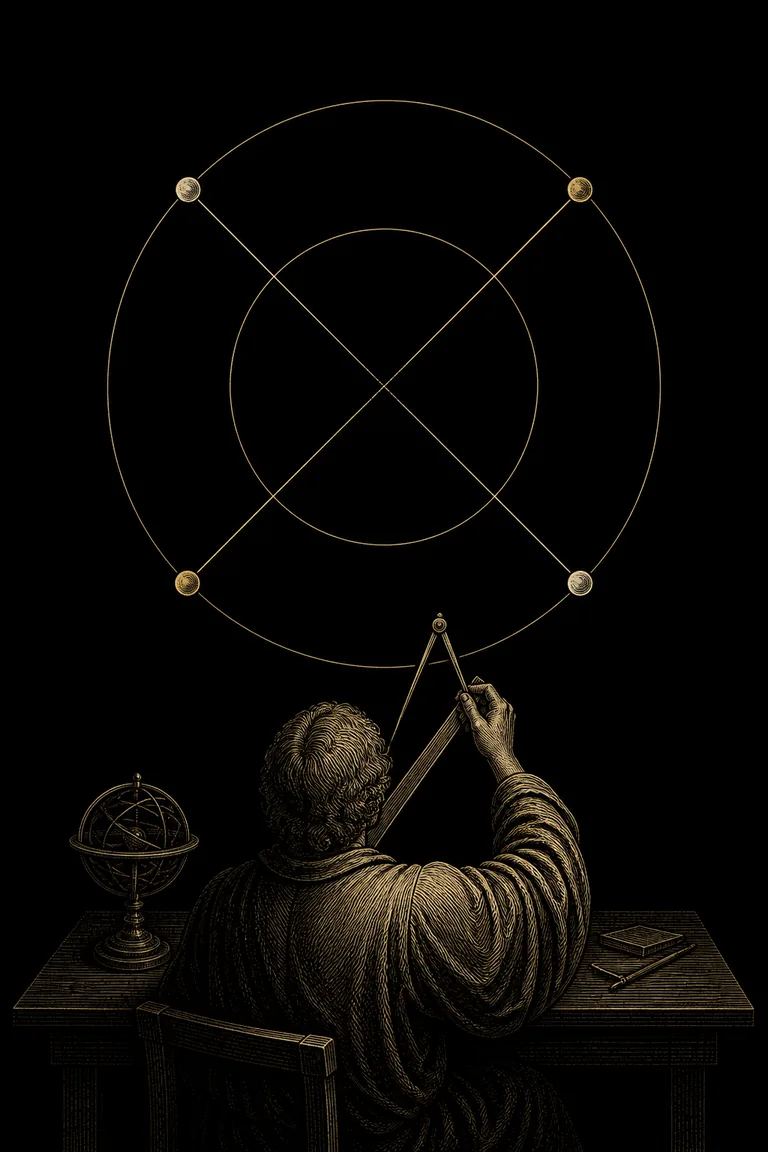
In astrology, a nodal semisquare is an exact 45-degree relationship between the transiting North Node and the natal North Node. Because the nodes form an axis, there are two North-to-North orientations: 45 degrees and 315 degrees. At either orientation, the transiting North Node is simultaneously 135 degrees from the natal South Node, a relationship often called a sesquisquare or sesquiquadrate.
The aspect can be calculated reproducibly, but its interpretation remains symbolic. A rounded age, software label, or exact date does not prove that conflict, pressure, correction, or a destined event will occur. Record the node convention, zodiac, reference frame, target orientation, exact timestamp, motion state, and every crossing before using the phase as one modest review lens.
Take the next insight with you
Explore personalized Astrology guidance in Veritas, available for iOS and Android.
 Scan with your phone
Nodal semisquare at a glance
What makes a semisquare 45 degrees
A circle divided into eight equal sectors produces 45-degree intervals. The semisquare is half a square and is usually classed as a minor aspect. Astrologers disagree about its weight and orb, especially when it involves calculated points rather than planets. For timing work, calculate the exact longitude first and treat any symbolic review window as a separate declared choice.
Semisquare, sesquisquare, and the node axis
The North and South Nodes are always opposite. If transiting North Node is 45 degrees from natal North Node, it is 135 degrees from natal South Node. The reverse 315-degree orientation has the same cross-axis relationship. A program may display one label and omit the other, so record the two points actually compared. Geometry does not decide whether the semisquare or simultaneous sesquisquare should dominate interpretation.
The two semisquare orientations
Normalize natal North Node minus 45 degrees and plus 45 degrees on a 0-to-360-degree circle. With a continuously retrograde mean node, the minus-45 target usually arrives about one-eighth of a cycle after a return. Reaching the plus-45 target requires 315 degrees of retrograde travel, about seven-eighths of a cycle. True-node oscillation can briefly reverse local direction, so longitude and signed motion identify each actual pass.
Approximate age windows
One-eighth of 18.6 years is about 2.33 years, while seven-eighths is about 16.28 years. Search centers therefore recur near ages 2.3, 16.3, 20.9, 34.9, 39.5, 53.5, 58.1, 72.1, 76.7, and 90.7. These rounded ages only help locate an ephemeris window. Exact dates depend on natal longitude, node convention, ephemeris, and nonuniform true-node motion.
Mean node versus true node
The mean node smooths short-period oscillation and moves retrograde continuously. The true node follows modeled oscillation more closely and can briefly move direct. Use the same convention for natal and transiting longitude. If programs disagree, compare mean or true setting, tropical or sidereal zodiac, reference frame, timestamp, timezone, and coordinate precision before interpreting the difference.
How to calculate a nodal semisquare
- Save the natal node
Record exact North Node longitude, mean or true setting, zodiac, reference frame, birth timestamp, and ephemeris source.
- Calculate both targets
Normalize natal North Node minus 45 degrees and plus 45 degrees to the 0-to-360-degree circle.
- Name the orientation
State which North-to-North semisquare is approaching and identify the simultaneous sesquisquare to natal South Node.
- Open a cycle window
Search near the relevant 2.3-year or 16.3-year offset instead of treating a rounded age as exact.
- Bracket and refine
Find timestamps on opposite sides of zero signed angular distance, then shorten the bracket with an ephemeris or numerical solver.
- Keep every pass
True-node oscillation may cross the same target repeatedly, so retain each exact timestamp and signed motion state.
Circular-longitude example
Suppose the natal mean North Node is 12°40' Libra, equal to 192°40' zodiac longitude. The first retrograde semisquare target is 27°40' Leo, or 147°40' longitude. If the transiting mean node is 28°25' Leo and moving retrograde at 3 arcminutes per day, it has 45 arcminutes to travel. The first estimate is fifteen days later, after which the ephemeris should refine the timestamp.
Illustrative first estimate before ephemeris refinement
First semisquare target = 192°40' - 45° = 147°40'
Remaining retrograde distance = 148°25' - 147°40' = 45 arcminutes
45 arcminutes ÷ 3 arcminutes per day = 15 days
Why the true node can create several passes
The mean node normally crosses a target once. The true node can oscillate over the same longitude, creating a direct pass between retrograde passes. Save every exact timestamp as one semisquare season rather than choosing the hit that best matches a story. The stationary motion guide explains why signed motion remains useful for a calculated point.
Orbs, exactness, and software labels
Software may omit minor aspects, apply a default orb, or list an aspect to only one end of the node axis. A wide orb can merge the semisquare with nearby transits or create a long period that seems to fit almost anything. Check the actual circular distance. Save the exact pass separately from any before-and-after review window.
How this differs from a nodal square
The nodal square guide owns the two 90-degree North-to-North phases at one-quarter and three-quarters of the cycle. A semisquare uses 45 degrees and appears halfway between a return and the first square, or between the second square and the next return. Do not call every eighth-cycle phase a square or transfer the square article's search intent to this minor aspect.
Connection with the nodal semisextile
The nodal semisextile guide calculates 30-degree phases near one-twelfth and eleven-twelfths of the cycle. A semisquare is 45 degrees, one-eighth of the cycle. The dates and cross-axis aspects differ, so a software label or rounded age should never substitute for the exact longitude.
Does birth time matter?
The lunar node moves slowly enough that modest birth-time uncertainty usually shifts its longitude less than fast planets or angles. It can still matter near an exact threshold, and houses or angles can change substantially. When birth time is uncertain, calculate a range across plausible times and keep interpretation independent of houses. See the birth chart without a birth time guide.
A grounded interpretation framework
Some astrologers associate semisquares with low-level friction, pressure, or an issue that needs adjustment. Treat these as optional symbolic hypotheses, not discovered causes. Choose one ordinary area already under review, name what evidence made it relevant before checking astrology, and compare at least one rival explanation. An exact 45-degree phase does not manufacture a problem that direct evidence cannot support.
A review protocol for an exact pass
Record the exact timestamp, orientation, motion state, and one concrete topic. Define what would count as improvement, no change, or harm. Take only a proportionate action supported by ordinary evidence, then review after the final pass. Preserve misses and neutral periods. Otherwise a broad word such as friction can be retrofitted to nearly any week.
Save a reproducible nodal semisquare
Use Veritas to record the natal node, both 45-degree targets, orientation, simultaneous sesquisquare, mean or true setting, orb, every crossing, motion state, chart settings, observations, alternatives, and review date.
Common calculation mistakes
Frequent errors include using only one 45-degree target, confusing 45 with 315 on a circular chart, mixing mean and true nodes, forgetting wraparound, overlooking the simultaneous sesquisquare, treating a rounded age as exact, discarding repeated true-node passes, or adding houses from uncertain birth data. Preserve settings and show the arithmetic.
Limits and responsible use
Astrology is an interpretive tradition, not a scientifically validated forecasting system. A nodal semisquare cannot diagnose illness, reveal a hidden cause, prove destiny, require a relationship or career decision, predict conflict or money, or determine safety. Use direct evidence and qualified medical, legal, financial, or mental health advice for consequential decisions.