Astrology Journal
Nodal Septile in Astrology: Timing and Calculation
A nodal septile occurs when the transiting lunar node is 51°25'43" from its natal longitude; a reproducible calculation keeps both cycle orientations, the cross-axis geometry, and every exact crossing.
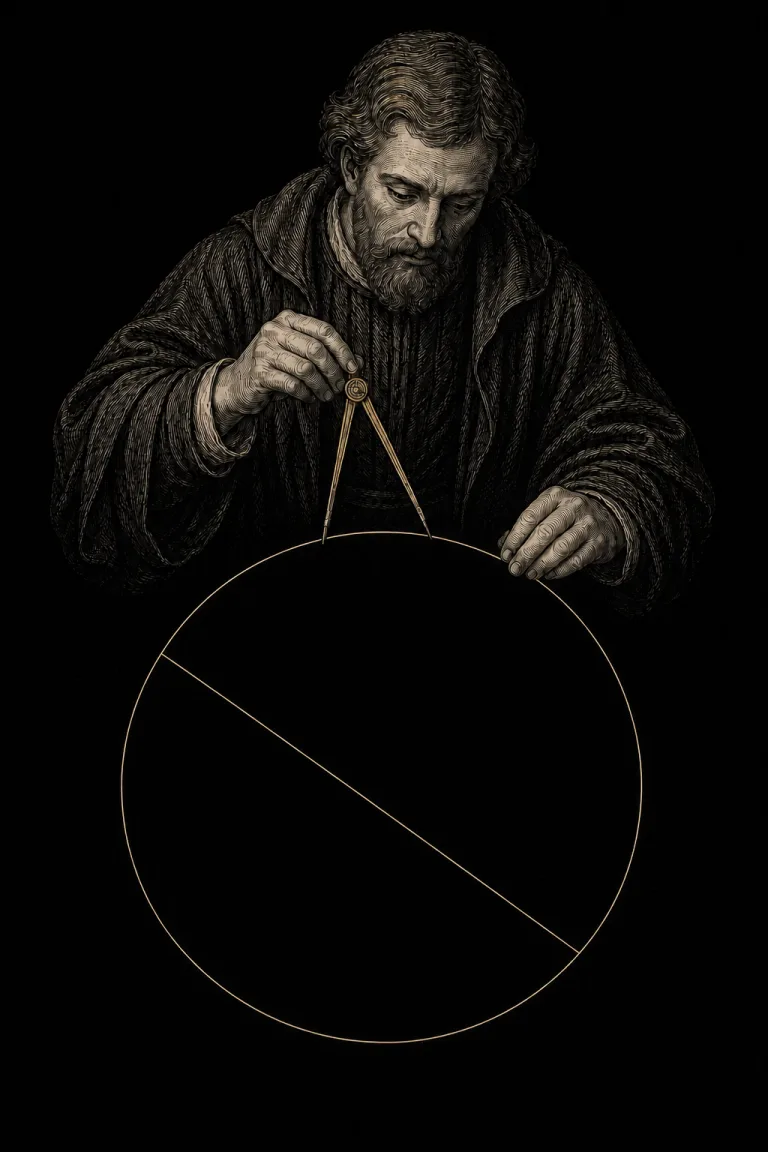
A nodal septile compares the transiting North Node with the natal North Node at one seventh of a circle, about 51.428571 degrees. There are two distinct targets: natal longitude minus 51°25'43" and natal longitude plus 51°25'43". They have the same shortest separation but occur near different parts of the roughly 18.6-year nodal cycle, so both must be named and calculated.
At either target, the transiting North Node is also about 128°34'17" from the natal South Node. That complementary cross-axis distance belongs to the same geometry and is not an independent confirmation. Use one ephemeris, consistent mean or true nodes, exact circular longitude, signed distance, and every true-node pass. The septile is a symbolic aspect convention, not evidence of destiny, crisis, spiritual initiation, or a caused event.
Take the next insight with you
Explore personalized Astrology guidance in Veritas, available for iOS and Android.
 Scan with your phone
Nodal septile at a glance
What a septile measures
Dividing 360 degrees by seven gives 51.428571 degrees, or approximately 51°25'43". Aspect software may round to 51°26' or display a decimal value. Save the exact convention used because a displayed label can hide different rounding and orb rules. The geometry is precise only when the underlying longitudes, timestamp, reference frame, and node definition are also specified.
One-seventh aspect angle
360° ÷ 7 = 51.428571°
0.428571° × 60 = 25.71426 arcminutes
0.71426 arcminutes × 60 ≈ 42.86 arcseconds
Septile angle ≈ 51°25'43"
The two septile orientations
Normalize natal North Node minus 51°25'43" and plus 51°25'43" into the 0-to-360-degree circle. Because the mean node moves retrograde, it generally reaches the minus target after about one seventh of a cycle. Reaching the plus target requires about six sevenths of retrograde travel. Shortest separation alone cannot show which part of the cycle is under review.
The 128°34'17" cross-axis relation
Natal South Node is exactly 180 degrees from natal North Node. Subtract the septile angle from 180 degrees and the simultaneous 128°34'17" relation is the complementary shortest separation. Record it because it proves that the full axis was considered. Do not treat it as another hit or multiply interpretive weight merely because software lists both ends of the nodal axis.
Approximate age windows
One seventh of 18.6 years is about 2.66 years, while six sevenths is about 15.94 years. Search centers therefore recur near ages 2.7, 15.9, 21.3, 34.5, 39.9, 53.1, 58.5, 71.7, 77.1, and 90.3. These are rough ephemeris windows, not exact dates or developmental deadlines. The natal longitude, node convention, ephemeris, and local true-node motion determine the actual crossings.
Mean node versus true node
The mean node smooths short-period oscillation and moves retrograde continuously. The true node models oscillation and can briefly move direct. Use the same convention for natal and transiting positions. When programs disagree, compare mean or true node, tropical or sidereal zodiac, reference frame, UTC conversion, coordinate precision, ephemeris version, and orb before interpreting anything.
How to calculate a nodal septile
- Save the natal value
Record exact natal North Node longitude, node convention, zodiac, reference frame, birth timestamp, and ephemeris source.
- Calculate both targets
Normalize natal longitude minus and plus 51°25'43" into the 0-to-360-degree circle.
- Name the orientation
State which target is being solved and note the simultaneous 128°34'17" relation to natal South Node.
- Open a search window
Start near the corresponding 2.7-year or 15.9-year cycle offset rather than claiming a universal exact age.
- Bracket and refine
Find timestamps on opposite sides of zero signed circular distance, then refine with an ephemeris or numerical solver.
- Keep every crossing
True-node reversals can create multiple exact passes, so retain every timestamp, motion state, and chosen orb.
Circular-longitude example
Suppose natal mean North Node is 22°10' Taurus, equal to 52°10' zodiac longitude. The first retrograde septile target is about 0°44'17" Aries. If the transiting mean node is 1°32'17" Aries and moving retrograde at 3 arcminutes per day, 48 arcminutes remain. The first estimate is sixteen days later. An ephemeris must then refine the timestamp because node speed is not perfectly constant.
Illustrative first estimate before ephemeris refinement
First septile target = normalize(52°10' - 51°25'43") = 0°44'17"
Remaining retrograde distance = 1°32'17" - 0°44'17" = 48 arcminutes
48 arcminutes ÷ 3 arcminutes per day = 16 days
Signed circular distance prevents wrap errors
Ordinary subtraction breaks near 0° Aries, as the example shows. Normalize transiting longitude minus target longitude into a signed range from -180° to +180°. A sign change between adjacent timestamps brackets a continuous crossing. Inspect shorter intervals around true-node stations because a reversal may touch the target, separate, and return. Absolute separation cannot identify applying versus separating motion.
Orbs and exact hits
Minor aspects are especially sensitive to wide orbs. Declare the orb before reviewing events, and keep the exact timestamp separate from the broader window. A one-degree orb around the mean node can span months, so it should not be presented as a single decisive day. Compare a tighter exploratory orb if useful, but do not change it after finding a memorable event.
Why every true-node pass matters
A true-node station can create an initial exact hit, a direct-motion return, and a final retrograde crossing. They form one aspect window rather than three independent confirmations. Preserve every pass and also record uneventful periods. Selecting only the timestamp nearest a relationship decision, move, conflict, or insight creates hindsight bias and overstates the method.
Birth data and reproducibility
The lunar node does not depend strongly on birthplace within ordinary geocentric practice, but the birth timestamp still determines its longitude. If a birth time is unknown, test the full plausible day and report whether the node can cross your chosen orb boundary. The birth chart without birth time guide explains how to preserve uncertainty instead of inventing precision.
A grounded interpretation framework
Septiles are often described with words such as fate, compulsion, initiation, or irrational choice. Those claims are not established by the geometry. A safer symbolic frame is to review how an unfamiliar constraint, choice, or pattern is being handled when ordinary categories feel insufficient. Compare that prompt with observable facts, the natal houses involved, and the broader chart. Do not infer an event from the aspect alone.
Questions for a septile review
Ask what decision currently resists a simple either-or frame, what constraint is verified rather than imagined, which response is actually available, and what evidence would change your interpretation. Then choose one bounded experiment with a review date. The nodal axis guide can supply symbolic language without turning the nodes into commands.
Context from the rest of the chart
Houses, angularity, natal aspects, and simultaneous transits can alter the questions a reader asks, but they do not make the septile causal. Compare the exact nodal crossing with a wider timeline rather than stacking many loose contacts. The aspect guide helps distinguish geometry, orb, applying motion, and interpretation. Keep contradictory evidence visible.
Keep a reproducible nodal record
Use Veritas to save natal and transit longitudes, mean or true setting, both septile targets, the 128°34'17" cross-axis relation, orb, every exact pass, facts checked before interpretation, and the result of one bounded review.
Common calculation and interpretation errors
Frequent errors include rounding one seventh of the circle to 51 degrees, calculating only one orientation, forgetting the 0° wrap, mixing mean and true nodes, using unsigned distance, keeping only one true-node pass, applying a wide orb after the fact, double-counting the South Node, and assigning an exact age from an average cycle. Another error is treating a septile label as proof of a fated encounter or irreversible choice.
Limits and responsible use
A nodal septile is a symbolic timing convention, not a scientific predictor or causal mechanism. It cannot diagnose health, establish danger, reveal another person's intentions, guarantee a relationship outcome, or replace medical, legal, financial, safety, or mental health guidance. Use exact geometry to make the astrological claim transparent, then base consequential decisions on direct evidence and qualified support.