Astrology Journal
North Node Conjunct Hekate Transit: Timing and Meaning
North Node conjunct Hekate transit can frame a narrow review of a threshold decision, provided asteroid 100, every calculation setting, all exact passes, and the full nodal axis are recorded.
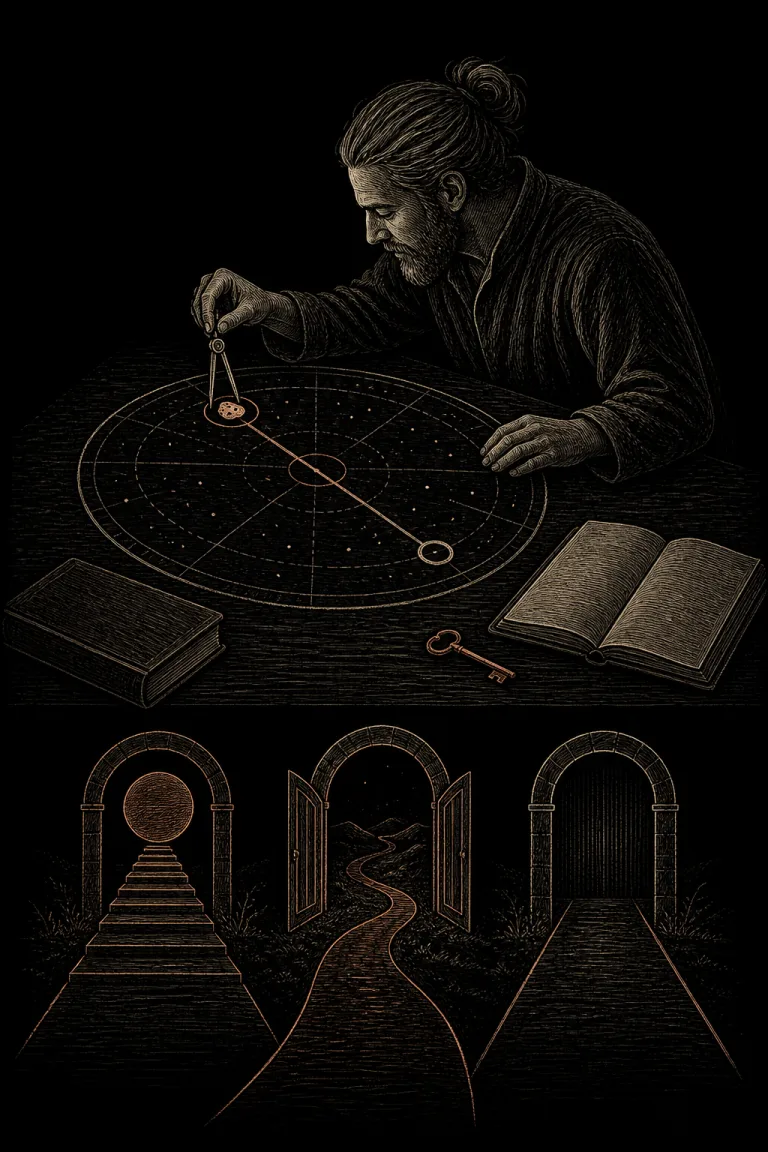
North Node conjunct Hekate transit occurs when the transiting North Node reaches the natal longitude of physical asteroid 100 Hekate. Astrologers may use this narrow window to examine a threshold, the options available at it, the authority to choose, and the conditions for entering, waiting, testing, or leaving. The contact does not prove a destined path, divine instruction, protection, danger, secret initiation, irreversible fate, or the correct decision.
A responsible interpretation begins with reproducible timing. Confirm asteroid 100 in the natal chart, choose mean or true node, choose tropical or sidereal zodiac, state the ephemeris and orb, save every exact pass, and preserve the simultaneous South Node opposition. Before reading events, define one threshold in plain language, list real options, identify the decision owner, record evidence and constraints, and choose an exit condition for any experiment.
Take the next insight with you
Explore personalized Astrology guidance in Veritas, available for iOS and Android.
 Scan with your phone
North Node conjunct Hekate transit at a glance
Verify the physical asteroid first
NASA/JPL identifies 100 Hekate, designation A868 NA, as a main-belt asteroid. Enter 100 explicitly in chart software and confirm the object name and natal longitude. Save the software version and data source. The natal Hekate guide owns broader sign, house, aspect, and synastry interpretation. Myth can provide symbolic vocabulary, but it cannot verify the calculation or authorize a decision.
Freeze node and zodiac settings
Mean and true lunar nodes can produce different exact dates. Tropical and sidereal zodiacs use different reference frames. Record one node model, one zodiac, ephemeris source, timezone, natal birth-data source, and narrow orb before reviewing events. If you compare settings, preserve both outputs as separate models rather than selecting the date with the strongest story.
Record every exact pass
The node's motion can create more than one exact contact within a wider period. Export every date and time when the chosen North Node reaches natal Hekate, then keep applying and separating phases under the same orb. A quiet pass remains part of the record. The transit guide helps separate exact contact from a broad narrative window.
Preserve the South Node opposition
A conjunction to one lunar node necessarily places the other node opposite the same natal point. The South Node side can prompt review of familiar entry rules, old exit habits, inherited roles, or a threshold crossed before. It is not a second omen. Use the node guide to keep the whole axis visible and avoid treating the North Node as a command to proceed.
Use a narrow orb and an event table
Minor-asteroid timing becomes difficult to evaluate when the orb expands until any event fits. Choose the orb first. Build a table with exact pass, distance, applying or separating status, observable event, evidence source, option considered, decision, and alternative explanation. Do not move the threshold date after the fact to rescue an interpretation.
Natal condition defines the reference point
Record natal Hekate's sign, house, close aspects, and birth-time confidence. House placement and angle contacts are sensitive to time uncertainty. If the birth time is unknown, keep house claims conditional and follow the unknown-time method. Planets and angles remain primary chart factors; one asteroid should not govern the whole reading.
Define one threshold before the window
Write the threshold as a testable decision, not a mood. "Should I cross into a new phase?" is too broad. "Should I accept a three-month trial assignment under these hours, pay terms, duties, and exit rights?" names an actual choice. Specify what changes on each side of the threshold, what stays reversible, and what evidence would make waiting preferable.
Build an option matrix, not a prophecy
List at least three real options when they exist: enter, wait, or decline; renew, renegotiate, or close; move, test a short stay, or remain. Compare cost, benefit, consent, authority, dependencies, reversibility, safety, and missing information. Astrology may organize the review, but records and competent assessment determine whether an option is legal, safe, affordable, or available.
The decision owner must be explicit
A threshold may affect several people, but that does not give one person authority over everyone. Name who owns the decision, who must consent, who supplies evidence, and who carries consequences. Another person's hesitation is not resistance to destiny. A symbolic crossroads cannot override refusal, policy, guardianship, contract terms, or professional responsibility.
Reversible tests reduce false urgency
When stakes permit, choose a bounded experiment: a trial schedule, short lease, prototype, supervised visit, written draft, or information interview. Set duration, budget, success evidence, safety constraints, and an exit condition before starting. A reversible step can generate information without pretending the transit requires permanent commitment. High-stakes matters may not be suitable for experimentation.
A seven-step Hekate transit method
- Verify
Confirm natal asteroid 100 Hekate, longitude, birth-data source, and software.
- Freeze settings
Choose node model, zodiac, ephemeris, timezone, and narrow orb.
- Map the axis
Save every North Node conjunction and the simultaneous South Node opposition.
- Define the threshold
State the actual decision, what changes across it, and the deadline if one exists.
- Compare options
Record evidence, cost, consent, authority, dependencies, reversibility, and alternatives.
- Test proportionately
Choose one safe reversible step or formal decision process with a clear exit.
- Review
Compare the result with the original criteria on a fixed date, including quiet and contradictory evidence.
Worked example: a new role
A manager is offered a new role near an exact pass. Instead of calling it a destined doorway, they compare responsibilities, authority, salary, workload, reporting line, trial period, and return rights. They request the terms in writing and speak with the affected team. The transit frames a threshold audit; it does not prove promotion, success, approval, or a safe workplace.
Worked example: a relationship boundary
Two people are considering a change in their relationship agreement. They describe the proposed change, each person's consent, privacy needs, consequences, review date, and right to stop. They do not use Hekate symbolism to claim the bond must deepen, end, open, reconcile, or transform. A valid threshold requires freely given agreement.
Worked example: relocation
A household is considering a move. They compare housing contracts, income, schooling, health access, transport, immigration rules, support networks, and a short visit if feasible. The exact pass is recorded alongside the decision process, not used as proof that one city is fated. Legal, medical, and financial professionals handle the relevant high-stakes questions.
Read Hekate in the wider chart
Mercury can describe information and negotiation. Saturn can describe rules, cost, duty, and limits. Mars can show action or conflict. The Moon can show needs and security. Use the aspect guide, Mercury guide, and Saturn guide without turning one minor asteroid into a total explanation.
Compare Hekate with Kassandra
North Node conjunct Kassandra owns a defined warning, its evidence, authority, delivery, and reception. Hekate owns a threshold decision, available paths, entry conditions, reversibility, and exit. A warning may influence a threshold, but the two intents should remain separate. Neither asteroid proves the underlying claim.
Guard against threshold hindsight
After a major choice, almost any earlier moment can be described as the true crossroads. Save the threshold definition, options, criteria, expected outcomes, and pass dates before the result is known. Record comparable decisions outside the transit window and choices that produced no dramatic change. This makes the interpretation reviewable rather than self-confirming.
Save the complete threshold audit
Use Veritas to log asteroid 100, node and zodiac settings, every pass, both nodes, the threshold, options, evidence, decision owner, reversible test, exit condition, and review date.
A practical journal prompt
Complete: "Using __ node and __ zodiac, the North Node conjoins natal asteroid 100 Hekate at __ across these passes: __. The threshold is __. My real options are __. The decision owner is __, and consent is needed from __. I will test __ under these limits: __. I will exit or revise when __ and review on __."
Responsible limits
North Node conjunct Hekate transit is a symbolic timing framework, not scientific evidence of fate, divine instruction, protection, danger, permission, initiation, diagnosis, legal rights, financial outcomes, consent, safety, or future events. Visit the <a href="/astrology">Astrology journal hub</a> and use records, qualified guidance, privacy, due process, contracts, and ordinary safety checks.