Astrology Journal
Parallels and Contraparallels in Astrology
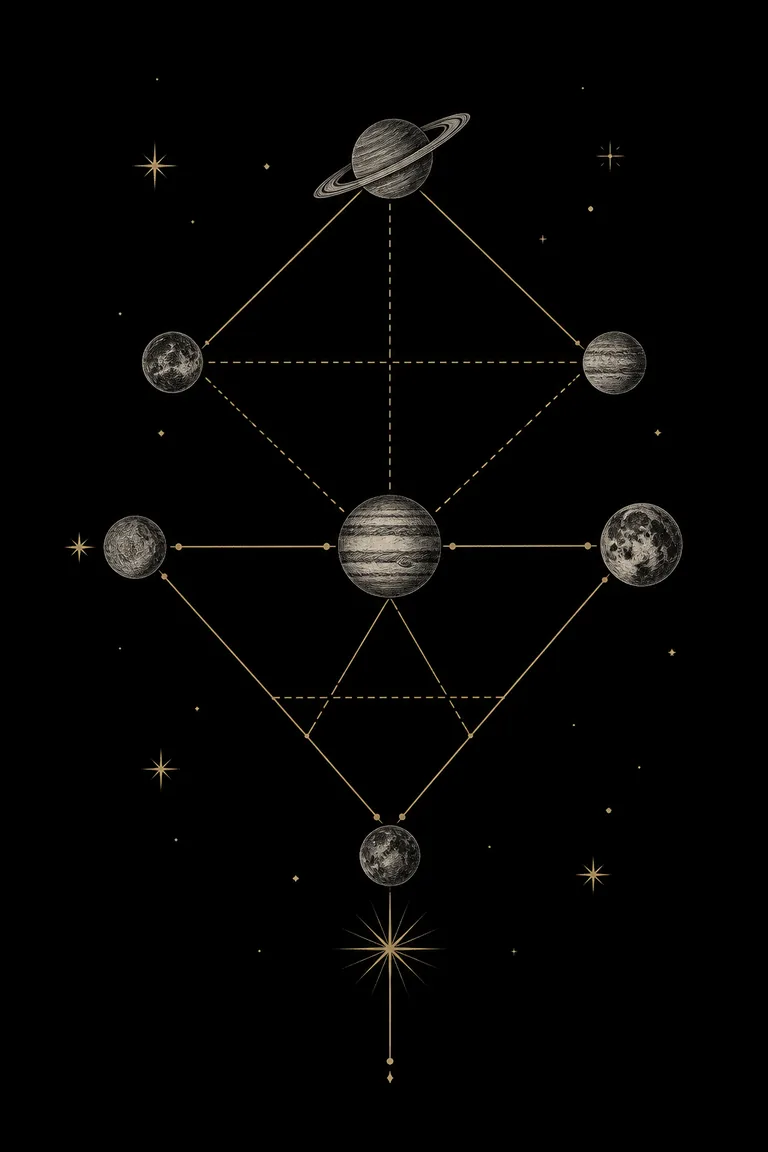
A parallel joins two bodies at nearly the same declination on the same side of the celestial equator. A contraparallel compares similar declination magnitudes on opposite sides.
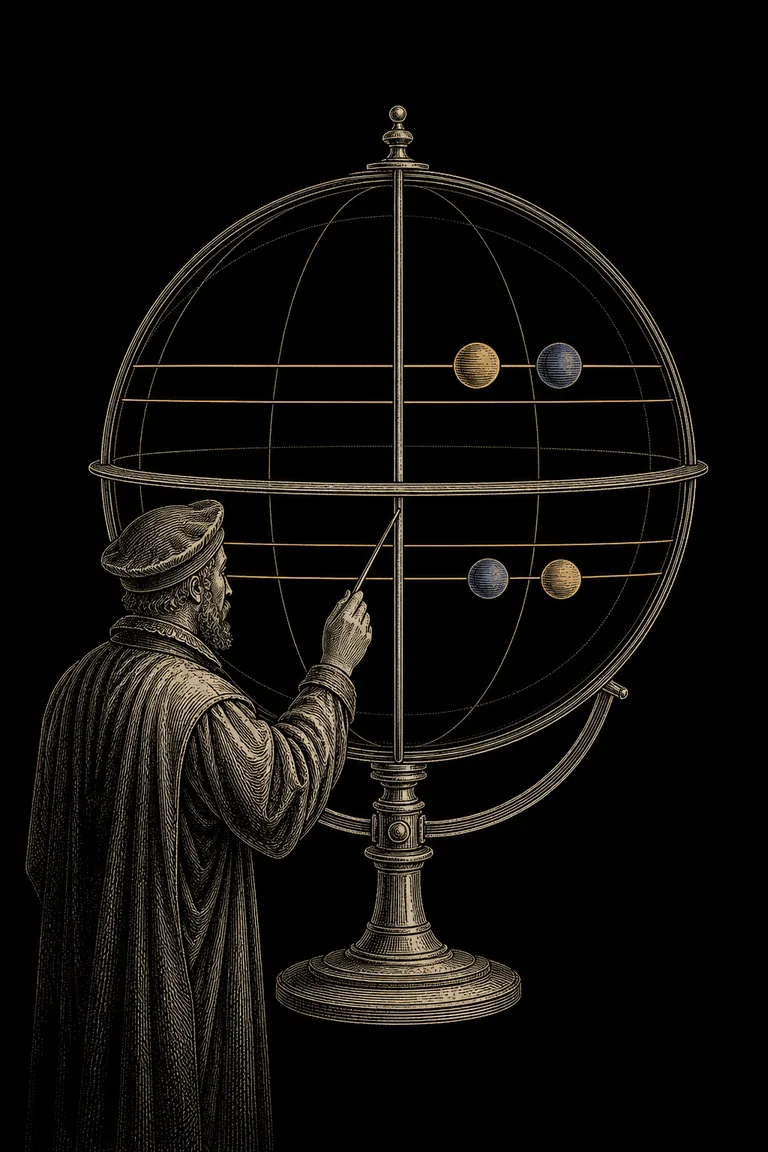
Parallels and contraparallels are astrology aspects measured by declination rather than zodiac longitude. A parallel occurs when two bodies occupy nearly the same north or south declination. A contraparallel occurs when one is north and the other south, with nearly equal absolute values. Both require a declared orb and a timestamp.
They are often compared symbolically with conjunctions and oppositions, but they are not hidden versions of those longitude aspects. The calculation uses equatorial coordinates, so preserve the raw signed declinations, coordinate source, and time before interpreting the label.
Take the next insight with you
Explore personalized Astrology guidance in Veritas, available for iOS and Android.
 Scan with your phone
Parallel and contraparallel astrology definitions
Declination in plain language
The celestial equator extends Earth’s equator onto the sky. Declination measures angular distance north or south of that plane, commonly written in degrees and minutes with N or S, or as positive and negative decimals. Zodiac longitude measures position around the ecliptic. Because the coordinate systems answer different questions, two planets can be conjunct by longitude without being parallel, or parallel while occupying different signs.
How to calculate a parallel
- Fix the moment
Use the same exact timestamp and viewpoint for both bodies. Geocentric declination is the common default.
- Read signed declinations
Record degrees, minutes, and north or south direction without rounding them prematurely.
- Confirm the same side
Both bodies must be north or both south for a parallel under the standard definition.
- Find the difference
Subtract one signed declination from the other and take the absolute value.
- Apply a declared orb
Call the aspect only when the difference fits the orb used by your source or practice.
Parallel worked example
Suppose the Sun is at 18 degrees 42 minutes north and Mars is at 18 degrees 17 minutes north. The difference is 25 minutes of arc. Under a 1-degree orb, they are parallel. If Mars were 18 degrees 17 minutes south, the same magnitudes would not form a parallel because the bodies are on opposite sides.
How to calculate a contraparallel
First confirm that one body is north and the other south. Then compare their absolute declination values. Venus at 21 degrees 10 minutes north and Saturn at 20 degrees 32 minutes south differ in magnitude by 38 minutes, so they form a contraparallel under a 1-degree orb. Subtracting the signed values directly would produce 41 degrees 42 minutes, which measures separation across the equator but does not provide the orb test used for a contraparallel.
What orb should you use?
Many contemporary astrologers use about 1 degree, with tighter preferences for planets and somewhat wider allowances sometimes given to the Sun or Moon. Traditional and software conventions vary. Declination changes continuously, so an orb is a method choice rather than a physical boundary. State it. A 12-minute contact and a 58-minute contact should not be presented as equally exact simply because both fit a one-degree setting.
What does a parallel mean in a natal chart?
Modern astrologers often read a parallel as an integration or intensification of the two planetary functions, roughly analogous to a conjunction. This can be a useful interpretive shorthand, but the aspect remains distinct. Begin with what each planet signifies, its sign, house, rulership, condition, and longitude aspects. Then ask what the declination contact adds. A Sun-Mars parallel does not by itself prove courage, anger, athletic ability, conflict, or success.
What does a contraparallel mean?
A contraparallel is often compared with an opposition and interpreted as polarity, negotiation, projection, or alternating emphasis. Treat that as symbolic language, not a diagnosis. Venus contraparallel Saturn cannot establish rejection, loneliness, age-gap relationships, financial hardship, or lasting commitment. Look for the theme in choices and context, and compare it with any actual opposition by longitude rather than merging the two.
Parallels in synastry
In synastry, compare one person’s planet with the other person’s planet using coordinates calculated for each natal moment. A close parallel may be read as similarity or reinforcement; a contraparallel may be read as a complementary tension. It cannot prove attraction, compatibility, consent, marriage, betrayal, or relationship fate. Accurate birth times matter especially for the Moon and angles, while planetary declinations may be less time-sensitive depending on the body and date.
Parallels in transits and progressions
For a transit, calculate when the moving body enters the chosen orb, reaches the smallest declination difference, and leaves the orb. A planet can make repeated exact contacts as its declination direction changes. These dates will not necessarily match a conjunction or opposition in longitude. Track the declination timeline independently and test interpretation against events and non-events rather than assuming every exact contact produces a visible outcome.
How parallels relate to out-of-bounds planets
Two planets may form a parallel inside the solar declination range, outside it, or with only one body out of bounds if the chosen orb reaches across the boundary. OOB compares one body with a solar limit; a parallel compares two bodies. A contraparallel can also join high north and high south declinations. Record both conditions when relevant, but do not treat one as proof of the other.
Save the coordinates behind the aspect
Use Veritas to record both raw declinations, north or south direction, exact difference, chosen orb, timestamp, ephemeris, longitude aspects, and later observations.
Why astrology programs disagree
Programs may use different ephemerides, true or mean positions, geocentric or topocentric coordinates, rounding rules, time-zone conversion, or aspect orbs. Some list declination contacts only when a display option is enabled. Compare the raw numbers first. If the coordinates match but the labels differ, the cause is probably the orb or same-side rule. If the coordinates differ, verify the timestamp and coordinate settings before interpreting anything.
Are parallels stronger than regular aspects?
There is no universal ranking. Some astrologers treat close parallels as important confirmations, especially when the same planets also form a conjunction or opposition by longitude. Others use declination as a secondary layer. A double contact is two measurements involving the same pair, not scientific proof that an outcome will occur. Weight it consistently within a disclosed method instead of increasing importance after recognizing a compelling story.
A reproducible declination workflow
- Export the table
Save the timestamped declinations rather than only a software aspect label.
- Preserve direction
Keep N or S, or the positive and negative signs, attached to every value.
- Calculate the difference
Use signed same-side values for a parallel and absolute opposite-side magnitudes for a contraparallel.
- Declare the orb
Record the threshold and the actual separation.
- Interpret in context
Read planets, houses, rulerships, longitude aspects, and lived evidence before drawing a conclusion.
Limits of declination aspects
Declination and its angular differences are astronomical measurements. Their astrological meanings are interpretive and not scientifically validated predictors of personality or events. Parallels and contraparallels cannot diagnose a condition, establish identity, reveal another person’s intentions, or guarantee health, legal, relationship, career, or financial outcomes. Use them as documented secondary chart factors.