Astrology Journal
Peregrine Planet in Astrology: Meaning and Test
A peregrine planet has none of its own essential dignities at its exact zodiac degree under a named traditional table. The label describes missing local authority, not a person's worth or a complete outcome.
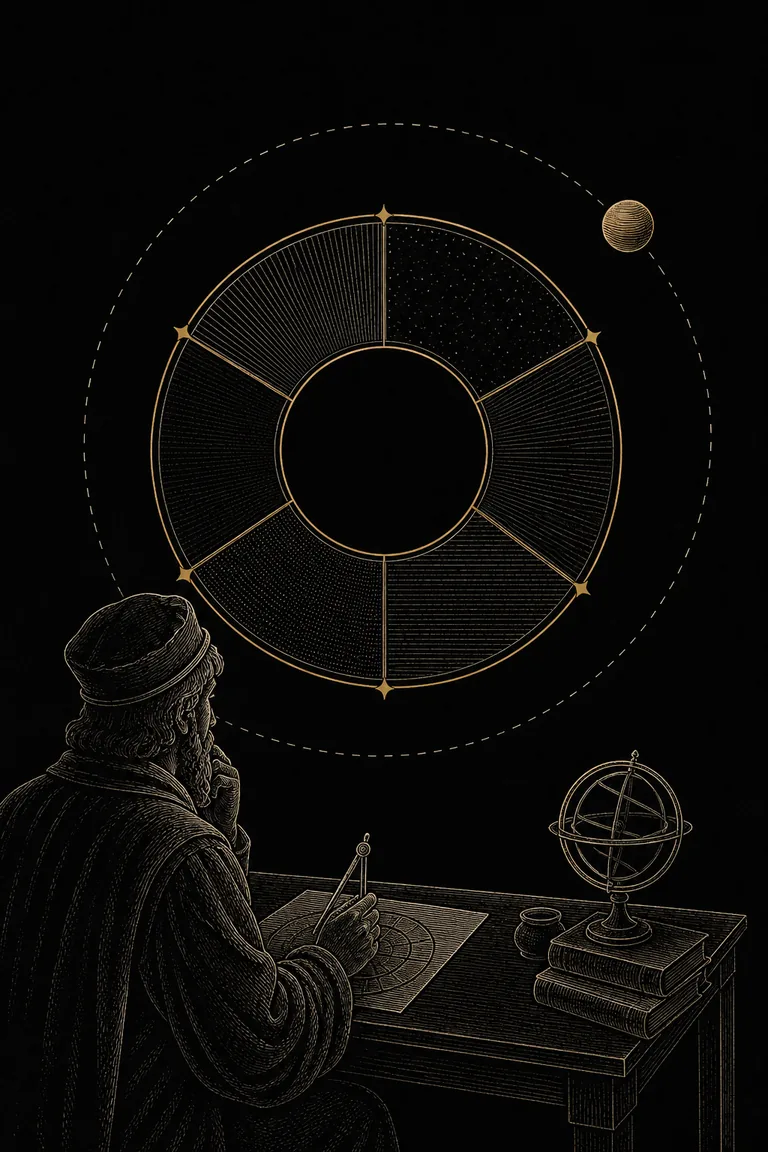
In traditional astrology, a planet is peregrine when it occupies no dignity of its own by domicile, exaltation, triplicity, bound or term, or face or decan. The test belongs to the planet at an exact sign and degree. It is not enough to notice that the planet is outside its domicile, and peregrine does not mean unaspected, retrograde, out of bounds, or neutral.
The result depends on the dignity tables and rules you use. Name the triplicity and bounds systems, decide whether a participating triplicity ruler counts, verify the degree, and test all five categories. Then assess reception, dispositor condition, house placement, sect, visibility, motion, and aspects before interpreting what the missing self-dignity means in a specific chart.
Take the next insight with you
Explore personalized Astrology guidance in Veritas, available for iOS and Android.
 Scan with your phone
What is a peregrine planet in astrology?
The term comes from a word associated with traveling outside one's own territory. Astrologically, the planet has no claim through its own domicile, exaltation, triplicity, bound, or face at that location. Traditional authors often treated this as weakness or lack of settled authority. The metaphor should stay attached to planetary function and chart context. It is not a diagnosis of alienation, morality, citizenship, or personal character.
The five essential dignity checks
- Domicile
Does the planet rule the whole sign it occupies?
- Exaltation
Is the planet in its traditional sign of exaltation?
- Triplicity
Does the planet rule the sign's element under the selected day, night, and participation rules?
- Bound or term
Does the exact degree fall inside a range assigned to that planet in the selected table?
- Face or decan
Does the planet rule the ten-degree face containing the placement?
If any one check gives the planet its own dignity, it is not peregrine under that method. A planet can have only minor dignity by bound or face and still avoid the label. This is why sign-only software summaries can be wrong and why an exact degree matters.
Audit the dignity test before interpreting it
In Veritas, record the zodiac, degree, chart sect, triplicity table, bounds table, face ruler, and yes-or-no result for all five checks.
Name the method before calculating
Traditional sources do not use one universal table in every period. Egyptian and Ptolemaic bounds can assign different rulers to the same degree. Triplicity schemes differ, especially in the water group and in how participating rulers are weighted. A transparent judgment might state: tropical zodiac, Dorothean triplicities, participating ruler counted, Egyptian bounds, Chaldean faces. Keep that configuration stable across charts rather than switching it to obtain a preferred result.
Why the exact degree matters
Domicile, exaltation, and triplicity can apply across a sign or element, but bounds and faces depend on degree. A planet at 11 degrees 59 minutes Aries and one at exactly 12 degrees Aries can occupy different Egyptian bounds. Faces change at 10 and 20 degrees of each sign. Record minutes and seconds near a boundary, and check whether software has rounded the displayed position.
Peregrine is not the same as detriment
Detriment places a planet in the sign opposite its domicile. Peregrine asks whether it lacks all five forms of its own dignity. The conditions can coexist. A planet in detriment may still hold its own bound or face and therefore fail the peregrine test, while a planet that is not in detriment can still be peregrine. Preserve each condition instead of treating peregrine as a midpoint between dignity and debility.
Peregrine is not the same as fall
Fall places a planet opposite its sign of exaltation. It is another specific debility, not a synonym for having no dignity. A fallen planet may also be peregrine if none of the five self-dignities applies at its exact degree. It may avoid peregrine status through a minor dignity even while remaining in fall. These layers can describe different constraints and should not cancel each other.
Unaspected, feral, and out of bounds are different
An unaspected planet lacks selected major aspects under a stated orb policy. Feral is a historical term whose definition varies and may concern a lack of aspects during a sign passage. Out of bounds concerns declination beyond the Sun's usual maximum, not zodiacal dignity. None of these conditions establishes peregrine status. A planet can be heavily aspected and peregrine, or unaspected and strongly dignified.
Reception can provide support without creating dignity
A peregrine planet still occupies the territory of one or more dignity rulers. Its domicile ruler is the dispositor, and other rulers may receive it according to the chosen doctrine and aspect requirements. Reception can describe access, permission, protection, or cooperation. It does not give the visiting planet ownership of the dignity or erase every debility. Assess the receiving planet's condition and the actual connection between them.
Accidental strength is a separate question
A peregrine planet can be angular, direct, swift, visible, in sect, and closely connected to relevant rulers. Those accidental conditions may give it opportunity, prominence, or capacity to act despite limited essential resources. Conversely, a planet with minor essential dignity may be cadent, combust, retrograde, or blocked from the topic. Essential and accidental condition answer different questions, so list both before forming a conclusion.
Worked example: Saturn at 10 degrees Aries
In the dignity method used by William Lilly, Saturn at 10 Aries has no domicile, exaltation, primary triplicity, bound, or face dignity of its own, so it is peregrine. Aries is also Saturn's sign of fall, which adds a separate debility. This example shows why peregrine can coexist with fall. A different rule that grants full dignity to a participating triplicity ruler must be disclosed and may change the test.
Worked example: Mercury at 15 degrees Taurus
Using Dorothean triplicities, Egyptian bounds, and Chaldean faces, Mercury at 15 Taurus does not rule Taurus by domicile or exaltation, is not an earth triplicity ruler, does not own the 14 to 22 degree Jupiter bound, and does not own the 10 to 20 degree Moon face. It is peregrine under that configuration. Venus disposes Mercury by domicile, so Venus's condition and any reception become central to interpretation.
A minor dignity changes the result
Mercury at 15 Aries is not peregrine in the Egyptian bounds table because 12 through 20 degrees Aries belongs to Mercury. It has no domicile authority over Aries, but it holds limited local dignity by bound. This does not make Mercury fully strong or guarantee a favorable outcome. It only means that the precise peregrine label no longer applies, and the minor resource should be judged with the rest of the chart.
Peregrine planets in a natal chart
In natal work, keep the interpretation tied to the planet's functions, houses ruled, house occupied, and relationships. A peregrine Mercury might describe communication that relies heavily on hosts, institutions, teachers, or changing contexts, but it does not prove poor intelligence or dishonesty. A peregrine Venus does not predict failed love. Look for repeated evidence and describe adaptable strategies rather than fixed defects.
Peregrine planets in horary
Horary may use peregrine status to show a significator with limited authority, resources, commitment, or settled place in the matter. The meaning depends on what the planet represents and whether reception, application, angularity, translation, collection, or prohibition changes the situation. Historical theft aphorisms should not be used to accuse a real person. A chart is not evidence of crime, intent, capacity, or guilt.
Peregrine planets in electional astrology
An electional astrologer may prefer key rulers with some essential dignity, but real schedules rarely permit every planet to be strong. Prioritize the ruler of the action, the Moon, relevant houses, and practical constraints under a documented method. A peregrine secondary planet does not automatically ruin an election, and a dignified ruler cannot repair an unsafe, unlawful, unaffordable, or poorly planned decision.
What if the birth time is uncertain?
Most planets remain at nearly the same zodiac degree across a short birth-time range, but the Moon can move enough to cross a bound or face boundary, and the chart may switch sect near sunrise or sunset. Houses and angularity can also change quickly. Test the earliest and latest plausible times. If peregrine status changes, report the uncertainty instead of selecting the time that supports the preferred interpretation.
A practical peregrine planet workflow
- Fix the framework
Name the zodiac, dignity tables, sect rule, and treatment of participating triplicity rulers.
- Verify the position
Record the planet, sign, degree, minutes, seconds, and any timing uncertainty.
- Test five dignities
Check domicile, exaltation, triplicity, bound, and face without skipping minor dignities.
- Separate debilities
Record detriment and fall independently from peregrine status.
- Judge support
Assess dispositor, reception, house, angularity, sect, visibility, motion, and aspects.
- Limit the claim
Connect the result to one planet, topic, and question without turning it into a verdict about the person.
Keep the absence test traceable
Use Veritas to save the five checks, table choices, dispositor, reception, accidental condition, chart topic, uncertainty, and narrow conclusion.
Common peregrine planet mistakes
Do not label every planet outside domicile peregrine, ignore bounds or faces, hide a table change, confuse peregrine with detriment, fall, retrograde motion, lack of aspects, or out-of-bounds declination, or interpret the word as social exile. Avoid numerical dignity scores without showing the underlying conditions. The term is useful only when the calculation is explicit and the interpretation remains proportional to the full chart.