Astrology Journal
Persephone in Astrology: Signs, Houses, and Aspects
Persephone in astrology is a modern optional asteroid lens on transition, separation, seasonal return, and the agency developed across a threshold.
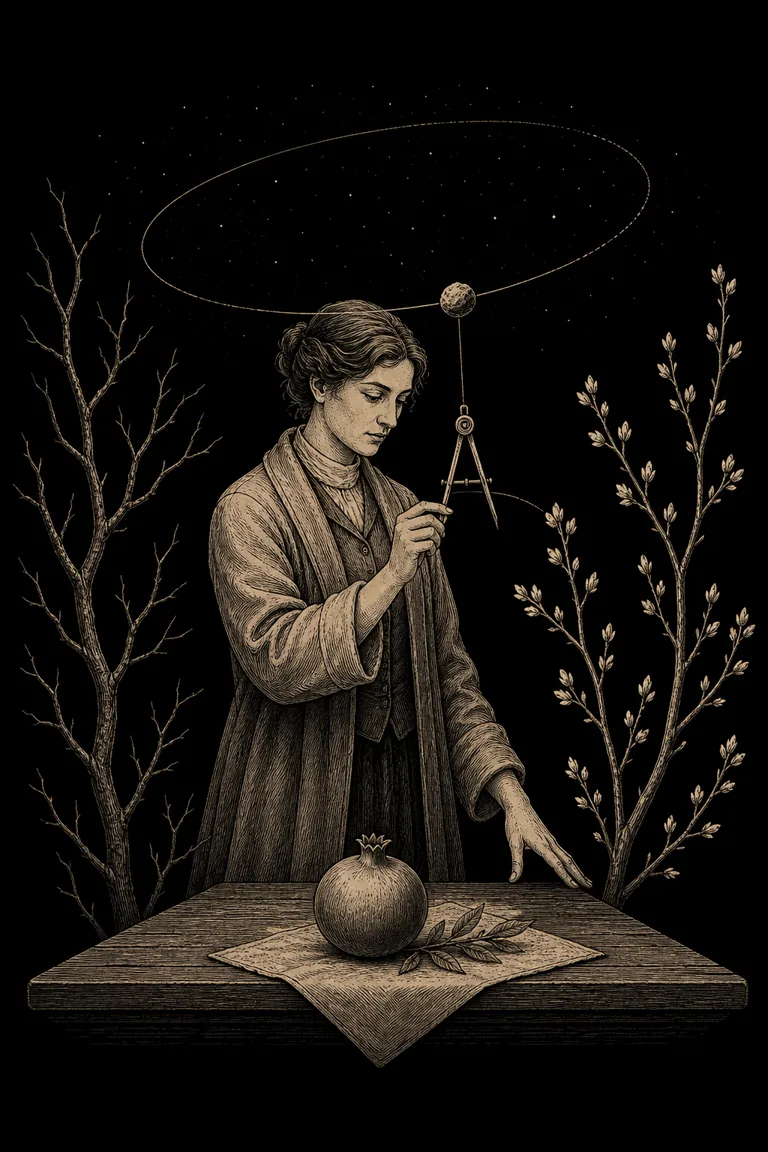
Persephone in astrology usually means asteroid 399 Persephone, a main-belt asteroid named for the Greek figure associated with separation, descent, seasonal cycles, return, and a changed relationship to power. Modern astrologers who include it may explore how a person crosses important thresholds through the asteroid's sign, house, and close aspects.
This is a recent symbolic practice, not an ancient chart doctrine or a scientifically validated predictor of trauma. Persephone cannot prove abduction, abuse, loss, depression, marriage, or rebirth. Confirm object number 399, then read it behind the luminaries, personal planets, angles, relevant houses, major aspects, and lived context. Myth offers questions, not a compulsory biography.
Take the next insight with you
Explore personalized Astrology guidance in Veritas, available for iOS and Android.
 Scan with your phone
What Persephone means in astrology
Astrologers who use asteroid 399 often connect it with separation from a familiar state, time spent between identities, seasonal withdrawal, negotiation, return, or authority gained through transition. Its shadow can include romanticizing suffering, treating powerlessness as initiation, or assuming every change must become profound. The asteroid contributes a focused metaphor. It does not replace the Moon, Pluto, Ceres, Saturn, the nodes, or the fourth and eighth houses.
Place Persephone in the whole chart
Open your astrology profile in Veritas and compare asteroid 399 with the Moon, Ceres, Pluto, the relevant house, angles, and close major aspects.
Asteroid 399 Persephone and object identity
Astronomically, 399 Persephone is a physical main-belt asteroid discovered by Max Wolf in 1895. Its orbit, position, and designation are measurable. Astrological meanings are later symbolic associations influenced by the assigned mythic name. Enter the number 399 in chart software because a name search can be incomplete or confused with a general myth reference. Record the ephemeris and chart settings when comparing results.
How to find Persephone in a birth chart
- Add asteroid 399
Search by number and confirm that the software returns the physical asteroid Persephone.
- Record the calculation
Note zodiac, house system, coordinates, birth-time source, ephemeris, degree, and minute.
- Start with close contacts
Prioritize narrow aspects to the luminaries, personal planets, Ceres, Pluto, Saturn, nodes, and angles.
- Require repetition
Keep a theme only when primary placements and actual experience support it.
The Persephone myth as a modern prompt
Ancient versions differ in detail and emphasis, but the myth commonly involves Persephone's separation from Demeter, life in the underworld, negotiated return, and a seasonal division between realms. Responsible astrology does not assign violence or loss to a chart owner because an asteroid is prominent. Safer questions ask what threshold changes a role, what support protects agency, and what conditions make return or integration possible.
Persephone through the signs
The sign can describe the style used at a threshold. Aries acts directly, Taurus protects continuity, Gemini names alternatives, and Cancer seeks belonging. Leo develops authorship, Virgo practical adaptation, Libra negotiated terms, and Scorpio privacy or consequence. Sagittarius reframes meaning, Capricorn builds authority, Aquarius changes group expectations, and Pisces works through permeability and retreat. These are prompts, not event forecasts.
Persephone through the houses
The house suggests the life area where crossing and return become noticeable. The first concerns identity; the second value and resources; the third language and local ties; and the fourth home and roots. The fifth involves creative authorship, the sixth routines, the seventh agreements, and the eighth shared consequence. The ninth concerns worldview, the tenth public role, the eleventh communities, and the twelfth retreat or unfinished material.
Persephone aspects to planets and angles
A close Sun contact may connect transitions with identity, while the Moon can emphasize belonging and emotional rhythm. Mercury adds narrative, Venus value and relationship, Mars action and conflict, Jupiter meaning, Saturn limits, Uranus rupture, Neptune idealization, and Pluto power or deep consequence. Near the Ascendant, change may affect self-presentation; near the Midheaven, a threshold may color public direction. The contacted factor remains primary.
Persephone in synastry
In synastry, a close Persephone contact may be used to discuss separation, return, changing roles, protective attachment, or a relationship that coincides with a threshold. It cannot prove a fated bond, abuse, abandonment, marriage, or reunion. Ask who has choice, whether terms can be renegotiated, how absence and contact are handled, and whether both people can grow without requiring one person to remain in a mythic role.
Persephone transits
A transit from asteroid Persephone can serve as a minor timing prompt when it closely contacts a natal planet or angle. Attention may turn to a transition, seasonal routine, changed role, departure, return, or the integration of two environments. Minor-asteroid transits are frequent and do not guarantee a crisis. Track major transits, practical causes, and observable developments before assigning symbolic importance.
Persephone compared with Ceres and Pluto
Ceres can frame care, nourishment, separation, return, and resource cycles, while Pluto is a core planetary factor associated in modern astrology with power, compulsion, loss, and renewal. Persephone is a narrower named-asteroid prompt about crossing between states and renegotiating agency. Mythic overlap does not make the three factors interchangeable or equal in weight. Repetition across them may sharpen a question, not prove an event.
Define the threshold in real terms
Use Veritas to name what is ending, what remains available, which condition protects agency, and what a workable return or next season would require.
Birth time and aspect orbs
Without an accurate birth time, house placement and angle contacts may be unreliable even when the asteroid sign and degree remain usable. Because a minor asteroid adds fine detail, many readers begin with narrow orbs of about one to three degrees and widen only when several chart factors repeat the theme. Record the exact degree, aspect, orb, birth-time source, object number, and calculation settings.
Common Persephone interpretation mistakes
Do not predict trauma, diagnose separation anxiety or depression, romanticize coercion, or tell someone suffering is required for maturity. Do not treat a named asteroid as evidence against a person's account of their own life. Avoid presenting asteroid 399 as an ancient chart factor or letting it outweigh primary planets and behavior. A responsible reading protects agency and permits an ordinary explanation to remain ordinary.
Questions for interpreting Persephone
- What threshold is visible?
Name the concrete role, place, relationship, season, or expectation that is changing.
- Where does agency live?
Identify what can be chosen, negotiated, declined, documented, or supported.
- What belongs to each phase?
Separate what must end from what can be retained, adapted, or revisited.
- What would return mean now?
Define the observable conditions for renewal without requiring the past to repeat exactly.