Astrology Journal
Planetary Joys in Astrology: A Practical Guide
Planetary joys are the traditional houses where each of the seven visible planets finds a particularly fitting place of expression. A joy is one supporting testimony, not modern house rulership.
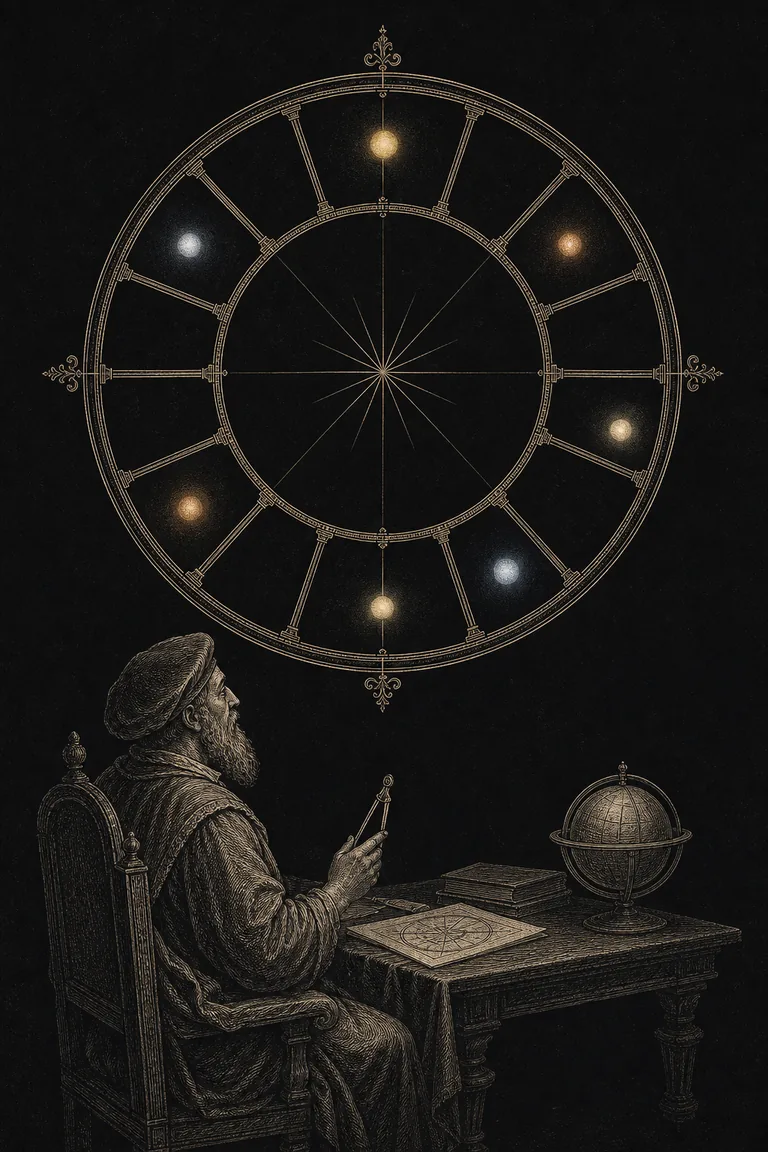
The planetary joys in astrology assign Mercury to the first house, the Moon to the third, Venus to the fifth, Mars to the sixth, the Sun to the ninth, Jupiter to the eleventh, and Saturn to the twelfth. The scheme appears in ancient traditional astrology and links planetary nature, sect, visibility, and the topics of particular places in the chart.
A planet in its joy is not automatically dignified by sign, good, safe, or successful. Joy is a house-based condition and must be read beside sign, essential dignity, sect, motion, aspects, rulership, and the purpose of the chart. It also should not be confused with the modern shorthand that equates houses, signs, and planetary rulers.
Take the next insight with you
Explore personalized Astrology guidance in Veritas, available for iOS and Android.
 Scan with your phone
What are planetary joys in astrology?
A planetary joy is a traditional affinity between one of the seven visible planets and one house or place. The scheme is symmetrical around the horizon and highlights houses associated with topics that resemble each planet's nature. Later authors sometimes treated a joy as a small accidental dignity, but methods and weights vary. It is more informative to preserve the actual placement than to quote a score without its source.
The seven planetary joys at a glance
- Mercury in the first house
Mind, speech, interpretation, and mediation meet the place of the person and embodied agency.
- Moon in the third house
Daily movement, messages, kin, neighborhoods, and recurring practices suit the Moon's changeable rhythm.
- Venus in the fifth house
Pleasure, creativity, celebration, children, and chosen enjoyment correspond with Venusian union and delight.
- Mars in the sixth house
Labor, strain, illness, subordination, and necessary conflict provide a difficult but recognizable Martian field.
- Sun in the ninth house
Religion, divination, higher learning, journeys, and meaning suit the Sun's illumination and authority.
- Jupiter in the eleventh house
Friends, allies, benefactors, hopes, and support align with Jupiter's capacity to connect and provide.
- Saturn in the twelfth house
Isolation, constraint, hidden difficulty, and withdrawal correspond with Saturn's separating and limiting nature.
See the planet inside its actual house context
Use Veritas to inspect the planet's house, sign, aspects, and chart role before adding the traditional joy testimony.
Why Mercury joys in the first house
Mercury is the only planet whose joy sits directly on the horizon in the first house. This matches Mercury's adaptable role between categories: day and night, benefic and malefic, idea and expression. In the place of the person, Mercury can emphasize observation, language, calculation, craft, or mediation. It does not prove intelligence, honesty, or communication skill without considering condition and practice.
Why the Moon joys in the third house
The third house was traditionally associated with the Goddess and with nearby travel, siblings, messages, and customary religious practice. The Moon's rapid movement and recurring phases fit ordinary circulation and repetition. A third-house Moon may make these topics prominent, but the joy does not rank family bonds, guarantee mobility, or replace the Moon's sign, phase, rulership, and aspects.
Why Venus joys in the fifth house
The fifth house, often called Good Fortune in Hellenistic sources, concerns children, pleasure, gifts, celebration, and creative or erotic enjoyment. Venus finds a congenial field here. The placement can support participation in fifth-house topics, yet it does not guarantee romance, fertility, artistic talent, or uncomplicated pleasure. Boundaries, consent, resources, and the rest of the chart remain essential.
Why Mars joys in the sixth house
Mars is a nocturnal planet in traditional sect doctrine and joys below the horizon in the sixth, a difficult place associated historically with illness, labor, injury, and subordination. The match describes affinity, not comfort. Mars may confront or perform demanding sixth-house work, but the joy is not a medical diagnosis and does not make conflict beneficial. Distinguish capable effort from overwork and risk.
Why the Sun joys in the ninth house
The ninth house was called the place of God and includes religion, divination, philosophy, advanced study, and long journeys. The Sun's light, coherence, and authority suit the search for an orienting principle. A ninth-house Sun can highlight meaning-making or teaching, but it does not certify belief, moral authority, academic status, or spiritual truth.
Why Jupiter joys in the eleventh house
The eleventh was known as Good Spirit and concerns allies, patrons, friendship, hopes, and resources that arrive through connection. Jupiter's expansive and supporting symbolism fits this place. Joy can increase interpretive emphasis on networks and assistance, while sign condition and aspects describe how those opportunities operate. It never proves that a group is trustworthy or that a hope will be fulfilled.
Why Saturn joys in the twelfth house
The twelfth, traditionally Bad Spirit, concerns isolation, confinement, hidden opposition, loss of control, and beings or conditions difficult to manage. Saturn's cold, separating, and limiting nature resembles these topics. A Saturn joy does not turn the twelfth house fortunate, nor does it predict imprisonment, illness, enemies, or loneliness. It can describe sustained engagement with limits, retreat, institutions, or unseen burdens.
Sect, horizon, and the pattern of the joys
The diurnal planets Saturn, Jupiter, and the Sun have joys above the horizon in houses twelve, eleven, and nine, while the nocturnal planets Mars, Venus, and the Moon joy below it in houses six, five, and three. Mercury occupies the first at the horizon. The arrangement also pairs benefic and malefic planets with places called good and bad spirit or fortune, revealing an organized system rather than seven unrelated keywords.
Planetary joy is not house rulership
The Sun joys in the ninth, but that does not make it the traditional ruler of the ninth house. Venus joys in the fifth, but the fifth is not simply a Venus house. House topics, zodiac signs, domicile rulers, and joys are separate layers. Avoid the modern twelve-letter alphabet that automatically maps first house to Aries and Mars, second to Taurus and Venus, and so on. The ancient joy scheme follows a different logic.
Joy, essential dignity, and accidental dignity
Essential dignity describes sign- and degree-based resources such as domicile, exaltation, triplicity, bounds, and face. Accidental dignity describes circumstances such as angularity, motion, visibility, and support. A house of joy is generally treated as a favorable or fitting house testimony within traditional practice. Keep all three observations visible. A planet can be in joy while debilitated by sign or constrained by combustion and difficult aspects.
Whole-sign and quadrant houses
Many Hellenistic practitioners evaluate joys using whole-sign places, while later traditions may also use quadrant houses and accidental-strength tables. State the house system and source you use. A planet near a cusp can occupy different numbered houses under different systems, so the joy judgment may change. Do not switch systems after seeing which placement produces the preferred interpretation.
Worked example: Venus in the fifth house
Imagine Venus in the fifth house in Virgo, where traditional astrology considers Venus in fall. The house offers a fitting arena for pleasure, art, affection, or children, while the sign can describe exacting standards, practical service, or difficulty relaxing into Venusian exchange. The synthesis is not that joy cancels fall. It is that fifth-house opportunities exist, but Venus may need discernment, skill, and kinder standards to use them.
Worked example: Saturn in the twelfth house
Suppose Saturn is in the twelfth house in Aquarius, its traditional domicile, and receives support from Jupiter. The chart may emphasize structured work with solitude, institutions, archives, or long-term constraints. Even with several supportive testimonies, do not predict confinement or claim immunity from difficulty. Identify the ruled topics, actual circumstances, and choices through which Saturn becomes concrete.
Document every testimony in the synthesis
Open Veritas and record the house system, joy assignment, essential condition, sect, aspects, and one concrete topic the planet governs.
A practical planetary-joy workflow
- Name the tradition
Choose the source, house system, and branch of astrology before judging the placement.
- Confirm the assignment
Use only the seven classical planets and the traditional house listed for each joy.
- Assess full condition
Check sign, sect, motion, visibility, aspects, rulership, and relevance to the chart question.
- Write a bounded synthesis
Explain how the house offers a fitting field without promising an event or moral outcome.
Common planetary joys mistakes
Avoid assigning joys to Uranus, Neptune, or Pluto as though they belong to the ancient seven-planet scheme, equating joy with domicile, or treating Mars in the sixth and Saturn in the twelfth as harmless. Do not ignore sect, house system, or conflicting testimony. Planetary joys are most useful when they reveal the architecture of traditional houses and add one precise observation to a complete chart reading.