Astrology Journal
Pluto Return Chart: Calculation and Interpretation
A Pluto return chart is cast for the exact instant transiting Pluto reaches its reference-chart apparent geocentric longitude, usually after roughly 248 years.
A Pluto return occurs when transiting Pluto returns to the same zodiacal longitude it held in a selected reference chart. Pluto takes roughly 248 years to orbit the Sun, so this is not a normal personal life-cycle milestone. It is most often discussed for nations, institutions, constitutions, cities, organizations, and historical research.
The orbital period only suggests a search window. An exact Pluto return requires one consistent zodiac and reference frame, a numerical solution for longitude equality, every direct and retrograde crossing, and a declared rule for the event chart and location. Interpretation also depends on whether the subject has remained meaningfully continuous across the centuries.
Take the next insight with you
Explore personalized Astrology guidance in Veritas, available for iOS and Android.
 Scan with your phone
Pluto return meaning at a glance
Can a person have a Pluto return?
A first personal Pluto return is mathematically definable but lies far beyond normal human longevity. Do not substitute a Pluto square, opposition, sign ingress, or broad generational transit and call it a return. A square is approximately 90 degrees from natal Pluto, an opposition 180 degrees, and a return a 0-degree match after the complete cycle. Those geometries occur at different times and support different research questions.
Choose the reference chart before calculating
A nation or institution may have several plausible events: legal incorporation, independence, a constitution, opening day, merger, relocation, or later reorganization. Record the event, original source, calendar, local time, time-zone conversion, place, and why that event owns the question. Do not choose among competing charts after seeing which return produces the preferred houses or narrative. Preserve alternatives when the historical record is genuinely disputed.
Settings required for a reproducible return
Save the reference Pluto longitude on a full 0 to 360 degree scale, tropical or sidereal zodiac, ayanamsha when sidereal, apparent or geometric position, geocentric or another frame, ecliptic coordinate type, ephemeris version, time standard, and numerical tolerance. The reference and transit values must share every setting. Rounded sign and degree labels are not sufficient for a slow planet.
How to calculate an exact Pluto return
- Save reference Pluto
Record its unrounded longitude and the complete source-chart settings.
- Open a wide search window
Scan around the reference timestamp plus roughly 248 years rather than adding a fixed anniversary and stopping.
- Track wrapped longitude difference
Calculate transit minus reference on a signed circular scale and locate every zero crossing.
- Search through both stations
Continue across the full direct-retrograde-direct loop even after the first exact hit.
- Refine and verify
Use higher-resolution ephemeris values, state the tolerance, and confirm the result independently.
A transparent interpolation example
Illustrative first estimate before ephemeris refinement
Reference Pluto longitude = 284.617 degrees
00:00 UTC transit = 284.615 degrees; 24:00 UTC transit = 284.619 degrees
fraction = (284.617 - 284.615) / (284.619 - 284.615) = 0.50
first estimate = 12:00 UTC
This linear estimate assumes smooth direct motion during the bracket. Pluto moves slowly, so daily positions rounded to minutes of arc may erase a crossing or create false precision. Refine the root with sub-daily values from the same ephemeris and handle the 0-degree boundary correctly. Adding 248 calendar years to the source time is not an exact return calculation.
Why a Pluto return may have three exact crossings
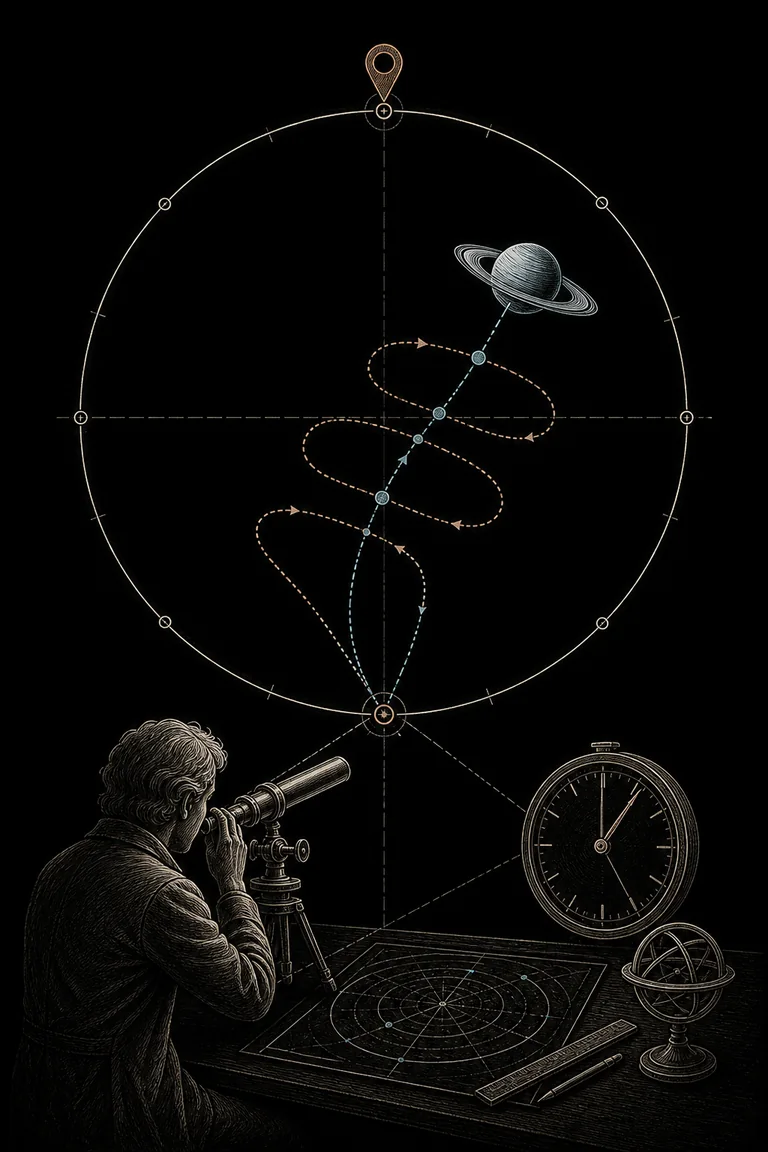
Earth's changing viewpoint produces Pluto's apparent retrograde loop. When the reference degree falls inside that loop, transiting Pluto may cross it direct, retrograde, and direct again. Save all three exact timestamps, signed daily motion, and station dates. Treat the sequence as one return period rather than selecting the pass that best matches a later event. The stationary planets guide explains why tighter sampling is required near a reversal.
Which location belongs in the return chart?
The Pluto longitude return happens at one global instant, while houses and angles depend on location. Plausible rules include the legal capital, founding place, current seat, headquarters, or place of a specific event. Choose the rule before reading the chart and explain it. If continuity or location is contested, prioritize the return planets and aspects rather than presenting one Ascendant as unquestioned fact.
How to interpret a Pluto return chart
Begin with return Pluto by sign, reliable house, angularity, speed, and its tight aspects. Inspect the dispositor and the chart ruler only when the time and location support them. The Pluto sign guide offers base vocabulary, but the sign is generational and cannot identify one institution's outcome. Ask which concrete system of ownership, coercion, extraction, secrecy, debt, security, waste, succession, or renewal is actually under review.
Compare the return with the reference chart
Use a biwheel to separate aspects inside the return chart from return-to-reference contacts. Record aspect type and orb. Exclude disputed source angles and houses. A useful interpretation names a limited theme, observable indicators, a review interval, and a competing explanation. Surrounding transits may describe the broader timing, but no single configuration establishes historical causation.
Pluto return versus Pluto square and opposition
A long-lived institution encounters Pluto squares and an opposition before the return. These aspects may be historically interesting, but they are not partial returns. Keep exact longitude geometry, dates, chart settings, and the subject's institutional stage separate. Comparing all four quarter-cycle points can support a longitudinal study if the same event definition and evidence rules are used throughout.
Preserve the long cycle accurately
Use Veritas to save the reference event, Pluto longitude, every exact crossing, signed motion, settings, source dispute, location rule, interpretation, rival cause, and review evidence.
How to test a historical interpretation
Write the astrological claim before searching archives. Define what would support it, what would count as a miss, and which political, economic, legal, technological, demographic, military, ecological, or organizational causes could explain the same change. Use primary documents and qualified historical research. A symbolic timing technique can organize questions, but it cannot isolate a cause.
Common errors
Common errors include adding 248 years and stopping, treating the return as a personal milestone, matching only the sign, missing retrograde crossings, mixing tropical and sidereal values, rounding Pluto too aggressively, changing the national or institutional chart after seeing the result, choosing a location for preferred houses, and attributing every crisis during a multi-year window to Pluto.
Limits and responsible use
A Pluto return is a symbolic astrological technique, not a scientifically validated forecast or historical cause. It cannot predict war, regime change, collapse, death, violence, economic crisis, disaster, legal outcomes, institutional survival, or personal harm. It cannot prove conspiracy, corruption, national destiny, or moral judgment. Use reliable ephemerides, primary sources, qualified expertise, and direct evidence for consequential conclusions.