Astrology Journal
Uranus Return Chart: Calculation and Interpretation
A Uranus return chart is cast for the exact instant transiting Uranus reaches its natal apparent geocentric longitude, with reference frame, crossings, location, and uncertainty preserved.
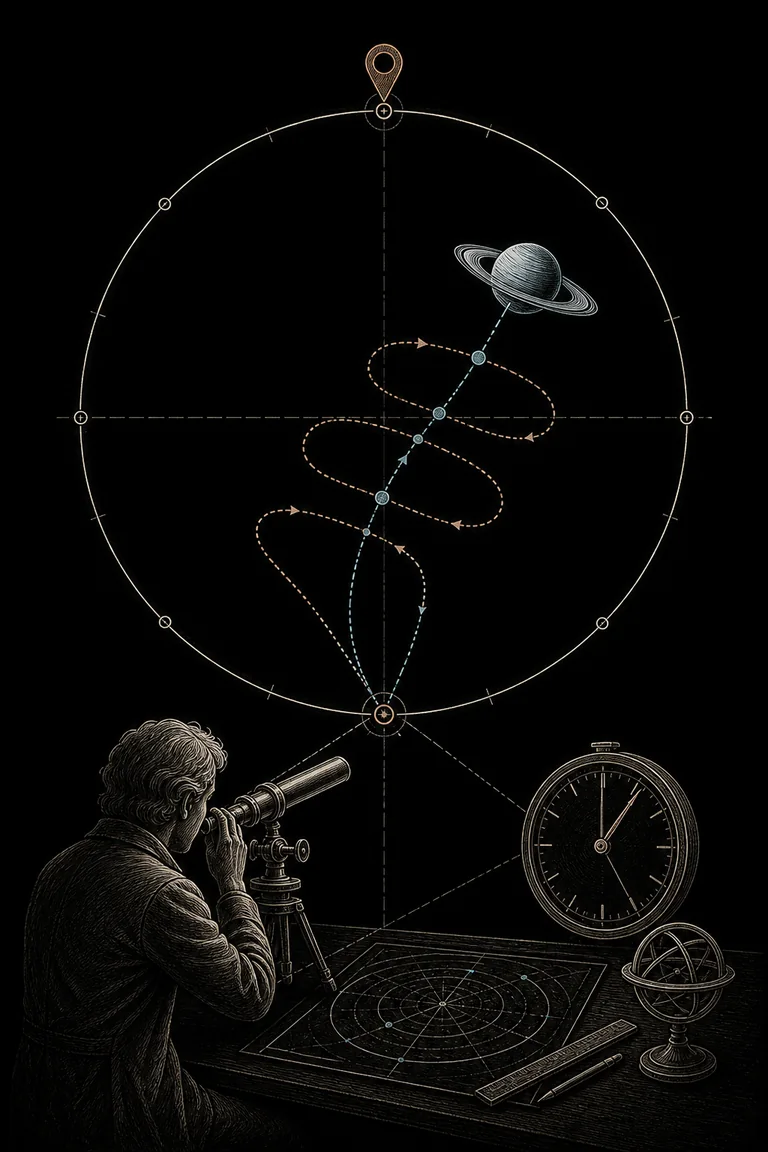
A Uranus return occurs when transiting Uranus returns to the same zodiacal longitude it occupied at birth. It is not simply Uranus entering the natal sign, reaching a broad conjunction, or arriving on the birthday near age eighty-four. A reproducible return solves an exact longitude match.
Uranus takes about eighty-four years to orbit the Sun, so the first return is a rare later-life cycle. That orbital period only locates a search window. Earth's motion creates apparent retrograde loops, while zodiac, reference frame, ephemeris settings, birth data, and tolerance determine the calculated timestamp.
Take the next insight with you
Explore personalized Astrology guidance in Veritas, available for iOS and Android.
 Scan with your phone
Uranus return meaning at a glance
What data and settings you need
Save birth date, time, time-zone conversion, birthplace, natal Uranus longitude, tropical or sidereal zodiac, ayanamsha if sidereal, apparent or geometric positions, ephemeris version, coordinate type, and numerical tolerance. Natal and return positions must share the same settings. If birth time is uncertain, Uranus longitude may move little, but angles, houses, and the Moon can become unreliable. Read birth charts without a birth time before using them.
How to calculate the exact Uranus return
- Save natal Uranus
Record its full 0 to 360 degree longitude and all calculation settings.
- Open a broad window
Begin near the birth timestamp plus eighty-four years, then scan well before and after it.
- Bracket every crossing
Track the wrapped transit-minus-natal difference and note each sign change around the station loop.
- Refine each root
Use interpolation only as a first estimate, then solve with a reliable ephemeris to a declared tolerance.
- Verify independently
Compare the longitude, timestamp, signed motion, zodiac, and reference frame in a second calculation.
A transparent interpolation example
Illustrative first estimate before ephemeris refinement
Natal Uranus longitude = 73.420 degrees
00:00 UTC transit = 73.414 degrees; 24:00 UTC transit = 73.426 degrees
fraction = (73.420 - 73.414) / (73.426 - 73.414) = 0.50
first estimate = 12:00 UTC
This simple bracket assumes smooth direct motion during the day. Uranus moves slowly, so rounded daily positions can hide the root or create false precision. Use higher-resolution ephemeris values, handle the 0-degree wrap, state the tolerance, and confirm the result. A date copied from a generic age table is not an exact return calculation.
One return or three crossings?
If the natal degree lies inside the apparent retrograde loop, Uranus can cross it direct, retrograde, and direct again. Save all three exact timestamps and signed daily motion. Continue the search beyond both stations even after finding one match. Stationary planets require especially careful numerical work because longitude changes slowly near reversal.
Which location belongs in the chart?
The longitude equality occurs at one global instant, but houses and angles depend on place. Astrologers commonly use the occupied return location or birthplace. Choose a rule before viewing alternatives and record it. If the location is unknown, interpret planetary positions without pretending that one set of houses is certain. Do not relocate the chart after reading it merely to produce a preferred Ascendant.
How to read a Uranus return chart
Begin with return Uranus by sign, house, speed, angularity, and tight aspects. Then inspect the ruler of its sign, the Ascendant and ruler when reliable, angular planets, and configurations connecting Uranus with the rest of the return chart. The Uranus sign guide supplies base vocabulary, while astrology aspects helps keep aspect type and orb explicit.
Compare the return with the natal chart
A biwheel separates return-to-return aspects from contacts to natal planets and angles. Record both charts, the aspect family, and the orb. Exclude natal angles and houses if birth time is weak. Because Uranus is a slow generational planet, its natal sign is shared by many peers; personal specificity comes from houses, aspects, biography, and current conditions, not the sign alone. See the broader guide to planets in astrology.
Uranus return versus Uranus opposition
The Uranus opposition occurs when transiting Uranus is about 180 degrees from natal Uranus, commonly near the middle of the full cycle. The return is a 0-degree longitude match near completion of the cycle. They are different geometries and life contexts. Neither deserves a universal crisis script. Calculate the exact aspect and consider the surrounding transits.
Later-life context without stereotypes
A first Uranus return often occurs in the eighties, but exact age varies. Readers may use it to examine autonomy, adaptation, technology, community roles, inheritance of knowledge, changing routines, or freedom within real physical and social constraints. Do not assume decline, isolation, rebellion, genius, illness, or death. Ask the person what change is relevant and what support makes it workable.
Preserve the rare cycle accurately
Use Veritas to save natal longitude, every exact Uranus crossing, signed motion, chart settings, location rule, birth-data confidence, limited interpretations, and later evidence.
How to review a long-cycle interpretation
Before outcomes are known, write a few specific themes, an ordinary alternative explanation, observable support, a miss condition, and review dates. A Uranus return unfolds within health, family, housing, money, policy, and technology conditions that astrology did not cause. For triple returns, review the whole sequence without moving events to whichever pass looks most convincing afterward.
Common errors
Common errors include adding eighty-four calendar years and stopping, confusing heliocentric orbital period with exact geocentric longitude, matching only the sign, missing retrograde passes, mixing tropical and sidereal values, rounding a slow position too aggressively, changing location after interpretation, and treating generational symbolism as a personal prediction.
Limits and responsible use
A Uranus return is a symbolic astrological technique, not a scientifically validated forecast. It cannot predict death, diagnose cognitive or physical health, prove incapacity, guarantee liberation or disruption, establish financial or legal outcomes, or replace medical, legal, financial, caregiving, safety, technology, or mental health expertise. Respect autonomy, consent, accessibility, and direct evidence.