Astrology Journal
Primary Directions in Astrology: Method and Timing Keys
Primary directions measure a symbolic arc of celestial rotation from a natal chart and convert that arc into age with a declared key, method, and tolerance.

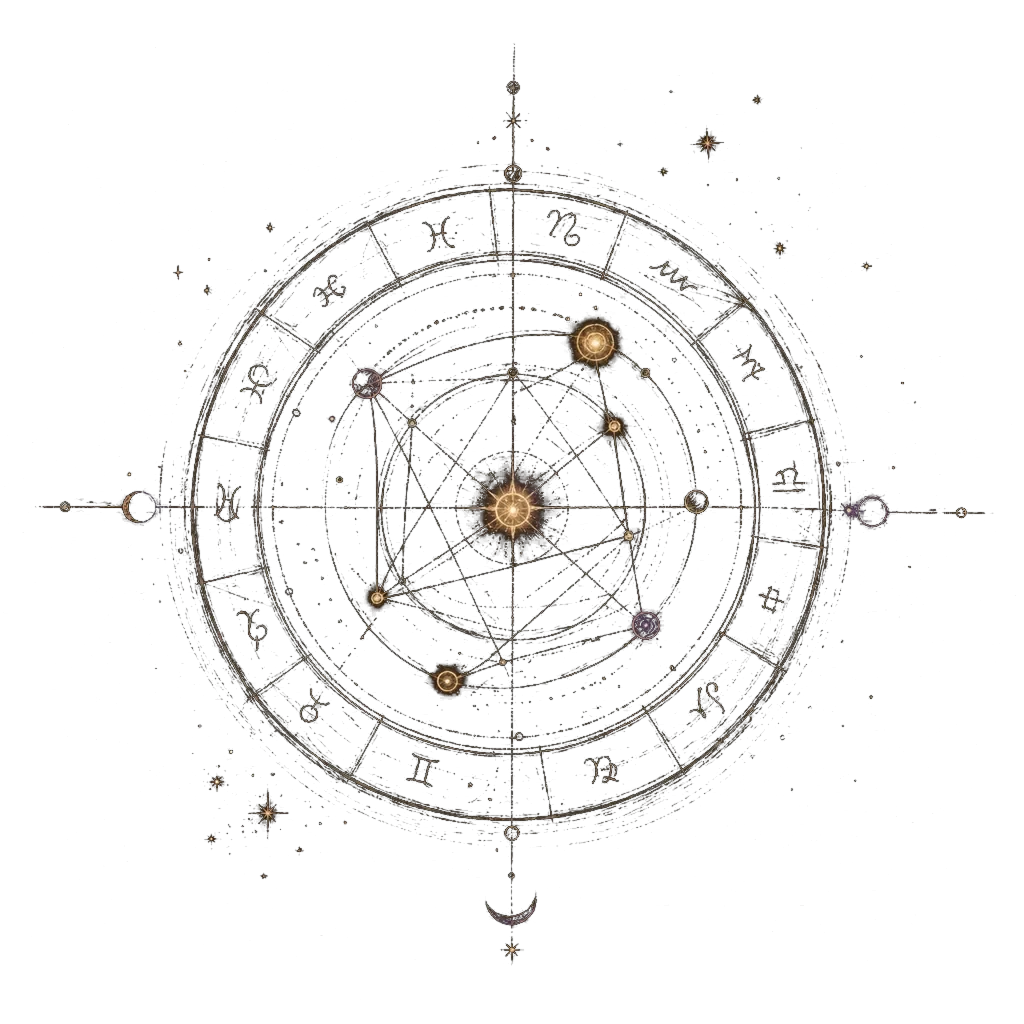
Primary directions are a traditional astrology timing technique based on the apparent daily rotation of the celestial sphere. In a direction, one natal factor called the promissor is carried toward the position, aspect, or circle of position of another factor called the significator. The resulting arc is converted into symbolic years of life with a chosen timing key.
That short definition hides several method choices. Direct or converse motion, mundane or zodiacal geometry, planetary latitude, house framework, aspect type, and timing key can all change a result. Primary directions therefore should not be read from an unlabeled date list. They require accurate birth data, explicit settings, a checkable arc, and a realistic date tolerance. They cannot guarantee an event or determine lifespan.
Take the next insight with you
Explore personalized Astrology guidance in Veritas, available for iOS and Android.
 Scan with your phone
Primary directions at a glance
Promissor and significator are different roles
The promissor is the factor directed by the chosen rotational method. The significator is the natal factor or position receiving the direction. Planets, angles, aspects, lots, bounds, and other points may be included under different traditions. The labels describe roles in a calculation, not active and passive people in real life. Record both roles because reversing them can create a different arc.
The geometry is not ordinary zodiac longitude
A birth chart is a local view of a sphere, not a flat zodiac strip. Primary directions relate a body to the equator, horizon, meridian, and its diurnal or nocturnal path. Right ascension, declination, oblique ascension, ascensional difference, semi-arcs, and circles of position may enter the calculation. This is why subtracting two ecliptic longitudes is not a general primary-direction method. Software must preserve the chosen spherical model.
What the direction arc represents
The direction arc is the amount of symbolic rotation required for the promissor to reach the relevant position of the significator or its aspect. It is usually expressed in degrees along an equatorial framework. The arc is not elapsed astronomical time after birth. A separate key maps that angular distance to years of life for interpretive timing. Save the raw arc before converting it so another calculator can be audited.
Primary keys: one degree and Naibod
A simple timing-key example
Convert the same 30 degree arc without changing the geometry
30.00 degrees x 1.0000 years per degree = 30.00 years
30.00 degrees x 1.0146 years per degree = 30.44 years
The example isolates only the time key. It does not show how the 30-degree arc was derived, and it is not a prediction for age thirty. With the Naibod conversion, the result is roughly five months later than the one-degree result. Rounding rules, calendar conversion, and the original arc precision can shift the displayed date further.
Direct and converse directions
Direct directions follow the conventional order of the apparent diurnal rotation used by the chosen system. Converse directions reverse a defined part of that relationship, but historical and software definitions are not fully uniform. A checkbox labeled converse may therefore hide different algorithms. Confirm what is reversed, which point moves, and whether the same coordinate framework and key remain in use.
Mundane and zodiacal directions
Mundane directions work through the actual proportional positions of bodies in their diurnal or nocturnal arcs. Zodiacal directions direct points or aspects through the zodiac under a stated projection. Some zodiacal methods ignore planetary latitude, while others include it. These are not interchangeable display modes. A close date from two variants does not prove that the underlying geometry is the same.
Why latitude and birth place matter
Geographic latitude changes how the celestial sphere meets the local horizon and therefore changes ascensional differences and semi-arcs. Planetary latitude can also affect methods that preserve a body's position away from the ecliptic. Birth longitude and time determine the local meridian. A software result that requests only a date but not a time and place cannot calculate a full location-sensitive primary direction.
Angles are highly time-sensitive
The Ascendant and Midheaven move quickly with clock time, and many primary-direction calculations depend directly on the horizon and meridian. A small birth-time error can move an angle, alter a semi-arc, or shift a direction date. Rectifying a birth time by selecting whichever directions match known events creates circular evidence unless the proposed time is tested against independent records and held out events.
How to audit a primary-directions calculator
- Verify the birth record
Check local time, time zone, daylight-saving rule, coordinates, and confidence in the recorded time.
- Name the direction method
Record direct or converse, mundane or zodiacal, house framework, and treatment of latitude.
- Identify both roles
Write the promissor, significator, aspect, and whether angles or other points are included.
- Preserve the raw arc
Check one result before the software converts it into an age or date.
- Verify the timing key
Recalculate one date with the displayed key and record rounding and tolerance.
Primary directions versus secondary progressions
Secondary progressions commonly map one day after birth to one year of life and use actual ephemeris positions from those later days. Primary directions symbolically rotate the natal sphere and convert an angular arc with a key. The word direction appears in both histories, but the calculations are not the same. Do not label a progressed Moon aspect as a primary direction.
Primary directions versus solar arc directions
Solar arc directions move every natal point by a common arc based on the progressed Sun, often close to one degree per year. Primary directions derive arcs from celestial-sphere relationships and local geometry. A similar-looking age does not merge the techniques. Keep the solar arc, primary arc, coordinate system, and conversion rule in separate fields.
Primary directions versus transits and profections
Transits compare current astronomical positions with the natal chart. Annual profections advance one sign or house for each year of life to identify a time lord. Primary directions use a natal spherical arc and a symbolic key. Practitioners may compare all three after calculating each independently, but adding techniques until one matches an event encourages hindsight fitting.
Interpret the natal promise before the date
Interpretation begins with what the promissor and significator already mean in the natal chart: their houses, rulerships, condition, sect, aspects, and relevance to the question. A Venus direction is not automatically romance or pleasure, and a Saturn direction is not automatically loss. State a narrow hypothesis and a date range, then preserve ordinary periods and misses as well as striking coincidences.
Keep every direction reproducible
Use Veritas to save birth-data confidence, coordinate system, direction type, promissor, significator, aspect, latitude rule, raw arc, timing key, date tolerance, natal context, evidence, and misses.
Limits and responsible use
Primary directions cannot determine lifespan, diagnose illness, predict death, guarantee marriage, pregnancy, wealth, employment, legal outcomes, or public success. Historical texts may connect the technique with life-length doctrine, but that is not a safe or validated use. For consequential decisions, use medical care, records, contracts, budgets, direct communication, and qualified advice. Treat the method as a historical symbolic chronology with material uncertainty.