Astrology Journal
Secondary Progressions in Astrology: Day-for-a-Year Guide
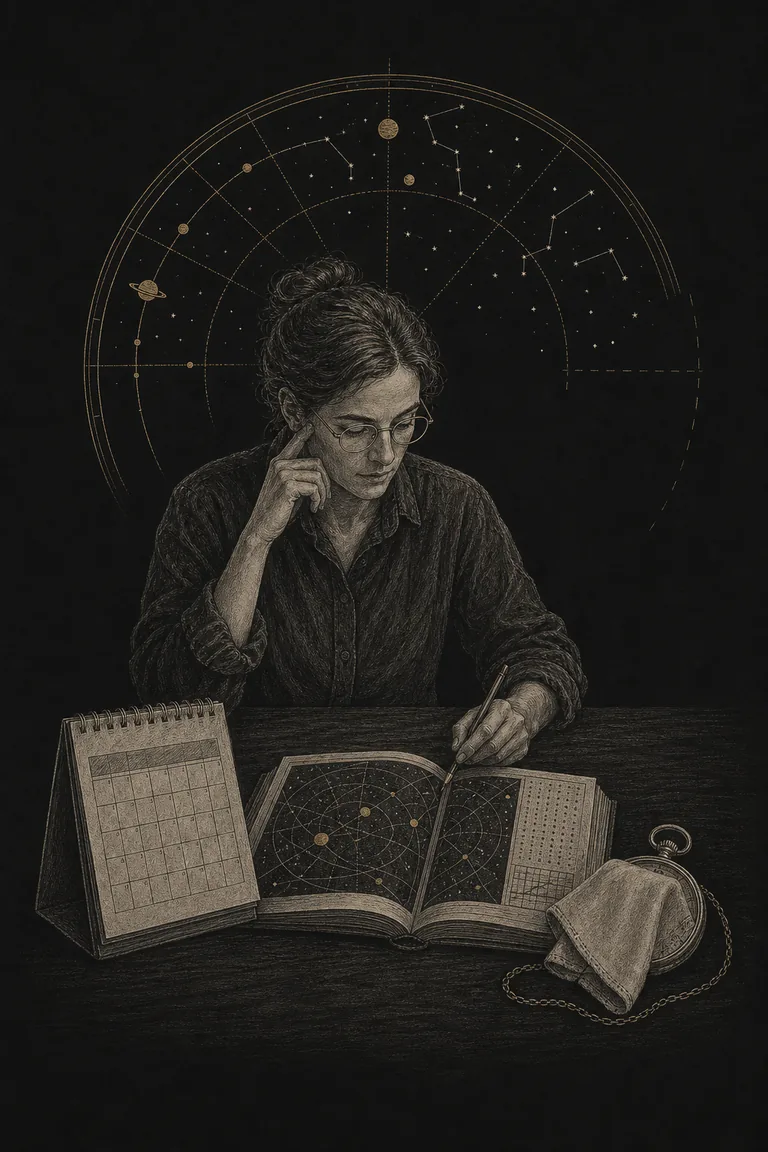
Secondary progressions use a symbolic day-for-a-year clock: each ephemeris day after birth represents one year of life, with method choices kept separate from transits.
Secondary progressions are an astrology timing technique that maps one day after birth to one year of life. To study age thirty, a direct secondary progression examines planetary positions roughly thirty days after the recorded birth moment. Those progressed positions are then compared with the natal chart and, when useful, with each other. The progressed date is a symbolic key, not the calendar date when an event must occur.
The calculation is simpler than primary directions, but it still has important settings. Birth time and time zone, exact age, fractional days, direct or converse motion, house and angle method, aspect set, and orb can change the output. The progressed Moon moves quickly enough that small timing choices matter. Secondary progressions cannot guarantee events, diagnose a condition, or prove that a life phase has one predetermined meaning.
Take the next insight with you
Explore personalized Astrology guidance in Veritas, available for iOS and Android.
 Scan with your phone
Secondary progressions at a glance
The day-for-a-year key
The direct method moves forward in the ephemeris from the birth moment. One completed year corresponds to one completed day, and a fraction of a year corresponds to the same fraction of a day. The technique does not speed the planets up in real space. It uses their actual motion during the first weeks or months after birth as a symbolic miniature of later years.
A checkable progressed-date example
Convert age 30 years and 6 months with the day-for-a-year key
30 years + 6/12 year = 30.5 years
30.5 years x 1 ephemeris day per year = 30.5 ephemeris days
0.5 ephemeris day x 24 hours = 12 hours
For a birth at 08:00 UTC, this simplified target lies thirty days and twelve hours after the birth date, at about 20:00 UTC on the thirtieth later date. Calendar counting must handle month boundaries and leap days correctly. Software may map the target by exact elapsed tropical years or by another stated convention, so preserve both the target civil date and the calculated progressed timestamp.
Progressed date and target date are not the same
The target date is the real-life date being studied. The progressed date is the early-life ephemeris timestamp selected by the symbolic key. A chart labelled only with the progressed date can look as if it describes a newborn several weeks old. Record the target age, target date, birth timestamp, progressed timestamp, time scale, zodiac, and geocentric settings so the result can be reproduced.
What each progressed planet can show
The Sun advances roughly one zodiac degree per ephemeris day, so it moves about one degree per progressed year. Mercury and Venus can change speed, station, or reverse during the post-birth interval. Mars moves more slowly, while Jupiter through Pluto usually change little by degree over an ordinary lifespan, though a station or exact aspect may still be emphasized. Interpret only changes that actually appear in the calculated ephemeris.
Why the progressed Moon gets special attention
The Moon travels roughly twelve to fifteen degrees per ephemeris day, which becomes about that amount per progressed year. It completes the zodiac in approximately twenty-seven to twenty-eight progressed years and changes sign about every two to two and a half years. These are useful scale estimates, not fixed appointment dates. The Moon's variable speed means an exact calculator is better than assuming one degree per month.
Progressed lunar phases
The angular relationship between progressed Sun and progressed Moon creates a progressed lunation cycle. A progressed New Moon begins a new roughly twenty-nine-year phase; quarters and the progressed Full Moon mark later relationships within that cycle. These labels describe symbolic phase geometry. They do not guarantee a beginning, crisis, peak, marriage, pregnancy, career change, or public event.
Progressed angles and houses need a declared method
Planetary progressions can be read against natal houses without progressing the cusps. Some software also offers progressed angles or houses, but it may use the progressed chart's apparent rotation, the solar arc of the Midheaven, a quotidian method, or another algorithm. Those options can produce different Ascendants and house positions. Name the house system, location, sidereal-time method, and whether natal or progressed cusps are displayed.
Direct, converse, and quotidian variants
Direct secondary progressions move forward after birth. Converse progressions move backward before birth, but programs can differ in how they map civil dates and fractions. Quotidian progressions advance the angles through a daily rotational scheme while the progressed planets follow a chosen progression key. Do not combine results under one generic progressed-chart label. Save each variant as a separate calculation.
Aspects and practical orbs
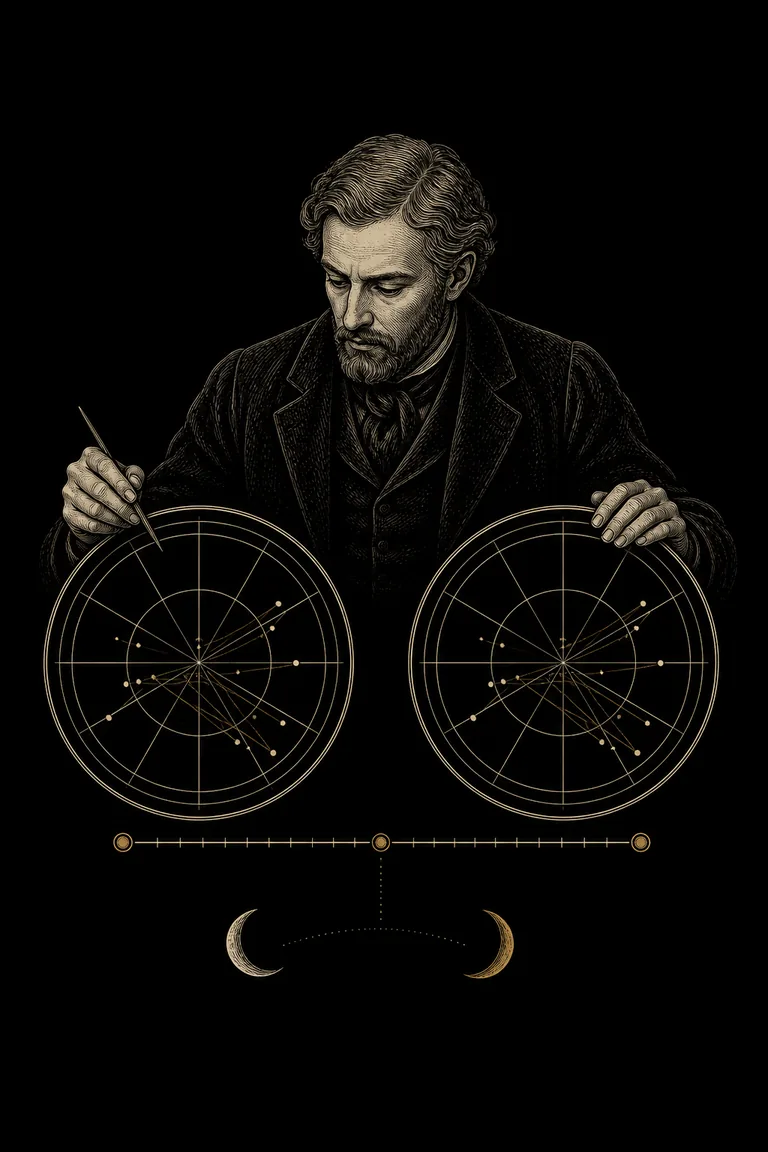
Progressed-to-natal aspects compare a progressed factor with a natal point. Progressed-to-progressed aspects compare two progressed positions. Many practitioners use tight orbs, often near one degree, because the technique changes slowly, but there is no universally binding orb. Declare the aspect family and orb before reviewing life events. Note applying, exact, and separating phases rather than treating the whole multi-year window as one instant.
How to audit a secondary-progressions calculator
- Verify the birth timestamp
Check local time, UTC conversion, daylight-saving rule, place, and time confidence.
- Record the target
Save the real target date, exact age, and whether the program uses elapsed years or a birthday convention.
- Check the progressed timestamp
Recalculate one age with the one-day-per-year key, including the fractional day.
- Name chart settings
Record zodiac, geocentric or topocentric frame, house system, angles, and direct or converse method.
- Verify one position
Compare the progressed Moon or Sun with a trusted ephemeris before interpretation.
Secondary progressions versus transits
Transits use the actual astronomical sky on the target date. Secondary progressions use an early-life ephemeris date selected by the symbolic day-for-a-year key. A transit Saturn aspect and a progressed Moon aspect may be compared after each is calculated independently, but one should not be substituted for the other. Adding transits only after an event is known encourages hindsight fitting.
Secondary progressions versus solar arcs and primary directions
Solar arc directions move every natal point by one common arc derived from the progressed Sun. Secondary progressions let each planet keep its own ephemeris motion. Primary directions derive a spherical rotation arc and convert it with a timing key. All three may produce motion near one degree per year for particular factors, but their geometry and moving roles are different. Keep their outputs separately labelled.
Secondary progressions versus annual profections
Annual profections advance one sign or house per year and identify a time lord. They do not calculate post-birth ephemeris positions. A practitioner may use the profected house to frame a question and then inspect a progressed aspect, but that synthesis should not erase the separate rules. Calculate first, state the hypothesis, and preserve years when the expected theme is not obvious.
Keep every progressed chart reproducible
Use Veritas to save birth-data confidence, target date and age, progressed timestamp, direction, zodiac, frame, house and angle method, aspect, orb, natal context, evidence, and misses.
Interpretation without a predetermined event
Begin with the natal meaning of the progressed body and the point it contacts, including houses, rulerships, aspects, and current relevance. Then describe a narrow process, not an outcome. A progressed Venus aspect is not automatically romance, and a progressed Saturn contact is not automatically loss. Use a time window appropriate to the body's speed and compare ordinary periods as carefully as memorable events.
Limits and responsible use
Secondary progressions cannot diagnose illness, determine lifespan, reveal another person's private thoughts, or guarantee marriage, pregnancy, separation, wealth, employment, legal outcomes, relocation, or public success. Birth-time uncertainty and method choices add real error. For consequential decisions, rely on records, medical care, contracts, budgets, direct communication, and qualified advice. Treat progressions as a symbolic chronology, not a validated forecasting system.