Astrology Journal
Solar Arc Directions in Astrology: Method and Calculation
Solar arc directions move every natal planet and point by one shared arc, usually the distance from the natal Sun to the secondary progressed Sun for a stated age.
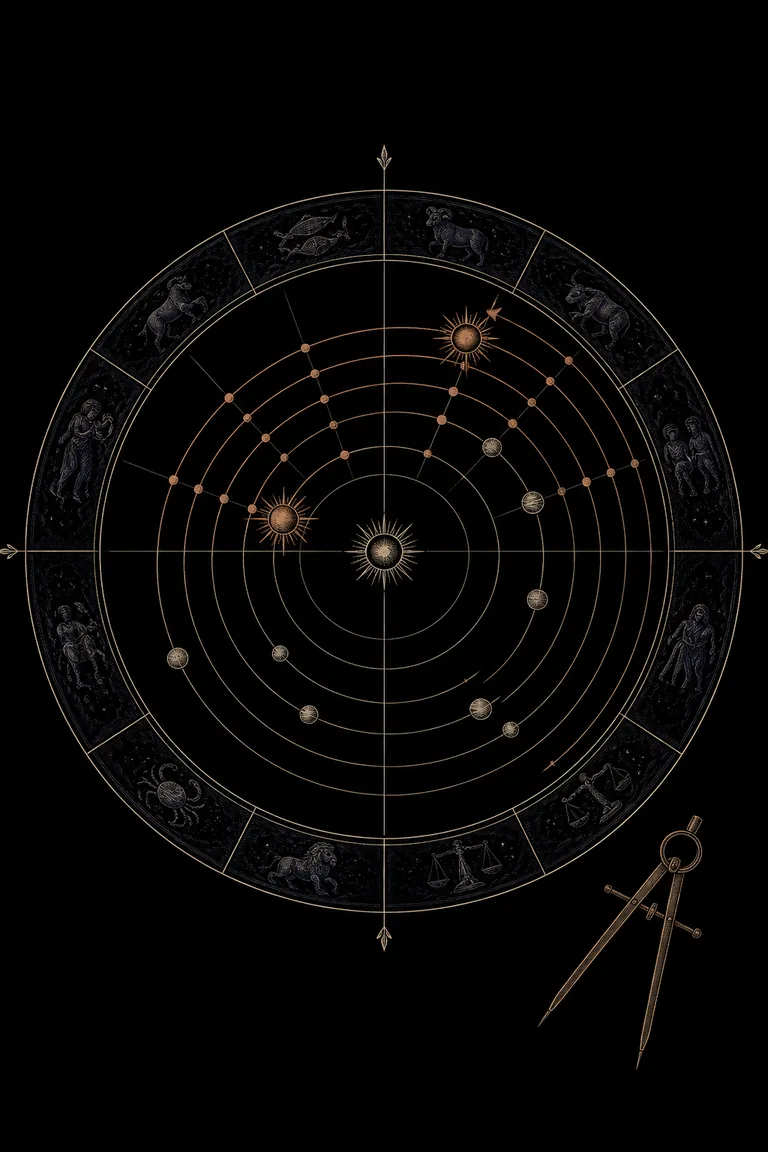
Solar arc directions are a symbolic astrology timing method. First calculate how far the secondary progressed Sun has moved from the natal Sun. Then add that same arc to every natal longitude. The directed chart is compared back to the natal chart, often through close aspects to planets and angles.
The method is often approximated as one degree per year, but a reproducible calculation must state whether it uses the true progressed-Sun arc or a mean arc. Birth time, target date, zodiac, direction, angle method, aspect set, and orb should remain visible. Solar arcs do not guarantee events or prove that a dated event had one astrological cause.
Take the next insight with you
Explore personalized Astrology guidance in Veritas, available for iOS and Android.
 Scan with your phone
Solar arc directions at a glance
How the true solar arc is calculated
For a target age, calculate the secondary progressed Sun with the day-for-a-year method. Measure its forward zodiacal distance from the natal Sun. That distance is the true solar arc. It reflects the Sun's actual variable ephemeris motion during the symbolic post-birth interval, so it is not always equal to the person's age in whole degrees.
A checkable longitude example
Apply a true solar arc of 30 degrees 18 minutes
Progressed Sun 42°48' - natal Sun 12°30' = solar arc 30°18'
Natal Mars 128°10' + 30°18' = directed Mars 158°28'
Natal Midheaven 341°55' + 30°18' = 372°13'
372°13' - 360° = directed Midheaven 12°13'
The same 30°18' is added to every included natal longitude. Values at or above 360° wrap back into the zodiac by subtracting 360°. Keep calculations in absolute longitude until the arithmetic is complete, then convert the result to sign and degree. This prevents sign-boundary errors.
True solar arc versus mean solar arc
A true solar arc comes from the actual secondary progressed Sun. A mean solar arc uses an average solar motion, commonly close to the Naibod rate of 0.9856 degrees per symbolic day or year. The results stay close but can differ enough to shift exactness by months when the orb is tight. Never combine contacts from both methods under one unlabeled timeline.
Why all directed planets keep natal geometry
Because every point receives the same addition, the angular distances among solar arc directed planets remain the same as their natal distances. New information appears when a directed planet or angle reaches an aspect with a natal target. A directed-to-directed trine that was not present at birth cannot be created by uniform rotation. Software that seems to show one should be checked for mixed chart layers.
Angles require accurate birth data and a named method
Adding the arc directly to the natal Midheaven is straightforward in zodiacal longitude. Programs may derive the directed Ascendant and intermediate house cusps from the directed Midheaven, latitude, and a table or house algorithm, or simply add the arc to every cusp. Those approaches are not identical. Record the birth-time confidence, location, house system, and angle method before interpreting an angular contact.
Which aspects and orbs to use
Many modern practitioners prioritize conjunctions, squares, and oppositions with an orb near one degree or less. Others include sextiles, trines, semisquares, sesquisquares, or midpoints. There is no universally binding aspect set. Declare the set and orb before scanning the timeline, and distinguish applying, exact, and separating contacts. A wider orb creates a longer and less discriminating window.
How to audit a solar arc calculator
- Verify the natal chart
Check timestamp, UTC conversion, place, zodiac, frame, and birth-time confidence.
- Record the target
Save the civil target date, exact age, and day-for-a-year convention.
- Recalculate the Sun
Compare natal and progressed Sun longitudes and reproduce the stated arc.
- Check one directed point
Add the exact arc to one natal longitude and wrap at 360 degrees.
- Name the comparison rules
Record direct or converse motion, angle method, aspect set, orb, and natal targets.
Solar arcs versus secondary progressions
Secondary progressions let each planet follow its own ephemeris motion after birth. Solar arcs borrow only the progressed Sun's arc and give it uniformly to the other natal factors. The progressed and solar arc Sun coincide when the same true-arc settings are used, but the progressed Moon, Mercury, Venus, and other bodies usually do not coincide with their solar arc counterparts.
Solar arcs versus primary directions
Primary directions derive arcs from diurnal rotation on the celestial sphere and convert arc to time with a key. Solar arc directions rotate zodiacal longitudes by a common solar measure. Similar language and an approximate one-degree-per-year scale can hide different geometry. Preserve the technique name, coordinate choices, moving role, and timing key in every record.
Solar arcs versus transits
Transits use actual planetary positions on the real target date. Solar arcs use symbolic directed positions derived from the natal chart. A transit may be compared with a solar arc contact after both are calculated independently, but it should not be added only because a known event needs confirmation. Keep ordinary dates and misses in the comparison set.
Keep every solar arc reproducible
Use Veritas to save birth-data confidence, target date, progressed Sun, true or mean arc, directed position, natal target, aspect, orb, angle method, evidence, and misses.
Interpret contacts without forcing events
Describe the two symbols and natal houses before naming a possible process. A directed Mars contact can concern action, conflict, effort, or assertion; it does not automatically mean injury. A directed Venus contact can concern values, attraction, agreement, or resources; it does not guarantee a relationship. Compare the hypothesis with dated records and plausible non-astrological explanations.
Limits and responsible use
Solar arc directions cannot determine lifespan, diagnose illness, reveal another person's intentions, prove a cause, or guarantee marriage, separation, pregnancy, death, employment, wealth, relocation, or legal outcomes. Exact-looking dates still depend on birth data, ephemeris settings, arc convention, angles, aspects, and orb. Use medical care, contracts, budgets, direct communication, and qualified advice for consequential decisions.