Astrology Journal
Sun, Moon, and Rising Signs: Your Big Three Explained
Your Sun, Moon, and rising signs are known as the Big Three in astrology. Each describes a different layer of experience, and their relationship explains far more than any one zodiac sign can on its own.
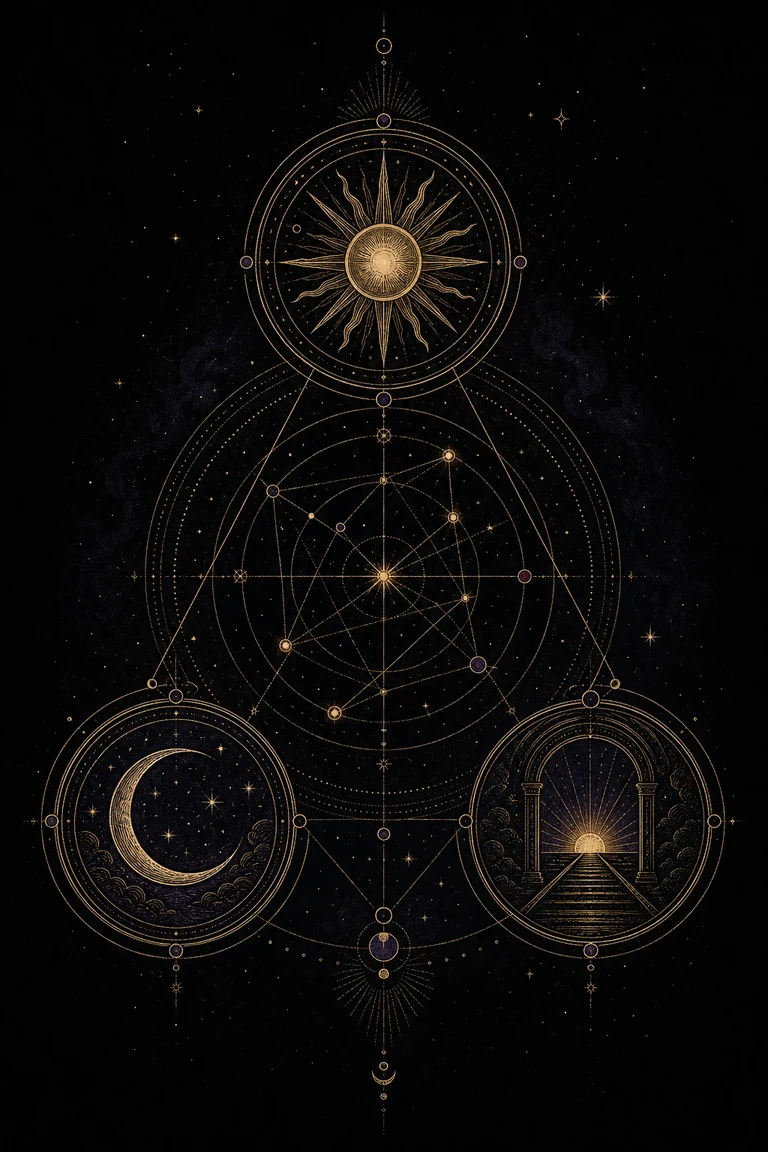
Most people meet astrology through their Sun sign. It is the sign associated with your birthday and the one used in newspaper horoscopes. A full birth chart contains much more information, but the Sun, Moon, and rising sign offer a practical first portrait. Astrologers often call them the Big Three.
The Sun speaks to identity and direction. The Moon describes emotional needs and instinctive responses. The rising sign, also called the Ascendant, shows how you enter situations and sets the structure of the houses in your chart. Understanding all three helps explain why two people born under the same Sun sign can feel completely different.
Take the next insight with you
Explore personalized Astrology guidance in Veritas, available for iOS and Android.
 Scan with your phone
What are the Big Three in astrology?
The Big Three are the zodiac signs occupied by the Sun, the Moon, and the eastern horizon at the time of birth. The Sun and Moon are astronomical bodies placed in signs. The rising sign is not a planet. It is the sign that was ascending on the eastern horizon, which is why it is also called the Ascendant.
These three points are popular because they give beginners a manageable way into the natal chart. They do not replace the planets, houses, aspects, or chart ruler. Think of them as three strong opening sentences rather than the complete story.
How to find your Sun, Moon, and rising signs
- Confirm your birth date
Your date usually identifies the Sun sign. People born near the day the Sun changes signs should use a chart calculation rather than relying on a generic date range.
- Find the most accurate birth time available
The rising sign changes roughly every two hours, though the exact timing varies by latitude. Even a modest time error can change the Ascendant near a sign boundary.
- Use the place of birth
A chart calculator needs the birth location to establish the local horizon, geographic coordinates, and historical time zone used for the Ascendant and houses.
- Calculate one complete natal chart
Read the Sun sign, Moon sign, and Ascendant from the same chart so the settings remain consistent. Save the chart before moving into interpretation.
Your Sun describes the life you are learning to inhabit, your Moon describes what restores you, and your rising sign describes how you meet the world.
What your Sun sign means
The Sun represents vitality, conscious identity, purpose, and the qualities through which you develop confidence. It often becomes more recognizable as you make deliberate choices and take responsibility for the direction of your life. It is not merely a list of personality traits you display at all times.
A Capricorn Sun may build identity through competence, patience, and meaningful responsibility. A Gemini Sun may become more fully itself through curiosity, language, exchange, and the ability to connect different ideas. The house of the Sun shows where that identity seeks expression, while aspects describe how easily it works with other parts of the chart.
What your Moon sign means
The Moon concerns emotional rhythm, memory, attachment, instinct, and the conditions that help you feel safe enough to respond naturally. Its sign often appears in private life, under stress, or in close relationships where there is less need to perform a social role.
An Aries Moon may process feeling through immediate action and direct expression. A Taurus Moon may need consistency, sensory comfort, and enough time for emotions to settle. Neither response is inherently mature or immature. The Moon shows a need and a habit; experience determines how consciously it is lived.
See your Big Three in one connected chart
Create your natal chart in Veritas and explore how your Sun, Moon, and rising signs combine with their houses, rulers, and major aspects.
What your rising sign means
The rising sign describes your orientation toward unfamiliar life. It can appear in first impressions, body language, style, and the strategies you use when entering a new environment. Calling it a mask is often too shallow. The Ascendant is not necessarily false; it is the doorway through which the rest of the chart meets experience.
The Ascendant also places the twelve houses. A Leo rising chart begins with Leo on the first house and organizes the remaining signs around the wheel from that point. Because of this structural role, the rising sign affects much more than appearance. It identifies the chart ruler, one of the most useful threads for reading the chart as a whole.
Why an accurate birth time matters
The Moon moves through the zodiac much faster than the Sun, changing signs about every two and a half days. On some birth dates, it remains in one sign all day. On others, the recorded time decides between two possible Moon signs. The Ascendant moves faster still, so it cannot be calculated reliably from the date alone.
If your birth time is unknown, do not guess and present the result as fact. You can still work with placements that remain stable across the date. Check whether the Moon changes signs that day, and leave the rising sign and houses open until better information is available. Some astrologers use chart rectification, but it is an interpretive process rather than a guaranteed recovery of the exact time.
How to read your Big Three together
Begin by giving each placement a different job. Ask what the Sun is trying to develop, what the Moon requires for emotional steadiness, and how the Ascendant approaches the outside world. Then look for cooperation and tension. Similar signs may reinforce a quality, while contrasting elements can describe different needs that must take turns.
Imagine a Virgo Sun, Pisces Moon, and Sagittarius rising. The Virgo Sun may seek usefulness, precision, and steady improvement. The Pisces Moon may absorb atmosphere and need quiet space for feeling and imagination. Sagittarius rising may appear candid, mobile, and ready to explore. The person is not one of these descriptions. The portrait emerges from how discernment, sensitivity, and outward momentum learn to work together.
Use elements and modalities to spot patterns
Fire signs tend to emphasize initiative and inspiration, earth signs practicality and material continuity, air signs ideas and relationship through exchange, and water signs feeling and emotional connection. If all three placements share an element, that style may feel immediate. If each uses a different element, adaptation and internal translation may become important themes.
Modalities add another layer. Cardinal signs initiate, fixed signs sustain, and mutable signs adapt. A fixed Sun with a mutable Moon may pursue a stable direction while processing feelings through flexibility. These categories help organize observations, but they should not replace the actual signs, houses, and aspects involved.
What if two or three placements share a sign?
A repeated sign concentrates its style but does not make the three placements identical. A Cancer Sun and Cancer Moon may align conscious direction with emotional instinct, yet their houses can direct them toward different parts of life. If Cancer also rises, the Moon becomes the chart ruler, giving its placement and aspects additional importance.
Repetition can make a quality visible, but it can also make that quality difficult to notice because it feels normal from the inside. Look for both skill and overuse. Strong cardinal emphasis may bring initiative and impatience. Strong water emphasis may bring emotional perception and porous boundaries. Every repeated pattern needs context.
Let the chart ruler connect the Big Three to the full chart
The planet that rules the rising sign is called the chart ruler. Aries and Scorpio rising traditionally point to Mars, Taurus and Libra to Venus, Gemini and Virgo to Mercury, Cancer to the Moon, Leo to the Sun, Sagittarius and Pisces to Jupiter, and Capricorn and Aquarius to Saturn. Modern astrologers may also consider Uranus, Neptune, or Pluto for Aquarius, Pisces, or Scorpio.
Read the chart ruler by sign, house, and major aspects. A Libra rising person may seem diplomatic and relational, but Venus in the tenth house ties that orientation to vocation and public contribution. The chart ruler prevents the Ascendant from becoming a surface description and connects it to the rest of the life pattern.
The Big Three are a beginning, not a verdict
If you do not identify with one placement, first check the birth data and then examine its house, ruler, and aspects. A planet under pressure may be harder to express directly. A Sun in the twelfth house can feel less publicly obvious than the same Sun near the Midheaven. Culture, family, health, identity, and lived experience also shape how any symbolic pattern is expressed.
Astrology is a symbolic interpretive tradition and is not scientifically validated as a method for measuring personality or predicting events. Use the Big Three as prompts for reflection, not proof of character or compatibility. The most useful interpretation gives language to a pattern while leaving room for choice, contradiction, and change.
FREE CALCULATOR · PRIVATE BY DESIGN
Sun Moon Rising Calculator
Calculate your Sun, Moon, and Rising signs from exact birth time and place using a local astronomical engine and historical timezone rules.