Astrology Journal
Tertiary Progressions in Astrology: T I and T II
Tertiary progressions are symbolic timing methods based on lunar-month ratios. Tertiary I maps one ephemeris day to one tropical month of life, while Tertiary II maps one tropical month after birth to one year of life.
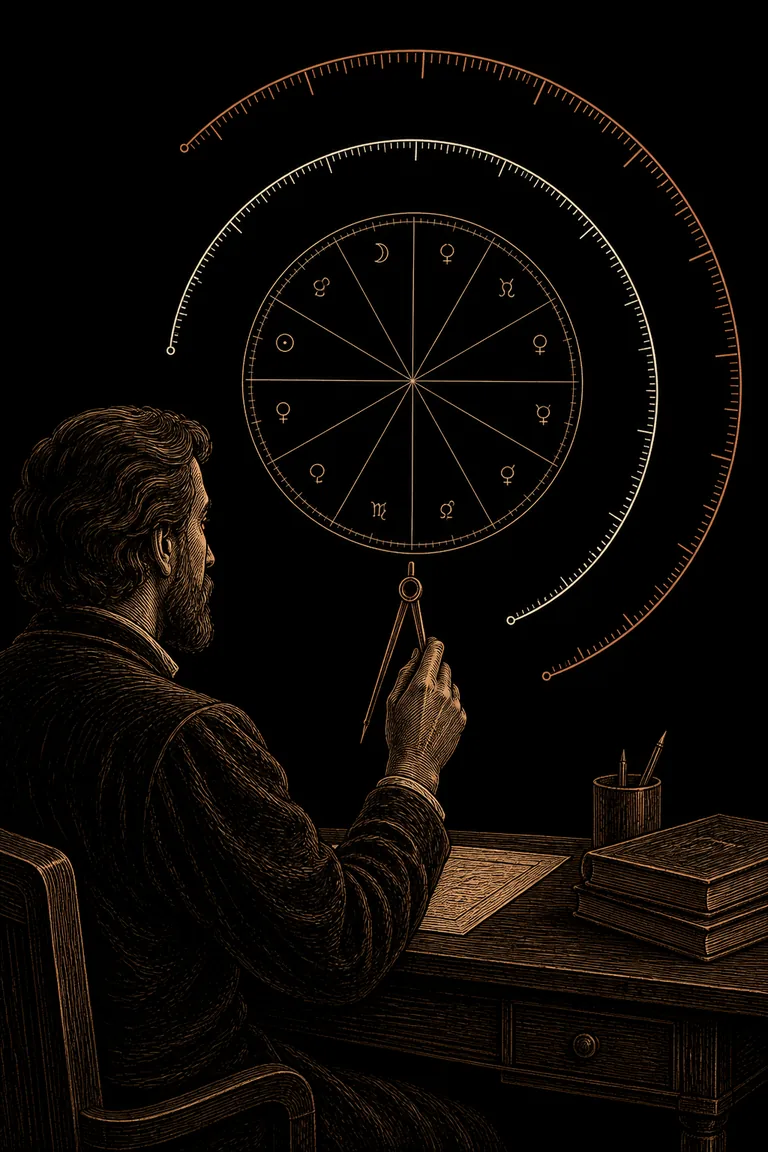
Tertiary progressions in astrology need a method label before interpretation. In Tertiary I, one day of planetary motion after birth corresponds to one tropical lunar month of lived time. In Tertiary II, one tropical lunar month of ephemeris time corresponds to one tropical year of life. The two charts are not interchangeable, even though software and articles may use overlapping names.
A reproducible calculation records the birth timestamp, target timestamp, elapsed civil time, lunar-month constant, year constant, forward or converse direction, zodiac, coordinates, houses, and angle method. Astrodienst documents 27.32158218 days as the tropical-month key for these chart types. Tertiary charts are symbolic constructions, not scientific forecasts, and exact-looking contacts do not guarantee events.
Take the next insight with you
Explore personalized Astrology guidance in Veritas, available for iOS and Android.
 Scan with your phone
Tertiary progressions at a glance
How Tertiary I works
Tertiary I counts elapsed life in tropical months, then advances the ephemeris by the same number of days after birth. Because each life month uses 27.32158218 days in this convention, the converted chart advances roughly one ephemeris day per month of life. Some implementations change only after a completed month, while others interpolate continuously. State whether the chart is stepped or continuous.
A checkable Tertiary I example
Convert 273.2158218 elapsed life days with the tropical-month key
273.2158218 life days / 27.32158218 days per tropical month = 10 tropical months
10 tropical months x 1 ephemeris day per month = 10 ephemeris days
Birth timestamp + 10 ephemeris days = Tertiary I chart timestamp
This example isolates the ratio. A production calculator should use precise elapsed time rather than assuming every civil month has the same length. Save the UTC birth and target timestamps, the time scale used by the ephemeris, and the full converted timestamp. Rounding the number of months too early can move the Moon and angles substantially.
How Tertiary II works
Tertiary II converts elapsed tropical years of life into the same number of tropical months after birth. Using 365.242199 days for a tropical year and 27.32158218 days for a tropical month, an age of 30 tropical years advances the ephemeris by 30 tropical months, about 819.65 days. Astrodienst associates this Tertiary II method with Klaus Wessel. Record the exact constants rather than using a casual month-for-a-year slogan.
Why the word month causes confusion
A tropical month tracks the Moon's return to the same ecliptic longitude relative to the equinox and is about 27.32 days. A synodic month tracks lunar phases and is about 29.53 days. Calendar months vary from 28 to 31 days. Some sources casually call the 27.32-day key sidereal or synodic, or use minor progression for a month-for-a-year method. Do not repair the ambiguity silently. Name the constant and formula that produced the chart.
Tertiary progressions and minor progressions
Naming is not consistent across schools. Some writers reserve tertiary progression for day-for-month and call month-for-year minor or quaternary progression. Others use Tertiary I and Tertiary II for both lunar ratios. Search intent often blends them. The safe comparison is mathematical: identify the elapsed life unit, the ephemeris unit, the month definition, and whether the motion is direct or converse.
Angles, houses, and birth time
A small change in the converted timestamp can noticeably alter the Midheaven, Ascendant, and houses. Software may calculate a progressed chart for the converted place and time, retain the natal location, relocate it, or use a specialized angle method. Those choices are not equivalent. If birth time is uncertain, prioritize planetary longitudes and disclose that angular and house claims are especially unstable.
How to audit a tertiary progression calculator
- Name the method
Write Tertiary I, Tertiary II, minor, quaternary, direct, or converse exactly as the software does.
- Capture the constants
Record the tropical-month and tropical-year lengths instead of assuming a calendar month.
- Reproduce elapsed time
Calculate exact age from timestamps and show the conversion to ephemeris time.
- Verify one longitude
Check the converted date in a trusted ephemeris and compare one fast and one slow body.
- Record chart settings
Save zodiac, frame, coordinates, location, houses, angles, aspects, and orb.
Aspects and comparison layers
Practitioners may compare tertiary positions with natal factors, with other tertiary positions, or with transits to the target date. These are separate layers. Use a declared aspect set and a narrow, preselected orb, then distinguish applying, exact, and separating contacts. Do not add wider aspects or another tertiary method after learning an event date merely to create a match.
Tertiary versus secondary progressions
Secondary progressions map one ephemeris day to one tropical year of life. Tertiary I reaches about twelve ephemeris days during one life year, so its planets, especially the Moon and angles, change more quickly across the year. Tertiary II advances by about one 27.32-day month per life year. Each ratio creates a different symbolic date and should be calculated independently.
Tertiary versus solar arcs and transits
Solar arc directions add one shared arc to natal positions, while tertiary progressions use actual ephemeris positions at a converted post-birth timestamp. Transits use real planetary positions on the target date. Similar aspect language can hide these different constructions. Keep symbolic dates, real dates, moving bodies, natal targets, and orbs in separate fields.
Make the converted date auditable
Use Veritas to save the method label, constants, birth and target timestamps, elapsed time, converted timestamp, chart settings, contacts, evidence, alternatives, and misses.
Interpretation without false precision
Read a contact as a limited symbolic hypothesis. Tertiary Moon to natal Saturn might frame questions about emotional pacing, duty, limits, or support; it does not diagnose depression or predict loss. A tertiary angle contact may focus attention on visibility or relationship, but its reliability depends heavily on birth time and angle calculation. Compare hypotheses with dated records and ordinary causes.
Limits and responsible use
Tertiary progressions cannot determine lifespan, diagnose illness, recover facts, reveal another person's intentions, or guarantee marriage, separation, pregnancy, death, employment, wealth, relocation, or legal outcomes. Different method names and constants can produce different charts that all look precise. Use medical care, contracts, budgets, direct communication, and qualified advice for consequential decisions. Astrology is a symbolic interpretive practice, not a scientifically validated forecasting method.