Astrology Journal
Under the Beams in Astrology: Meaning and Orbs
A planet under the beams is close enough to the Sun to be obscured by solar light under a declared traditional orb, but it may lie outside the narrower zone of combustion. Exact distance, phase, dignity, and context all matter.
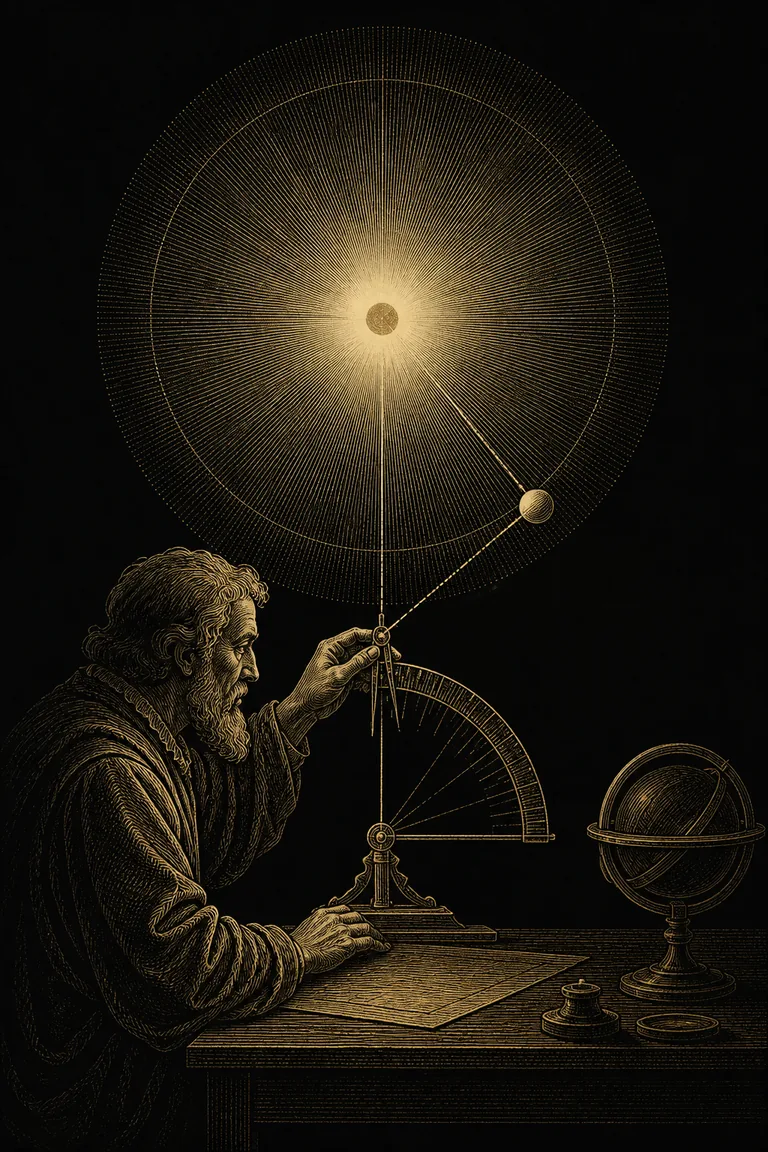
In traditional astrology, a planet is under the beams when it is within a wider distance of the Sun associated with reduced visibility. Many astrologers use about 15 degrees, while some use 17 degrees or another source-specific boundary. In a common tiered method, a planet between 8 degrees 30 minutes and the chosen outer boundary is under the beams but not combust.
The label describes one solar condition, not a complete judgment. It does not prove that a person is shy, deceptive, powerless, unnoticed, or destined to work in secret. Calculate the shortest zodiacal distance, state the rule, and then judge the planet's phase, motion, dignity, reception, house, rulerships, sect, aspects, and real circumstances.
Take the next insight with you
Explore personalized Astrology guidance in Veritas, available for iOS and Android.
 Scan with your phone
What does under the beams mean in astrology?
Under the beams describes a planet enveloped by the Sun's bright vicinity and therefore less independently visible. Traditional authors used solar visibility as one way to assess a planet's accidental condition. The symbolism can suggest concealment, enclosure, dependence on solar priorities, limited public expression, or a process not yet fully seen. These are hypotheses tied to the planet's actual topics. The condition is milder and wider than combustion in many modern traditional workflows, but terminology varies by source.
Save the rule with the chart
In Veritas, record exact longitudes, separation, the selected outer-beam and combustion thresholds, phase, motion, dignity, reception, and chart topics.
The 15-degree and 17-degree rules
There is no single threshold used by every tradition. A common practice marks the beams at 15 degrees from the Sun; another extends the condition to 17 degrees. Some sources distinguish planet-specific visibility or use different technical language. Choose one documented method before inspecting the result and keep it consistent across comparable charts. A software label is incomplete unless you know its configured orb and whether it also labels combustion separately.
How to calculate whether a planet is under the beams
- Record exact longitudes
Use positions from the same chart, zodiac, and coordinate convention.
- Find the shortest distance
Subtract the two positions and use the smaller arc around the 360-degree zodiac.
- Test cazimi and combustion first
Apply the narrow conditions before using the wider under-the-beams category.
- Apply the outer boundary
Compare the remaining separation with the disclosed 15-, 17-, or source-specific rule.
- Record direction and context
Check applying or separating motion, phase, latitude, dignity, reception, house, and rulerships.
Cazimi, combust, and under the beams
A widely used tiered model places cazimi within 17 arcminutes of the Sun, combustion outside cazimi to about 8 degrees 30 minutes, and under the beams beyond combustion to 15 or 17 degrees. These are conventional boundaries, and other sources differ. Do not call every Sun conjunction cazimi or every planet inside 15 degrees combust. State the doctrine and preserve borderline uncertainty instead of selecting the label with the most dramatic meaning.
Applying to the Sun or emerging from the beams
A planet applying toward conjunction is moving deeper into solar proximity. A separating planet has passed conjunction and may be moving toward greater elongation and eventual visibility. Traditional electional and horary work may treat these directions differently because one condition is developing and the other is releasing. Verify daily motion and retrogradation. Wheel position alone can mislead, especially for Mercury and Venus near their stations.
Morning and evening visibility
A planet can rise before the Sun as a morning star or set after it as an evening star. Its synodic phase adds information that a single longitude distance cannot supply. Actual naked-eye visibility also depends on latitude, declination, brightness, atmospheric conditions, season, horizon, and the planet itself. The astrological orb is a repeatable symbolic model, not a guarantee that an observer can or cannot see the body from a particular place.
Mercury under the beams
Mercury frequently travels within the Sun's beams because its elongation is limited. The condition may frame thinking, messages, trade, craft, or coordination as closely tied to solar priorities or not yet independently visible. It does not diagnose low intelligence, dishonesty, silence, or hidden intent. Ask what Mercury rules, whether it is direct or retrograde, its speed, sign dignity, reception from the Sun, house, phase, and the person's observable communication.
Venus under the beams
Venus under the beams can place values, agreements, attraction, pleasure, aesthetics, or resources near the solar agenda. Morning or evening phase and movement toward or away from the Sun help distinguish the process. The condition is not proof of a secret relationship, low self-worth, artistic gifts, infidelity, or poor finances. Relationship interpretation still depends on consent, behavior, shared circumstances, and the rest of the chart.
Mars, Jupiter, and Saturn under the beams
The superior planets also pass through the beams around conjunction with the Sun. Their topics may be less independently visible or more tightly organized around solar aims for a time. Mars may concern action, Jupiter judgment or growth, and Saturn limits or maintenance, but the label cannot predict conflict, success, illness, authority, or failure. Because their cycles and brightness differ from Mercury and Venus, phase and actual sky context deserve explicit attention.
Dignity, reception, and support
Under the beams is one accidental condition. Essential dignity describes a planet's zodiacal resources, while reception describes how planets host or assist one another under the chosen system. A planet can be under the beams and dignified, received, angular, or otherwise supported. It can also face several constraints at once. Do not cancel one testimony mechanically with another. Translate the combination into a proportionate statement about the specific house and rulership topics involved.
Under the beams in a natal chart
In natal work, treat the condition as a recurring way that a planetary function relates to visibility, authorship, authority, or concentration. Test the idea against life history rather than converting it into a fixed personality label. A planet ruling the second house raises different questions from one ruling the seventh or tenth. Ask where the person has agency, what remains private by choice, and whether reduced visibility is protective, frustrating, temporary, or simply irrelevant in practice.
Under the beams in horary and electional astrology
Horary practice may use the condition as testimony that a significator or matter is concealed, constrained, or absorbed by another priority. Electional practice may avoid placing an important significator too close to the Sun when independent visibility matters. Neither use should stand alone. Confirm radicality, significators, houses, aspects, reception, timing, and the real-world requirements of the question. Never use the label to allege fraud, diagnose danger, or bypass legal, medical, or financial evidence.
Worked example with a 15-degree boundary
Suppose the Sun is at 10 degrees Taurus and Mercury is at 22 degrees Taurus. Their separation is 12 degrees. Under a method using 8 degrees 30 minutes for combustion and 15 degrees for the beams, Mercury is under the beams but not combust. Next determine whether Mercury is applying or separating, morning or evening, direct or retrograde, and what it rules. The distance establishes the category, not the final interpretation.
Worked example across a sign boundary
If the Sun is at 27 degrees Gemini and Venus is at 9 degrees Cancer, the shortest longitude separation is 12 degrees, not 342. A distance-based 15-degree method places Venus under the beams. Some doctrines handle cross-sign bodily conjunctions differently, so disclose that rule as well. Do not ignore the measured proximity or switch sign-boundary rules only because one classification better fits the desired story.
Latitude and literal visibility
Two bodies can share similar zodiacal longitude while differing in celestial latitude. That geometry, plus brightness and local observing conditions, affects whether a planet is literally visible. Many astrological techniques simplify the question to longitudinal distance for consistency. This simplification is useful if named honestly. If your claim is about historical heliacal rising or real observational visibility, use an appropriate astronomical model rather than treating a generic orb as direct observation.
Keep solar proximity in full context
Use Veritas to save the source rule, calculations, phase, dignity, reception, house topics, supporting testimony, contradictions, and real evidence.
A responsible interpretation workflow
- Name the source
State the chosen outer-beam, combustion, and cazimi thresholds.
- Show the distance
Record exact positions and the shortest longitudinal separation.
- Identify direction
Check applying, separating, direct, retrograde, and station conditions.
- Add phase and visibility
Note morning or evening phase and whether literal visibility is relevant.
- Judge planetary resources
Review dignity, reception, sect, speed, house, aspects, and angularity.
- Connect specific topics
Interpret the planet and the houses it rules rather than the whole person.
- Test against evidence
Keep conclusions that fit observable circumstances and preserve contradictions.
Common under-the-beams mistakes
Avoid hiding the orb, confusing the beams with combustion, ignoring cazimi, reading distance from a chart wheel by eye, and forgetting the shortest path across zero degrees. Do not equate symbolic concealment with deception, weakness, illness, or lack of talent. A planet under the beams remains a complete planet in a complete chart. The label narrows one technical question and should narrow, not inflate, the claim you make.