Tarot Journal
Eight of Swords Tarot Meaning: Constraints and Clarity
The Eight of Swords often depicts restriction, but it does not say every barrier is imaginary. Its useful question is which limits are fixed, which are assumed, and which can be tested safely.
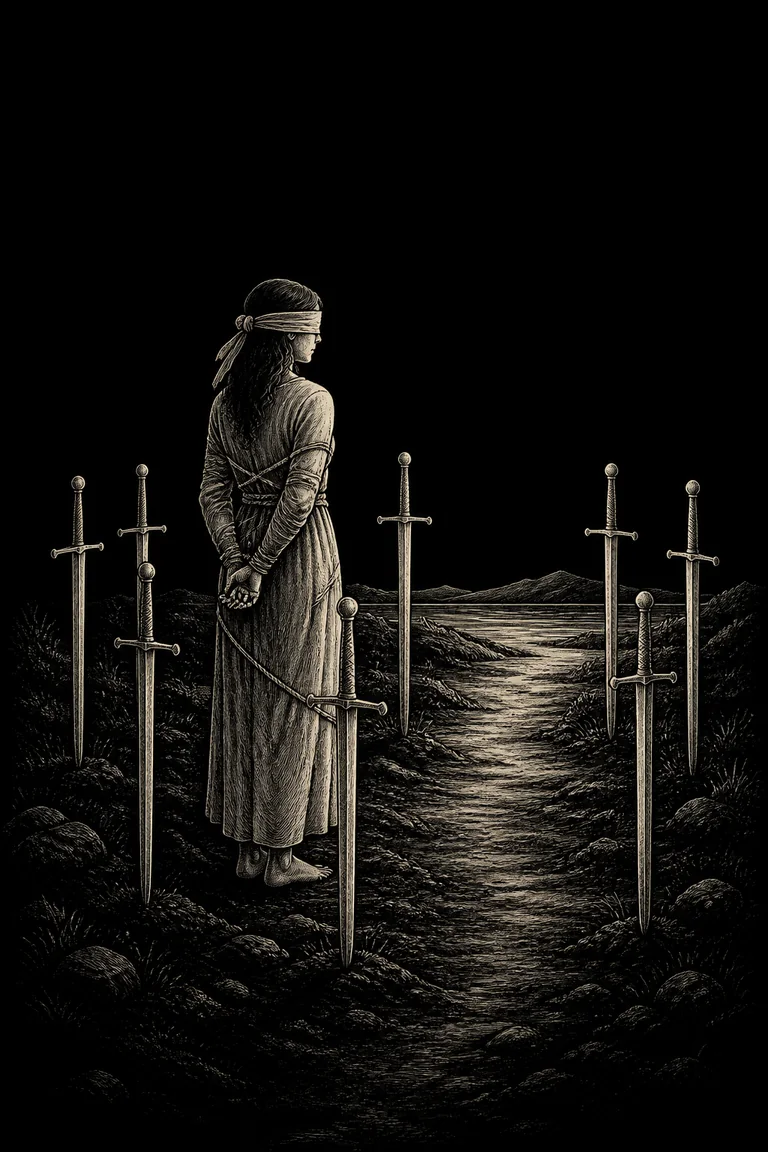
The Eight of Swords Tarot meaning centers on constraint, narrowed attention, and the difficulty of acting when information or confidence is limited. In the familiar Rider-Waite-Smith image, a blindfolded, loosely bound figure stands among eight swords. The scene can describe a real restriction, an unverified belief about what is possible, or both at once.
A careful reading does not tell someone to simply think positively or blame them for structural barriers. It separates facts from predictions, names who controls the situation, and looks for one safe way to gather better evidence. Upright, the card often emphasizes feeling trapped or operating inside a narrow frame. Reversed, it may show a loosening constraint, new information, or the need to stop denying a genuine limit.
Take the next insight with you
Explore personalized Tarot guidance in Veritas, available for iOS and Android.
 Scan with your phone
Eight of Swords meaning at a glance
Symbols in the Eight of Swords
The blindfold limits sight, the bindings limit movement, and the swords create a threatening perimeter. Yet the arrangement is not a sealed wall, and the figure can often be read as having some room to move. Water or mud suggests emotional uncertainty and unstable footing, while the distant structure can represent authority, safety, or a system that feels hard to reach. These details create tension between real vulnerability and incomplete perception. Read the image as a question about evidence and access, not proof that escape is easy.
Upright Eight of Swords meaning
Upright, the Eight of Swords can appear when a problem has been compressed into two bad options, a rule has not been checked, or fear makes uncertain consequences feel inevitable. It can also describe genuine dependency on an employer, partner, institution, budget, contract, or caregiving arrangement. The practical work is classification. Mark each limit as fixed for now, controlled by another person, negotiable, unknown, or internally predicted. That distinction prevents both helplessness and reckless optimism.
Reversed Eight of Swords meaning
Reversed, the card may show a blindfold coming off, a restriction easing, or a person reclaiming enough agency to ask better questions. A new option can become visible through advice, documentation, training, savings, or support. The reversal can also expose the opposite problem: insisting that everything is fine while a real boundary is being crossed. If many possibilities suddenly appear, avoid rushing into the first exit. Compare risk, cost, consent, and reversibility before acting.
Eight of Swords in love and relationships
In a relationship reading, the Eight of Swords can describe a conversation that feels impossible, dependence that narrows choice, or assumptions about what a partner will say. Ask whether both people can speak freely, whether a no is respected, and whether practical resources affect the decision. For someone dating, the card may warn against treating anxiety as knowledge about another person. For an unsafe or controlling relationship, a Tarot interpretation is not a safety plan. Contact trusted support or a qualified local service and avoid actions that increase danger.
What someone may feel
As feelings, the Eight of Swords can indicate hesitation, self-consciousness, uncertainty, or fear of consequences. It does not reveal a private mind with certainty. Someone may care and still feel unable to act, or they may use confusion to avoid responsibility. Look at what they communicate, whether their behavior is consistent, and whether they respect boundaries. The card is more useful for choosing your response than for inventing an explanation they have not offered.
Career, work, and money
At work, this card can point to a restrictive role, unclear authority, missing qualifications, fear of asking, or a policy that nobody has verified recently. Collect the written requirements, identify the decision maker, and ask what evidence would change the answer. With money, distinguish a hard limit such as available cash from a forecast such as assuming no better terms exist. Do not treat the card as advice to quit, borrow, invest, or ignore contractual obligations. Use actual figures and qualified guidance for high-stakes decisions.
Advice, yes or no, and timing
As advice, the Eight of Swords says to reduce uncertainty before making an irreversible move. Ask for the rule in writing, seek an independent view, or test one assumption. For yes-or-no questions, it is a pause rather than a reliable yes or no: present conditions restrict action or the question lacks enough information. For timing, the card does not provide a dependable date. Progress is more likely to follow a verified permission, resource, conversation, or change in conditions than a calendar promise.
Eight of Swords combinations
With Justice, examine law, policy, documentation, and fair process. With the Devil, identify dependency, coercion, shame, or a binding agreement without assuming there is no exit. With the Star, hope becomes useful when paired with support and a concrete route forward. With the Magician, inventory the tools and skills already available. With the Six of Swords, a supported transition may be possible. With the Seven of Swords, check whether missing information comes from legitimate privacy, avoidance, or deliberate concealment.
How it differs from nearby Swords cards
The Six of Swords emphasizes passage and necessary distance. The Seven of Swords tests strategy, privacy, and accountability. The Eight focuses on restricted agency and the frame around available choices. The Nine of Swords, when present, places more emphasis on worry, guilt, and mental distress, while the Ten depicts a decisive ending or collapse. Keeping these intents separate prevents every difficult Swords card from becoming the same warning.
Map the constraint before choosing the exit
Use Veritas to record what is fixed, negotiable, controlled by others, unknown, or predicted, then choose one safe step that can produce better evidence.
A practical Eight of Swords constraint audit
- State the decision
Describe the exact choice or obstacle without turning it into a judgment about your worth.
- List the constraints
Include money, time, policy, safety, health, skills, consent, responsibilities, and other people's authority.
- Label the evidence
Mark what is documented, directly observed, reported by someone else, assumed, or still unknown.
- Find one opening
Choose a low-risk question, document, consultation, rehearsal, or small experiment that can clarify an unknown.
- Protect the downside
Set a stopping rule, preserve essential support, and involve qualified help where safety or high stakes are involved.
Common Eight of Swords mistakes
The most harmful mistake is claiming that a trapped person created every barrier through negative thinking. The opposite mistake is treating uncertainty as proof that no choice exists. Avoid diagnosing anxiety, trauma, or another person's motives from one card. Do not promise that courage alone will remove institutional, financial, medical, or legal constraints. Tarot is a symbolic reflective practice, not proof of future events. A grounded reading validates the real limit, tests the uncertain part, and measures progress through observable change.