Tarot Journal
No Minor Arcana in a Tarot Reading: What It Means
No Minor Arcana in a Tarot reading means every drawn card is a Major Arcana, a pattern that can widen the frame without proving fate, certainty, or loss of practical choice.
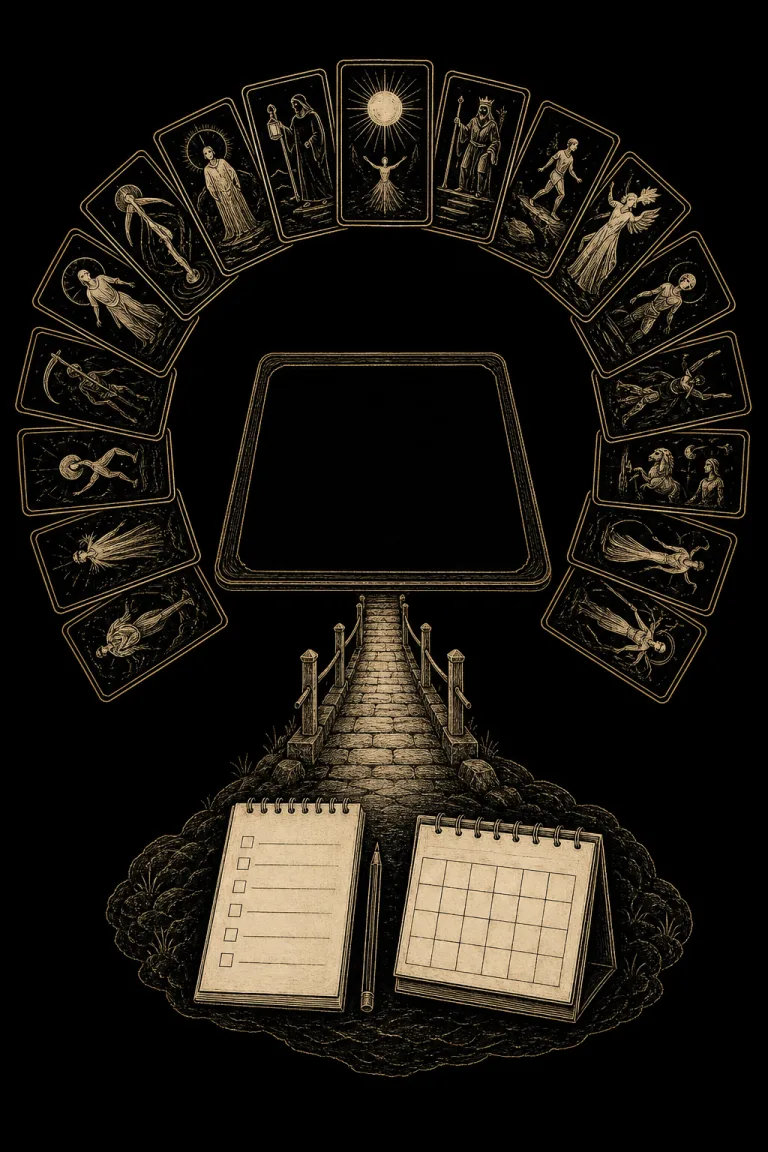
No Minor Arcana in a Tarot reading means that the recorded spread contains only Major Arcana cards. In a complete seventy-eight-card deck, this can invite attention to broad transitions, values, identity, authority, consequence, or a pattern that crosses more than one everyday situation. It does not prove that destiny has taken control, that every card predicts a large event, or that ordinary details no longer matter.
Treat the pattern as an unusual feature of one verified draw. Confirm that all fifty-six Minor Arcana were available, preserve the card count and positions, and read the Majors as a sequence rather than a chorus of dramatic keywords. Then translate each archetypal theme into a concrete question, evidence source, decision owner, proportionate action, and review point. The spread can widen inquiry while facts, consent, expertise, and real-world limits still govern action.
Take the next insight with you
Explore personalized Tarot guidance in Veritas, available for iOS and Android.
 Scan with your phone
No Minor Arcana at a glance
Verify that the Minor Arcana were available
A standard Tarot deck contains twenty-two Major Arcana and fifty-six Minor Arcana. Before interpreting an all-Majors spread, confirm that the deck was complete and properly mixed. A Major-only exercise, a separated packet, missing cards, duplicate cards, or a custom deck changes the denominator. Record whether two, three, or many cards were drawn. Two Majors in a two-card spread and ten Majors in a ten-card spread share an absence pattern, but the concentration and interpretive burden differ.
Unusual does not mean supernatural certainty
An unusual draw can feel compelling, especially when the question already carries emotion. Probability alone does not tell you what the cards mean, and the spread does not become external proof because its composition is uncommon. Do not calculate odds after the fact and then convert surprise into destiny. Preserve the event as observed, compare it with the deck procedure, and keep symbolic interpretation separate from claims about causation, prediction, or hidden intervention.
Read position before intensity
A Major Arcana card still answers the position it occupies. Justice in resources may point to criteria, records, or a fair process; in an obstacle it may expose unclear authority or inconsistent standards. The Hermit in advice may support a bounded period of independent review; in an outcome it can describe the isolation produced by current choices. Position turns the image into a sentence. Intensity should never erase grammar.
Read the cards as a sequence
Use the Major Arcana guide to identify each card's function, then track how the functions change across the spread. The Chariot followed by Justice may move from directed action into standards and accountability. Justice followed by the Hanged Man may move from a formal decision into delay, perspective, or surrender of one approach. Avoid blending the cards into a single claim that everything is important. Sequence preserves difference and movement.
Translate archetype into evidence
For every card, write one symbolic theme and one factual question. The Emperor may suggest structure, but the factual question is who has authority, which policy applies, and what can be appealed. The Moon may suggest uncertainty, but the factual question is which information is missing and how it can be checked. Death may suggest transition, but the factual question is what has actually ended, what continues, and who is affected. This translation prevents grand language from replacing observation.
Restore the practical layer deliberately
Minor Arcana normally provide detailed language for resources, communication, emotion, labor, conflict, exchange, and stages of work. Their absence does not remove those conditions from life. Consult the Minor Arcana meanings only as a practical checklist, not as permission to insert invisible cards. Ask about time, money, tools, health, messages, consent, workload, dependencies, and next steps because real decisions require them, not because an absent suit secretly appeared.
Agency remains visible
Major Arcana can describe forces larger than one immediate task, but they do not erase agency. Separate what the reader controls, influences, observes, and cannot control. Name the person or institution with actual decision rights. A card cannot grant authority that someone does not possess, obligate another person, waive consent, cancel a contract, or replace professional judgment. The most responsible reading often produces a smaller action than the imagery initially suggests.
Reversals change function, not reality
If you use reversals, keep the orientation method fixed. A reversed Major may suggest delay, internalization, excess, blocked access, refusal, or correction, depending on the card and position. It does not automatically predict disaster or make the all-Majors pattern more ominous. The reversed cards method begins with the upright function, names the exact change, and checks it against neighbors and facts.
Combinations need precise verbs
Use card combinations to describe relationships between adjacent functions. The Magician may initiate, Temperance may calibrate, and Judgement may review. That sequence suggests testing a capability, adjusting the method, and evaluating results. It does not guarantee successful manifestation or a cosmic verdict. Choose verbs that a reader can observe, such as request, compare, pause, document, revise, transfer, or end.
A six-step method for an all-Majors spread
- Verify
Record the complete deck, shuffle method, question, card count, positions, orientation rule, and exact draw.
- Sequence
Read each card in position and describe the change from one function to the next.
- Translate
Pair every archetypal theme with one factual question and an appropriate evidence source.
- Locate agency
Separate control, influence, observation, external authority, consent, and genuine constraints.
- Act proportionately
Choose one bounded action with an owner, cost, stop condition, and escalation route.
- Review
Set a date to compare the interpretation with outcomes, missing evidence, and changed conditions.
Worked relationship example
A three-position relationship spread shows The Lovers, Justice, and Temperance. The reader does not declare a destined marriage. The Lovers frames a values choice, Justice asks which agreements and facts support it, and Temperance tests whether two routines can be combined sustainably. The practical layer includes consent, finances, privacy, caregiving, and timing. The couple writes two options, verifies shared terms, tests one weekly routine, and reviews the burden after a month.
Worked work example
A career spread shows The Tower, The Star, and The Emperor. Rather than predicting collapse followed by guaranteed success, the reader distinguishes a disrupted assumption, a repair standard, and formal authority. The employee documents the changed requirement, identifies who can approve resources, proposes one recovery plan, and sets a stop point if safety or compliance remains unresolved. Employment policy and qualified advice outrank the cards.
Compare no Minors with many Majors
The many Major Arcana guide owns concentration when several Majors appear alongside other cards. This article owns complete Minor Arcana absence in the verified draw. The no Major Arcana guide owns the opposite pattern and its detailed suit, number, and court method. These pages answer different denominators and should not be treated as competing intensity scales.
Do not redraw for practical cards
Drawing repeatedly until a Minor appears changes the sample and can turn discomfort into answer chasing. Finish the documented spread first. If practical detail is missing, gather it from records, conversation, policy, budgets, calendars, or qualified expertise. A clarifying draw is appropriate only under a declared rule and a genuinely narrower question. The guide to reading Tarot for yourself helps distinguish clarification from compulsion.
Keep a translation record
In a Tarot journal, record deck integrity, denominator, question, positions, sequence, reversals, first interpretation, factual questions, evidence sources, decision authority, practical constraints, chosen action, stop rule, and review date. At review, note what the cards helped you ask and what they failed to establish. A record makes learning possible without retrofitting every later event into proof.
Translate the archetypes into a workable record
Use Veritas to save deck integrity, card count, positions, sequence, factual questions, evidence, decision authority, one bounded action, its stop condition, escalation route, and review date.
Responsible limits
No Minor Arcana in a Tarot reading is a symbolic pattern in one draw, not evidence of fate, crisis, protection, spiritual authority, legal truth, diagnosis, financial outcome, or another person's thoughts. Visit the <a href="/tarot">Tarot journal hub</a>. Use records, direct communication, consent, qualified guidance, and real safety procedures for consequential decisions.