Tarot Journal
No Court Cards in a Tarot Reading: What It Means
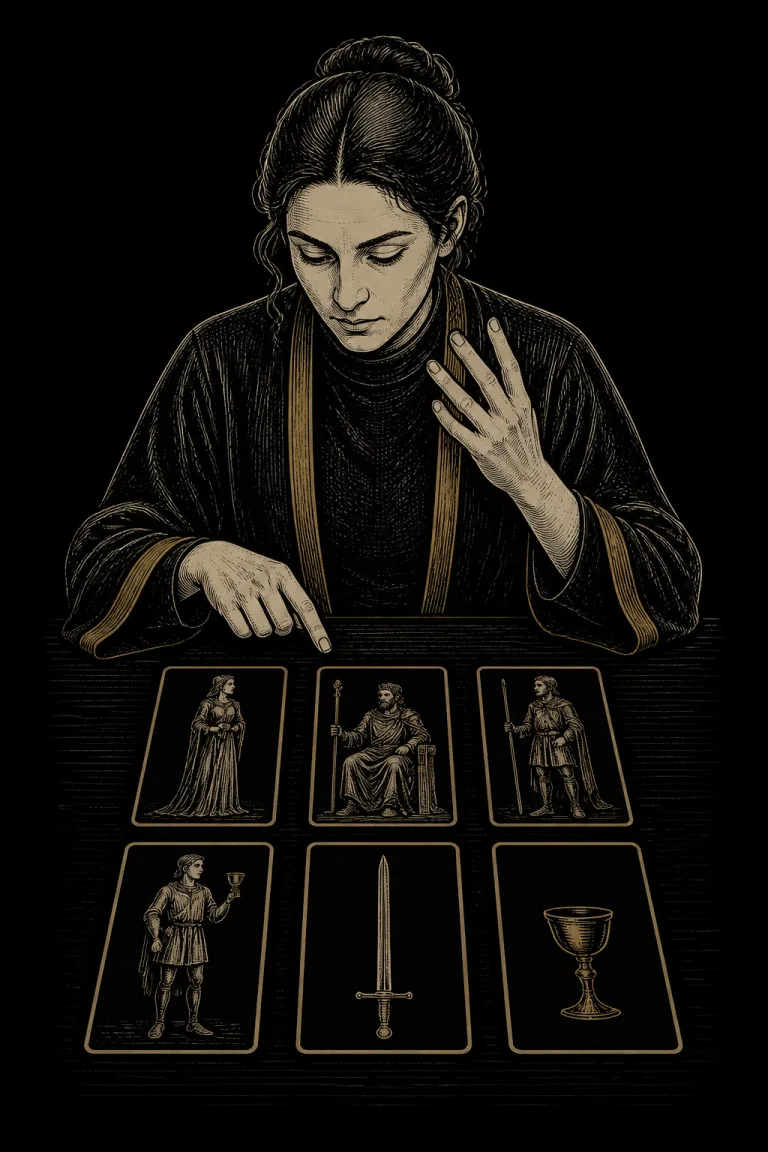
No Court Cards in a Tarot reading means no Pages, Knights, Queens, or Kings appeared, so roles and authority must be read from the cards that are actually present rather than invented figures.

No Court Cards in a Tarot reading means that the recorded spread contains no Pages, Knights, Queens, or Kings. In a complete seventy-eight-card deck, the absence can shift attention away from person-like role cards and toward the events, conditions, choices, resources, emotions, and transitions shown by the remaining Major Arcana and numbered Minor Arcana. It does not prove that no people matter, that nobody will help, or that the reader must handle everything alone.
Treat the pattern as one feature of a verified draw. Confirm that all sixteen Court Cards were available, record the spread size and positions, and interpret the suits, numbers, Majors, and reversals that did appear. Then ask factual questions about who carries information, who performs work, who maintains standards, and who holds decision authority. The missing cards can prompt a role audit, but real names, duties, consent, competence, and accountability come from evidence outside the deck.
Take the next insight with you
Explore personalized Tarot guidance in Veritas, available for iOS and Android.
 Scan with your phone
No Court Cards at a glance
Verify that the sixteen Court Cards were available
A standard Tarot deck contains four Court Cards in each suit: Page, Knight, Queen, and King. Before interpreting their absence, confirm that the deck was complete, mixed, and not separated for an exercise. A deck with courts removed, missing cards, duplicates, or a nonstandard structure changes the denominator. Record whether the spread contained two cards or twelve. No courts in a small draw is common enough to carry little weight, while a larger verified spread may justify a more deliberate role check without becoming proof of a message.
Absence is not a hidden prediction
An absence pattern describes what was not drawn. It does not insert an invisible card, identify a missing person, or predict abandonment. Do not decide after the reading that a Page must be a child, a Knight must be a visitor, a Queen must be a woman, or a King must be a boss who failed to appear. The Court Cards guide treats courts as flexible roles rather than fixed age, gender, or status labels. That boundary still applies when all courts are absent.
Read the cards that are present first
Begin with position, card function, suit, number, sequence, and orientation. Three of Pentacles in resources can describe coordinated skill and a visible standard even without a Queen or King. Eight of Wands in action can show rapid transmission without requiring a Knight. Justice in an outcome can foreground criteria and accountable process without identifying a particular authority figure. The spread already contains verbs and conditions. Use them before asking what the missing role imagery adds to the inquiry.
Suits still show the domain
The Minor Arcana guide helps separate domains. Cups can concern feeling, care, relationship, and receptivity. Wands can concern initiative, effort, visibility, and momentum. Swords can concern information, conflict, standards, and decisions. Pentacles can concern bodies, tools, time, money, and maintenance. A spread dominated by one suit may show where roles need clarification, but it cannot assign those roles by itself.
Numbers show stage, not rank
Numbered cards can describe beginnings, comparisons, development, structure, disruption, adjustment, assessment, implementation, completion, and transition. They do not form a ladder toward a superior Court Card. A Ten is not automatically more mature than a Page, and an Ace does not prove that nobody has experience. Read each number in its suit and position. Then ask what stage the real process has reached, which evidence supports that stage, and who has the competence to move it forward.
Translate the missing courts into four role questions
Use the absence as a prompt for questions, not answers. The Page question is who gathers, learns, tests, or communicates new information. The Knight question is who carries action through changing conditions. The Queen question is who maintains depth, access, capacity, and standards. The King question is who holds a formal mandate, allocates resources, accepts consequence, and permits appeal. These are non-gendered operational roles. One person may hold several, or a team may distribute them.
A missing role may be deliberately unassigned
Not every situation needs all four roles. A private reflection may require no external decision maker. A short experiment may need a learner and an operator but no permanent steward. A mature service may need clear maintenance and authority even if no new messenger is required. Do not fill every blank for symmetry. Define the purpose, risk, duration, affected people, and escalation path, then assign only the roles that the real situation requires.
Position controls the role audit
If no courts appear in a spread with positions such as self, other person, advice, and outcome, do not conclude that the people positions are empty. Read the cards occupying them. The Hermit in self may describe independent review; Two of Cups in other may describe negotiated reciprocity; Six of Pentacles in advice may require clear terms of exchange. Position gives the sentence its grammar. Court absence becomes a secondary question about responsibilities and authority, not a replacement interpretation.
Reversals do not create absent figures
If you use reversals, keep the method fixed. A reversed numbered card may change access, pace, direction, expression, excess, or correction. It does not secretly stand in for a reversed court. Follow the reversal method: name the upright function, specify the change, check the position, and compare neighboring cards. If role confusion appears in the facts, describe it directly instead of forcing a person onto the card.
Combinations identify handoffs
Use card combinations to track how work moves. Ace of Swords followed by Three of Pentacles may move from a clear requirement to coordinated execution. Eight of Pentacles followed by Justice may move from repeated craft to formal review. The combination can reveal a handoff even when no court depicts the people involved. Verify who sends, receives, approves, maintains, and records that handoff in real life.
A six-step method for a court-free spread
- Verify
Record the complete deck, all sixteen available courts, spread size, positions, question, and orientation rule.
- Read what appeared
Interpret position, Majors, suits, numbers, sequence, reversals, and combinations before discussing absence.
- Name the process
State the real task, decision, relationship, or transition in plain language.
- Audit roles
Ask who informs, acts, maintains, decides, allocates resources, reviews, and can stop.
- Verify authority
Check competence, consent, policy, evidence, accountability, handoffs, appeal, and genuine limits.
- Review
Choose one bounded action and a date to compare the reading with facts and outcomes.
Worked relationship example
A five-card relationship spread contains Two of Cups, Four of Swords, Eight of Pentacles, Justice, and Six of Pentacles. No courts appear. The reader does not conclude that the couple lacks maturity or that a third person is absent. The cards describe reciprocity, rest, repeated effort, clear standards, and balanced exchange. The role audit asks who initiates a conversation, who schedules the work, who monitors burden, and how both partners make and review agreements. Consent and direct communication decide the answer.
Worked work example
A project spread shows Ace of Swords, Three of Pentacles, Seven of Wands, and Judgement. The present cards point to a requirement, coordinated skill, a defended boundary, and formal review. No court card is needed to identify actual staff. The team writes down who owns the specification, who implements it, who maintains the standard, who approves exceptions, and who hears an appeal. Job descriptions, policy, competence, and available capacity outrank symbolic role assignment.
Compare no courts with many courts
The many Court Cards guide owns concentration when several courts appear. Its method distinguishes Pages, Knights, Queens, and Kings by suit, position, mandate, and evidence. This article owns complete court absence in a verified draw. The nearby Page, Knight, Queen, and King cluster explains each rank when it appears. These pages answer different patterns and should not be combined into an intensity scale.
Do not redraw to obtain a person card
Pulling repeatedly until a Court Card appears changes the sample and can turn uncertainty into answer chasing. Finish the documented spread first. If a role remains unclear, gather information from conversation, records, organizational charts, contracts, calendars, budgets, or qualified guidance. Draw a clarifier only under a declared rule and a narrower question. The guide to reading Tarot for yourself helps keep curiosity separate from compulsion.
Keep a role record
In a Tarot journal, record deck integrity, spread size, positions, present cards, absent courts, suit and number patterns, factual role questions, named owners, authority source, consent, evidence, handoffs, unresolved gaps, one action, stop condition, and review date. At review, note whether the absence helped expose a real responsibility gap or merely reflected an ordinary draw.
Turn the missing figures into a clear role audit
Use Veritas to save deck integrity, denominator, present cards, suits, numbers, positions, who informs, acts, maintains, decides, reviews, and can stop, plus evidence, one bounded action, and a review date.
Responsible limits
No Court Cards in a Tarot reading is an absence pattern in one draw, not evidence of isolation, abandonment, immaturity, leaderlessness, hidden people, spiritual authority, diagnosis, legal responsibility, financial outcome, or another person's thoughts. Visit the <a href="/tarot">Tarot journal hub</a>. Use direct communication, records, consent, qualified guidance, and real safety procedures for consequential decisions.