Tarot Journal
Love Tarot Spreads for Clarity, Communication, and Choice
Love Tarot spreads are most useful when they explore readiness, communication, boundaries, and choice. Try three grounded layouts without claiming access to private thoughts.
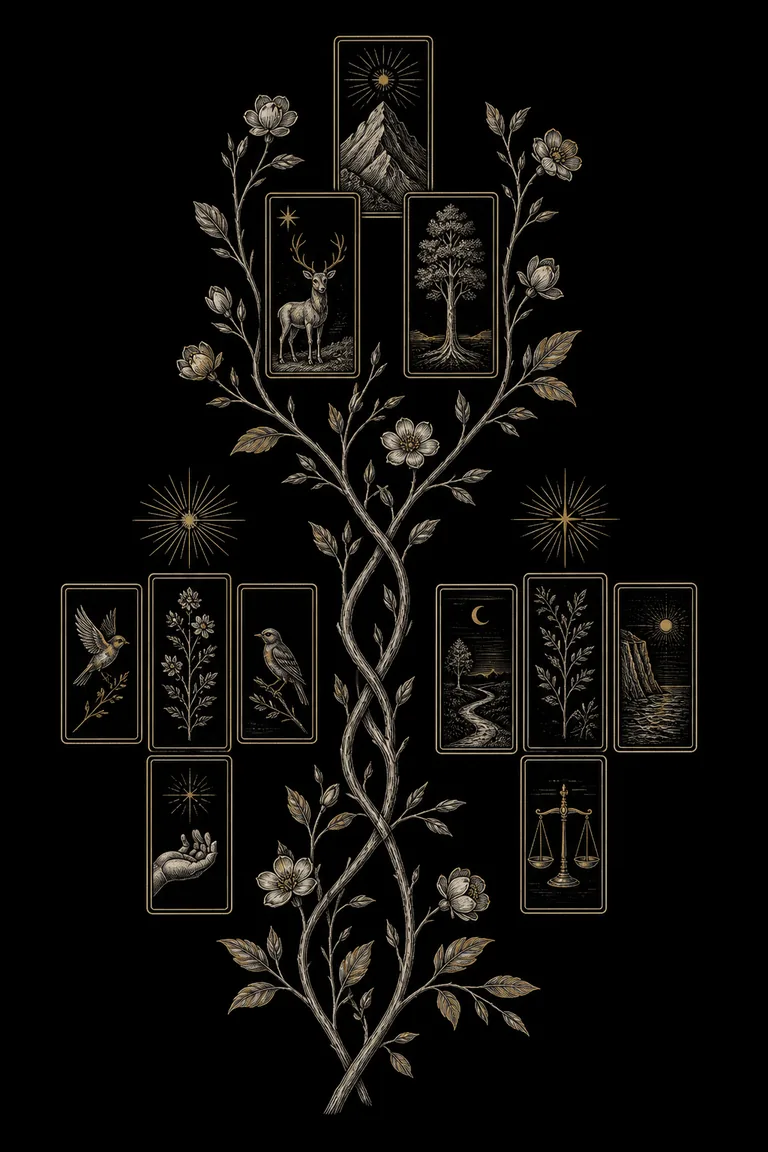
A love Tarot spread can help organize feelings and questions about connection, but it should not be used to prove what another person secretly thinks. The strongest layouts focus on what is observable, what you need, what you can communicate, and which choices are available.
The three spreads below serve different moments: preparing for a reciprocal relationship, clarifying a conversation, and evaluating whether to invest further. Choose one purpose before shuffling. Mixing all three into one reading usually creates more ambiguity than insight.
Take the next insight with you
Explore personalized Tarot guidance in Veritas, available for iOS and Android.
 Scan with your phone
How to ask a grounded love question
Ask about a dynamic you can observe or a choice you can make. “What would help me communicate my needs clearly?” is workable. “Is this person my soulmate?” asks the deck to certify a label that has no agreed evidence or practical definition.
Name the relationship stage and a realistic time frame. A first date, established partnership, separation, and uncertain reconnection need different questions. If safety, coercion, or abuse is present, prioritize qualified support and a practical safety plan rather than a reading.
Spread one: readiness for reciprocal love
What I am available for
The kind of connection, pace, or responsibility you can genuinely sustain now.
A pattern to notice
A habit, expectation, or defense that shapes who feels attractive or safe.
A practice that supports reciprocity
One behavior that helps giving and receiving remain mutual.
This spread is about preparation, not summoning a person or predicting a date. Translate the final card into a behavior. If Justice appears, you might define a non-negotiable and a standard you also agree to meet.
Bring clarity to a relationship question
Open a Tarot reading in Veritas and choose a spread focused on communication, boundaries, and decisions you can actually make.
Spread two: prepare for an honest conversation
What I need to say
The central truth, request, or boundary that should not be buried.
What I need to hear
The information or perspective that deserves genuine listening.
What I am assuming
A story that should be separated from observed facts.
What supports the conversation
Timing, tone, setting, or preparation that makes clarity more possible.
A constructive next step
One action after the conversation, whether agreement is reached or not.
The “what I need to hear” position is not a quotation from another person’s mind. It names the kind of information you should invite or tolerate. A Sword may ask for direct facts; a Cup may ask you to listen without rushing to solve.
Spread three: should I invest further?
What is working
A real strength supported by behavior, not only potential.
What is not working
A repeated friction, mismatch, or unmet requirement.
What is mine to address
Your contribution, boundary, or decision.
What requires mutual participation
Something that cannot be repaired by one person alone.
Cost of continuing unchanged
The likely effect of maintaining the current pattern.
Best next experiment
A limited action that creates better evidence before a larger commitment.
How to read several cards together
Begin with positions, then compare suits and direction. Many Cups may show emotional emphasis, but Pentacles can reveal whether care has practical support. Swords may identify conversations or conflicting interpretations. Wands can show desire and pursuit, including enthusiasm that moves faster than agreement.
Look for movement between cards. A guarded figure followed by an exchange card may suggest that disclosure needs a safer structure. Two figures facing away from one another can support a theme of disconnection, but the position and question remain more important than visual speculation.
Court cards in love readings
A court card can describe a role, communication style, action, or quality to practice. Avoid assigning every court to a rival or future partner. The Queen of Swords may advise a clear boundary; the Knight of Cups may describe pursuit that needs to be tested for consistency.
Difficult cards are not relationship verdicts
The Tower does not automatically mean breakup, and the Lovers does not guarantee lasting compatibility. Difficult cards can name instability that requires truth and reconstruction. Warm cards can describe attraction while leaving practical incompatibility untouched. Read the whole spread.
When to stop drawing
Stop when the spread has answered its assigned positions. Repeating the same question until a preferred card appears replaces reflection with reassurance seeking. If the answer remains unclear, write the missing factual question and gather information through conversation or observation.
Tarot is a symbolic reflective practice, not a scientifically validated forecasting method. It cannot establish consent, fidelity, pregnancy, abuse, or another person’s intentions. Use direct evidence and qualified help for high-stakes relationship decisions.