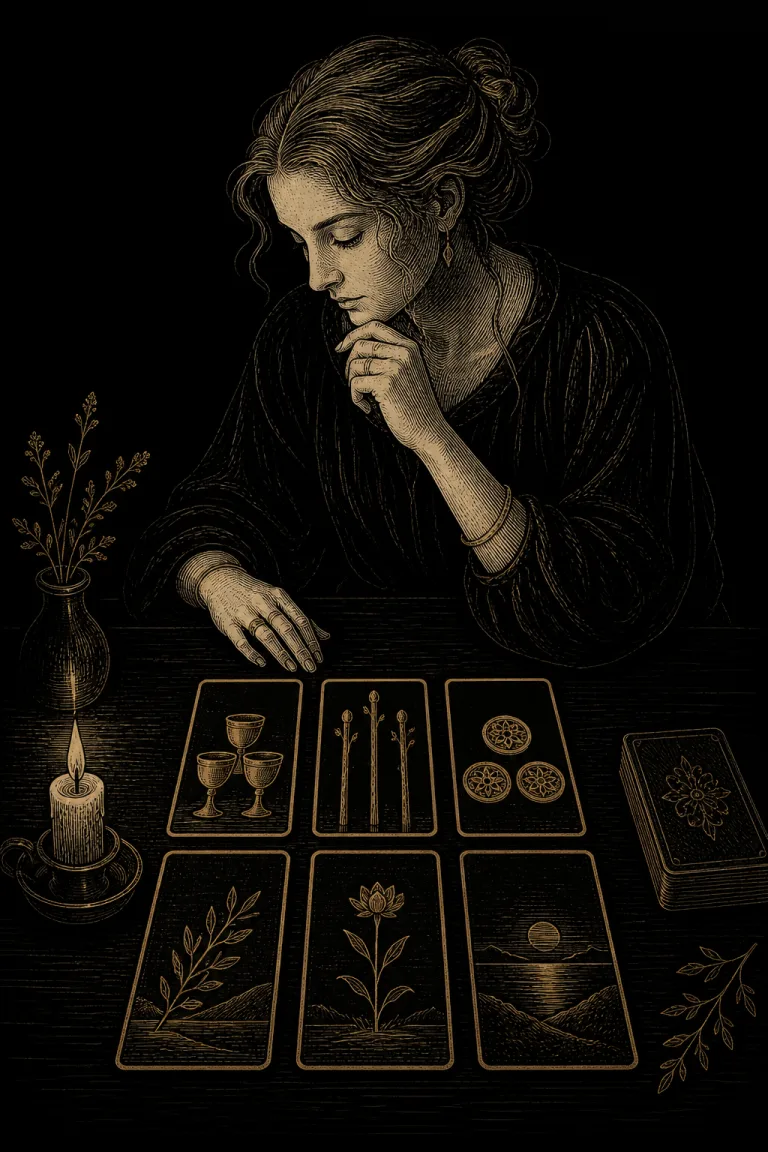
Tarot Journal
Many Fours in a Tarot Reading: What It Means
Many Fours in a Tarot reading can concentrate attention on stability, rest, boundaries, and what is being held, but they do not guarantee security or stagnation.
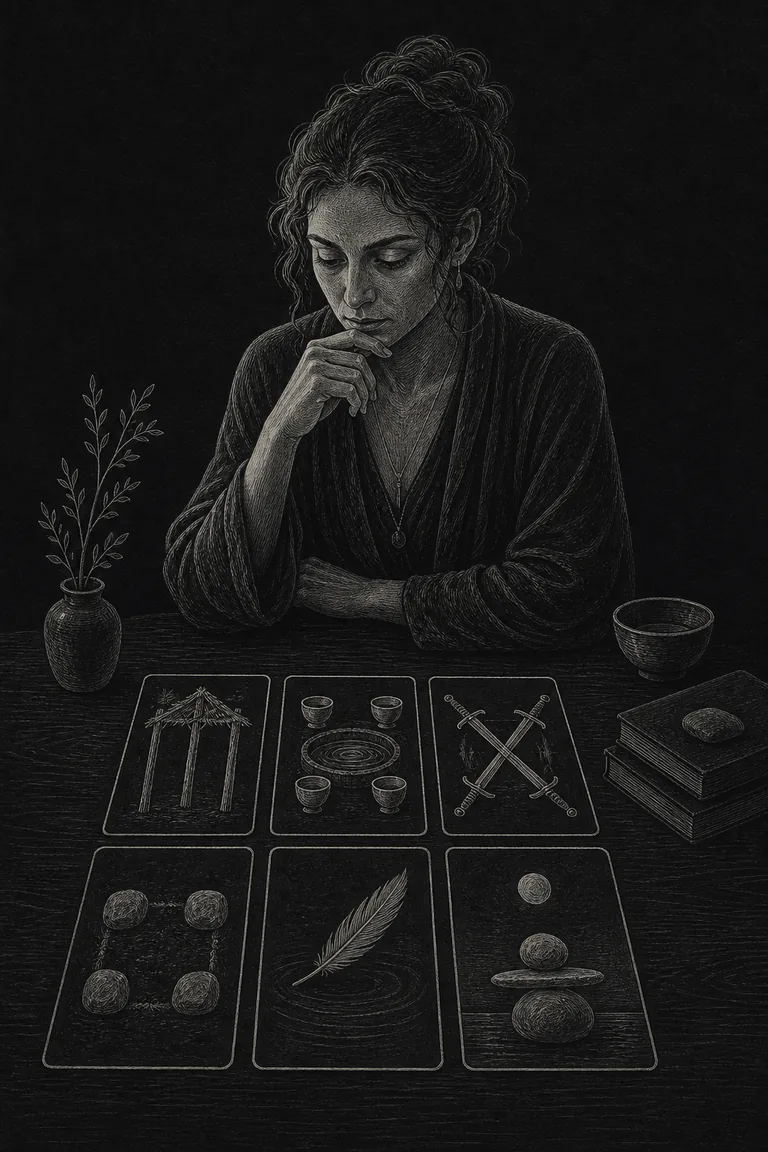
Many Fours in a Tarot reading means that two or more of the four Fours appear in the completed spread. The repeated rank can highlight several structures, pauses, boundaries, or resources that are trying to hold a situation in place. It does not automatically mean stability, commitment, boredom, control, a home, or a lasting result. Suit, position, surrounding cards, and the original question determine what each Four is holding and why.
Record the Four count and total spread size before interpreting. Then identify the structure shown by each card, what it protects, what it costs, and what evidence would show that it still works. Two Fours in three cards create a different concentration from two in twelve. Neither pattern proves that a relationship is secure, a job is permanent, money is protected, or a pause should continue.
Take the next insight with you
Explore personalized Tarot guidance in Veritas, available for iOS and Android.
 Scan with your phone
Many Fours at a glance
Start with the Four count and denominator
Write "three Fours in a seven-card spread" rather than only "three Fours." A standard deck has four Fours among seventy-eight cards. A restricted deck, duplicate cards, replacement, extra pulls, or continuing until a Four appears changes the baseline. Preserve the original procedure with the guide to how many Tarot cards to pull.
Four means consolidation, not guaranteed stability
Four can frame a container, rest period, boundary, routine, protected resource, or arrangement that follows earlier development. Consolidation may be useful, temporary, costly, exclusionary, or too rigid. Before calling the pattern stable, state what is holding, who maintains it, who can access it, what pressure it can withstand, and what would justify repair or release.
The repeated rank does not erase the spread
The rank is one layer. It does not override suit, imagery, orientation, position, or non-Fours. A Three may show the activity that produced a structure. A Five may expose a stress test or disruption. A court card can identify a role, while a Major Arcana card can widen the decision. Compare the shift from many Threes without assuming that development must settle into permanence.
Four of Wands: a shared structure needs terms
The Four of Wands can frame a gathering place, milestone, welcome, home base, or shared structure. It does not guarantee marriage, a house purchase, reunion, community approval, or lasting harmony. Ask who is included, who provides the labor, what the occasion marks, which rules govern the space, and whether participation is voluntary and accessible.
Four of Cups: a pause needs an end condition
The Four of Cups can frame emotional withdrawal, contemplation, dissatisfaction, or a pause before response. It does not prove rejection, depression, ingratitude, hidden love, or a missed soulmate. Name the offer or feeling being considered, the information still needed, the person's right not to engage, and the condition that would end or extend the pause.
Four of Swords: rest needs protection and review
The Four of Swords can frame rest, reduced demands, recovery time, private thought, or strategic quiet. It does not diagnose illness, guarantee healing, or require silence during danger. Define which tasks stop, which duties remain, who covers urgent needs, how long the interval lasts, and what qualified evidence determines readiness to resume.
Four of Pentacles: protection needs proportion
The Four of Pentacles can frame saving, guarding, controlling access, preserving a resource, or fearing loss. It does not prove greed, wealth, theft, property rights, or financial safety. Identify the resource, verified owner, minimum reserve, legitimate obligations, access rules, concentration risk, and the point where protection becomes harmful rigidity.
Positions define the job of each Four
A Four in resources can show an available routine, reserve, boundary, or place to rest. In obstacle, it may show inflexibility, exclusion, delay, or maintenance burden. In advice, it can request a limit, pause, documentation step, or minimum viable structure. In outcome, it remains conditional on the evidence and actions elsewhere in the spread.
Several Fours may hold different things
Do not merge all Fours into one story about security. The Four of Swords in wellbeing may describe protected rest, while the Four of Pentacles in finance describes a separate reserve rule. If both concern one project, state the connection precisely: workload may need to fall so the reserve is not consumed. Positions and ordinary evidence must support that link.
Three or four Fours increase maintenance load
A larger concentration can mean several structures need upkeep at once. More Fours do not mean stronger protection. List each structure, purpose, owner, users, maintenance task, cost, review date, failure signal, and exit path. Prioritize safety, consent, legal duty, accessibility, and essential resources. A missing suit can prompt a check, but absence is not proof of deficiency.
Reversed Fours can test rigidity or weak support
If your method uses reversals, a reversed Four may question a boundary, show incomplete rest, expose an unstable foundation, or suggest that a protected resource is inaccessible. It does not automatically mean freedom, eviction, loss, illness, or emotional availability. State your reversal rule first and compare it with the reversal guide.
A six-step method for a Four-heavy spread
- Preserve the draw
Record the question, spread, stopping rule, deck, Four count, denominator, positions, and orientations.
- Name each structure
State the pause, boundary, routine, resource, place, agreement, or container represented by each Four.
- Apply suit and position
Decide whether the card concerns shared action, feeling, rest, resources, support, obstacle, advice, or outcome.
- Read counterweights
Use non-Fours to identify development, stress, authority, missing facts, flexibility, and consequences.
- Audit reality
Check purpose, consent, ownership, access, cost, workload, evidence, maintenance, failure signals, and exit.
- Test one structure
Maintain, loosen, repair, or retire one element within a bounded period and review the result.
Worked example: Fours in a work spread
A seven-card work spread contains the Four of Pentacles in resources, Four of Swords in advice, and Four of Wands in outcome. The pattern does not promise job security or promotion. It can support protecting a verified reserve, reducing one workload for a defined interval, and testing a clearer team routine. Success requires authority, coverage, acceptance criteria, and a review date.
Worked example: Fours in a relationship question
The Four of Cups appears in obstacle and the Four of Wands in support, with the Eight of Cups in advice. A grounded reading can recognize an existing shared structure alongside a person's right to pause or leave. It supports clarifying terms and listening to a direct answer. It does not prove commitment, reconciliation, rejection, or hidden feelings.
Do not pull until the structure looks safe
Repeated clarifiers can turn an uncertain boundary into a preferred promise. Decide the purpose and number of clarifiers before drawing, photograph the original spread, and record later cards separately. Where the issue concerns housing, health, safety, money, employment, law, or another person's consent, use direct evidence and qualified guidance rather than symbolic reassurance.
Separate symbolic stability from a real safeguard
A Four can help name what appears to be holding. A real safeguard still needs records, ownership, capacity, maintenance, consent, and a tested response to failure. Check the agreement, inspect the system, measure the reserve, request the accommodation, or consult the relevant professional. If evidence contradicts the reading, revise it.
Save each structure and its review condition
Use Veritas to record the denominator, each Four, its position, what it holds, who maintains it, strongest counterweight, maintenance cost, failure signal, and review date.
A practical journal prompt
For each Four, complete: "This card shows __ being held by __ for the purpose of __ in the position of __." Add who has access, what maintenance is required, what evidence shows usefulness, and what would justify loosening or ending the arrangement. Then name one non-Four that most challenges it.
Responsible limits
Many Fours in a Tarot reading are a symbolic rank pattern, not scientific evidence or a command. They cannot establish ownership, housing security, commitment, consent, employment, diagnosis, recovery, financial safety, legal rights, another person's feelings, or future permanence. Visit the <a href="/tarot">Tarot journal hub</a>, preserve the complete spread, and use records, direct communication, professional guidance, and ordinary safety checks.