Tarot Journal
Many Threes in a Tarot Reading: What It Means
Many Threes in a Tarot reading can concentrate attention on development, participation, expression, and consequences, but they do not guarantee growth or celebration.
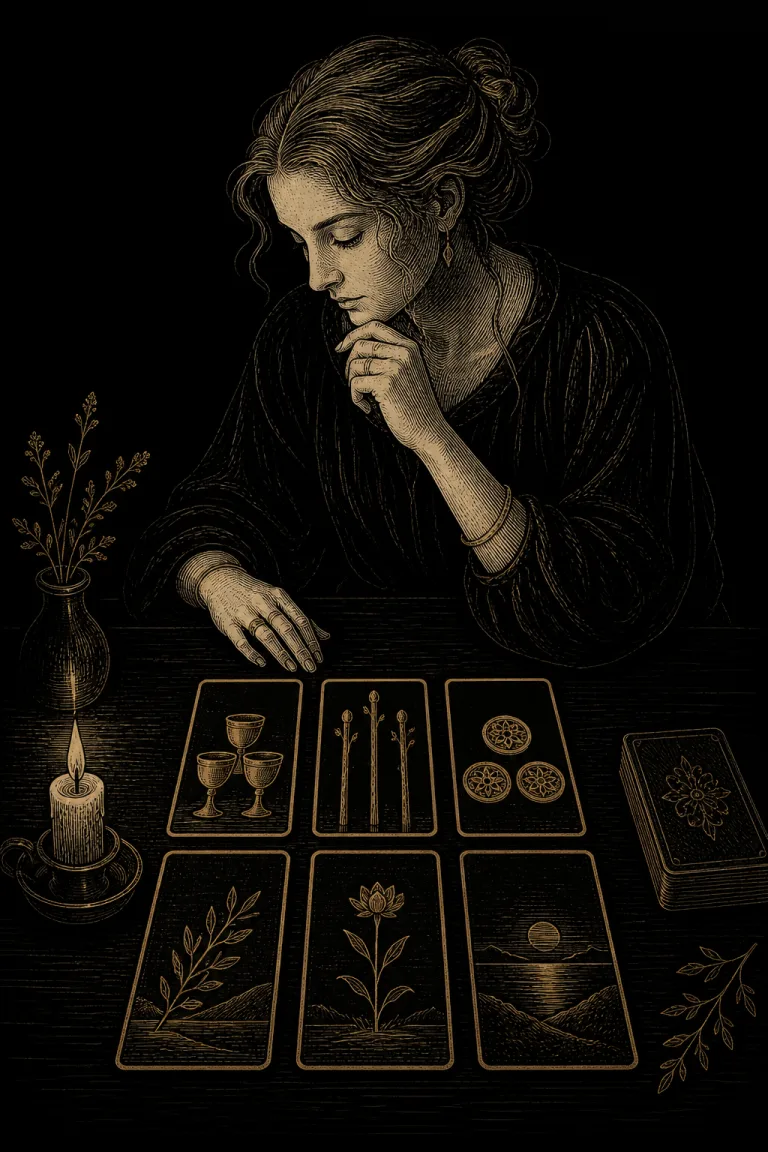
Many Threes in a Tarot reading means that two or more of the four Threes appear in the completed spread. The repeated rank can highlight several situations moving beyond a pair into development, contribution, expression, or a visible consequence. It does not automatically mean abundance, teamwork, pregnancy, a third party, or a successful result. Suit, position, surrounding cards, and the original question decide what each Three is developing.
Record the Three count and total spread size before interpreting. Then name the process, participants, output, or consequence shown by each card and identify the evidence that would mark its next stage. Three Threes in five cards carry a different concentration from three in fifteen. Neither pattern proves that a project will grow, a relationship will deepen, or a plan has enough support.
Take the next insight with you
Explore personalized Tarot guidance in Veritas, available for iOS and Android.
 Scan with your phone
Many Threes at a glance
Start with the Three count and denominator
Write "three Threes in a seven-card spread" rather than only "three Threes." A standard deck has four Threes among seventy-eight cards. A restricted deck, duplicate cards, replacement, extra pulls, or continuing until a Three appears changes the baseline. Preserve the original procedure with the guide to how many Tarot cards to pull.
Three means development, not automatic growth
A Three can move a situation beyond two-sided comparison into a third factor, shared field, created result, or consequence. Development can include repair, conflict, revision, or ending an unworkable attempt. Before calling the pattern "growth," state what has changed from the prior stage, who can verify it, and whether the change is desirable and sustainable.
The repeated rank does not erase the spread
The rank is one layer. It does not override suit, imagery, orientation, position, or non-Threes. A Four may show the structure required to keep a result. A Five may expose instability. A court card may identify a role, while a Major Arcana card can widen the decision. Compare the pattern with many Minor Arcana without turning a rank count into the whole reading.
Three of Wands: development needs feedback
The Three of Wands can frame expansion from an initial choice into observation, distribution, or a wider field. It does not guarantee travel, sales, promotion, or success. Ask what has actually been launched, which signal would show useful reach, what cost or delay is acceptable, and when expansion should pause. A small pilot may be more responsible than a larger commitment.
Three of Cups: participation needs consent
The Three of Cups can frame celebration, mutual support, friendship, or a shared occasion. It does not prove that everyone feels included, that a reunion will occur, or that a third person is romantically involved. Identify who was invited, who can decline, whose labor supports the gathering, and whether the group respects privacy and boundaries.
Three of Swords: consequence needs accurate scope
The Three of Swords can frame pain, a difficult fact, divided loyalties, or the consequence of an unresolved conflict. It does not prove betrayal, infidelity, illness, divorce, or permanent harm. Separate direct evidence from feared explanation, name the specific loss or contradiction, and decide whether the next step is clarification, distance, repair, or qualified support.
Three of Pentacles: collaboration needs roles
The Three of Pentacles can frame applied skill, review, apprenticeship, or coordinated work. It does not prove that a team is fair or competent. Name the deliverable, decision owner, contributors, standard, compensation, access needs, dependencies, and correction path. Collaboration is meaningful only when roles and authority are visible.
Positions define the job of each Three
A Three in resources can show available feedback, skill, or community. In obstacle, it may show coordination cost, conflicting voices, exposed pain, or premature scaling. In advice, it can request a prototype, review, or direct conversation. In outcome, it remains conditional on the work and evidence shown elsewhere. Read the position before deciding whether the development should continue.
Several Threes may describe separate stages
Do not merge all Threes into one optimistic story. The Three of Pentacles in work may describe peer review, while the Three of Swords in risk describes a separate unresolved contradiction. If both belong to one project, state the link: review may reveal evidence that requires revision. The question and positions must justify the connection.
Three or four Threes increase development load
A larger concentration can mean several processes need a next stage at once. More Threes do not mean faster or better growth. List each process, owner, current evidence, dependency, capacity limit, and decision date. Prioritize safety, consent, legal duty, scarce resources, and reversible experiments. The missing suit can prompt a check, but absence is not proof of deficiency.
Reversed Threes can question the next stage
If your method uses reversals, a reversed Three may suggest weak coordination, excluded participation, unclear feedback, delayed output, or a process that should not scale yet. It does not automatically mean failure, gossip, betrayal, or creative blockage. State your reversal rule before reading and compare it with the reversal guide.
A six-step method for a Three-heavy spread
- Preserve the draw
Record the question, spread, stopping rule, deck, Three count, denominator, positions, and orientations.
- Name each development
State the process, participant, output, contradiction, or consequence represented by each Three.
- Apply suit and position
Decide whether the card concerns initiative, relationship, information, resources, support, obstacle, advice, or outcome.
- Read counterweights
Use non-Threes to identify structure, instability, authority, missing facts, capacity, cost, and stopping conditions.
- Check reality
Verify consent, roles, evidence, access, deadlines, compensation, safety, alternatives, and who bears failure.
- Test one next stage
Choose a bounded prototype, review, conversation, or handoff with criteria and a review date.
Worked example: Threes in a project spread
A seven-card project spread contains the Three of Wands in opportunity, Three of Pentacles in advice, and Three of Swords in risk. The pattern does not promise expansion. It suggests testing a wider audience through reviewed work while naming one painful contradiction before scale. A sensible action is a small pilot with acceptance criteria, peer review, a correction owner, and a stop condition.
Worked example: Threes in a relationship question
The Three of Cups appears in support and the Three of Swords in obstacle, with the Two of Swords in boundary. A grounded reading can recognize helpful friendship alongside unresolved pain and missing information. It supports one consent-based conversation or independent support. It does not prove a third party, secret feelings, reunion, or betrayal.
Do not pull until development looks positive
Repeated clarifiers can turn an uncertain process into a preferred narrative. Decide the purpose and number of clarifiers before drawing, photograph the original spread, and record later cards separately. Where the issue concerns health, pregnancy, law, safety, money, employment, or another person's consent, obtain direct evidence and qualified guidance.
Separate symbolic development from an action plan
A Three can help name what appears to be developing. The next action still depends on ordinary evidence. Review the draft, ask the participant, test the prototype, check the budget, document the harm, or consult the relevant professional. If evidence contradicts the initial interpretation, revise it. Symbolism is not protected from correction.
Save each development and one next-stage test
Use Veritas to record the denominator, each Three, its position, current evidence, owner, strongest counterweight, next test, stop condition, and review date.
A practical journal prompt
For each Three, complete: "This card shows __ developing from __ into __ in the position of __." Add who participates, what evidence exists, what the process costs, and what would count as enough. Then write one alternative explanation and the non-Three that most challenges continued development.
Responsible limits
Many Threes in a Tarot reading are a symbolic rank pattern, not scientific evidence or a command. They cannot establish pregnancy, a third party, another person's thoughts, consent, love, fidelity, collaboration, employment, diagnosis, legal duty, financial result, or future success. Visit the <a href="/tarot">Tarot journal hub</a>, preserve the complete spread, and use records, direct communication, professional guidance, and ordinary safety checks.