Tarot Journal
How to Read Tarot for Yourself Without Forcing an Answer
Reading Tarot for yourself becomes clearer when you separate observation from desire, limit redraws, and turn symbols into questions that can meet evidence.
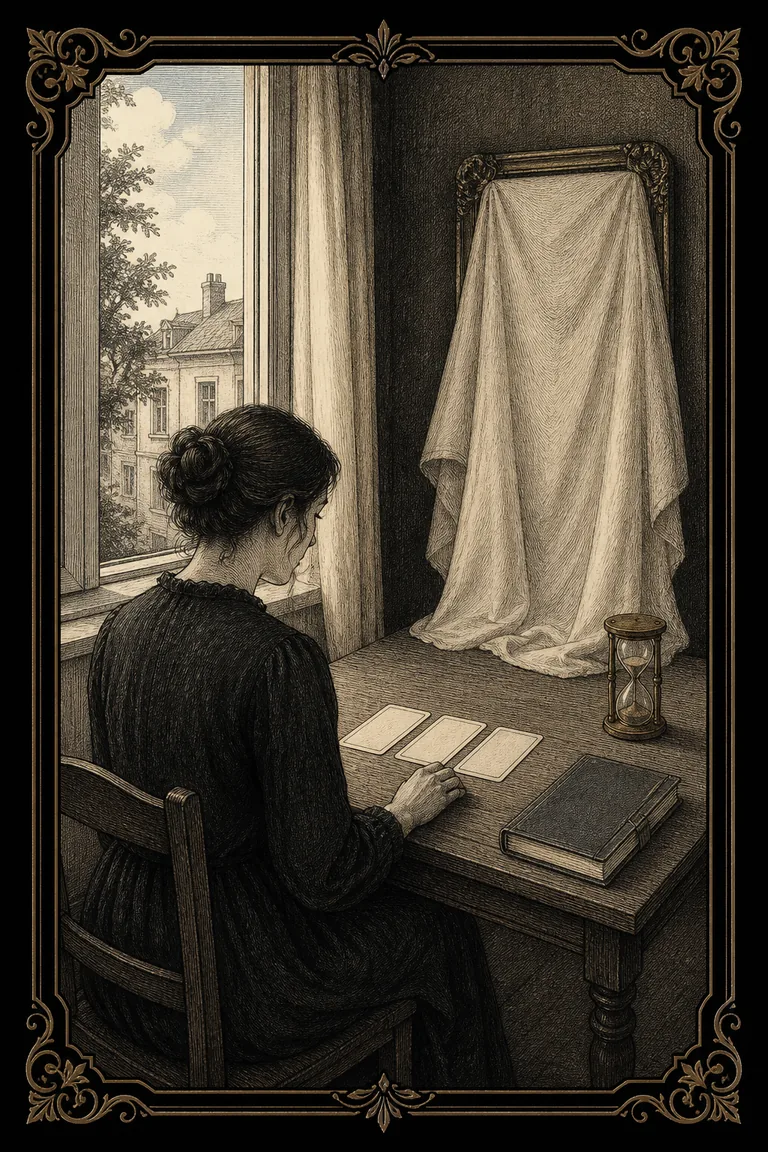
Self-reading is convenient and personal, but familiarity with the question can make preferred answers feel obvious. The goal is not perfect neutrality. It is a method that makes your assumptions visible before they control the interpretation.
Use a small spread, write the question and first response, and decide in advance when the reading ends. If the issue involves safety, health, law, money, or another person’s consent, evidence and qualified support take priority.
Take the next insight with you
Explore personalized Tarot guidance in Veritas, available for iOS and Android.
 Scan with your phone
Why self-readings become difficult
You already know the history, fear, and hoped-for outcome. That context can enrich a reading, but it also encourages selective attention. A desired card may be expanded while an inconvenient card is softened or redrawn. Naming the bias makes it easier to work with.
Give your own reading a clear container
Open a Tarot reading in Veritas, write one focused question, and preserve the first spread so reflection does not become reassurance seeking.
Write the question before shuffling
Ask about your participation rather than hidden facts: “What should I understand about my response to this situation?” is stronger than “What are they secretly thinking?” Include a useful time frame and one subject.
Use a three-position container
What I know
Facts, stated information, and observable conditions.
What I may be projecting
Fear, hope, habit, or an assumption that needs testing.
What I can do next
An action, question, boundary, or experiment within your control.
Observe before interpreting
Write what is literally visible: figures, direction, posture, weather, objects, color, and repetition. Then add the card foundation and position. This order slows the jump from image to preferred conclusion.
Read difficult cards proportionately
The Tower does not guarantee disaster, and Death does not predict physical death. A difficult image may identify disruption, ending, truth, or restructuring at the scale supported by the question and known circumstances.
Do not redraw for comfort
Set one spread and one optional clarification rule before beginning. A clarification should answer a named ambiguity, not replace an unwelcome card. If you want to draw again immediately, record that urge and pause.
Separate intuition from urgency
Intuition is often quiet enough to examine. Urgency demands certainty and repeated confirmation. Write the first impression, then ask what in the card supports it and what evidence would challenge it.
Use a cooling-off period
For emotionally charged questions, return to the notes after several hours or the next day. Do not change the cards. Check whether the language became more balanced once the immediate feeling passed.
Know when another reader may help
An ethical reader can offer distance, but cannot verify private thoughts or guarantee outcomes. Choose someone who respects consent, avoids fear-based claims, and leaves decisions with you.
Finish with evidence and action
Write one fact to verify and one action under your control. If the reading produces only prediction, convert it into a question. Review later against what actually happened rather than what could be made to fit.
Tarot is a symbolic reflective practice, not a scientifically validated forecasting method. It cannot diagnose conditions, establish consent, reveal private facts, or replace medical, legal, financial, or safety guidance.