Tarot Journal
Six of Pentacles Tarot Meaning: Giving and Receiving
The Six of Pentacles examines how resources move between people. It asks whether help is useful, consent is clear, conditions are visible, and power is handled with care on both sides of an exchange.
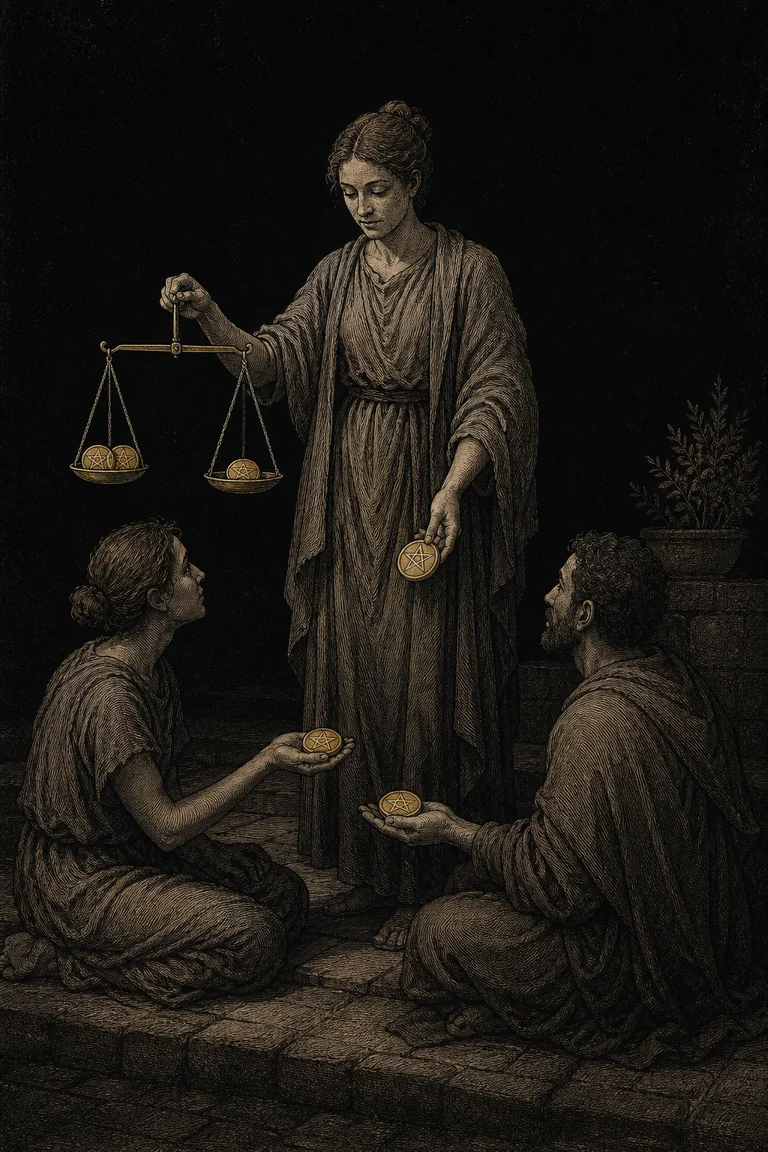
The Six of Pentacles Tarot meaning centers on giving, receiving, material support, and the balance of power that accompanies them. In the Rider-Waite-Smith image, a standing figure holds scales while giving coins to two kneeling people. The card can describe generosity and timely assistance, but it also asks who controls the resource, who sets the terms, and whether the exchange protects dignity.
Upright, the Six of Pentacles often supports fair aid, payment, mentorship, access, or a workable redistribution of time and money. Reversed, it can reveal hidden conditions, debt pressure, unequal attention, performative generosity, or difficulty asking for what is genuinely needed. Neither orientation guarantees a gift, loan approval, promotion, or repayment. Read the card through the question, position, and observable terms.
Take the next insight with you
Explore personalized Tarot guidance in Veritas, available for iOS and Android.
 Scan with your phone
Six of Pentacles meaning at a glance
Symbols in the Six of Pentacles
The scales introduce judgment, proportion, and allocation. They do not prove perfect equality. The coins make the exchange concrete: money, food, time, information, opportunity, care, or access can all function as resources. The standing and kneeling positions show an asymmetry that may be temporary, necessary, respectful, uncomfortable, or exploitative depending on context. Notice faces, hands, clothing, distance, and who remains outside the exchange in your deck. The image asks how assistance is delivered, not only whether it exists.
Upright Six of Pentacles
Upright, this card can indicate useful help moving toward a defined need. A grant is approved, a bill is paid, a colleague shares expertise, a manager credits labor, or someone with capacity offers time without taking control. It may also ask you to become the responsible giver. Good intent is only the beginning. Check whether the resource fits the need, whether the recipient can decline, and whether the arrangement can continue without resentment or harm.
Reversed Six of Pentacles
Reversed, the exchange may be opaque or distorted. Help can arrive with loyalty demands, a loan can conceal unaffordable terms, praise can substitute for payment, or one person can keep giving past capacity because refusal feels unsafe. Sometimes the problem is not exploitation but mismatch: advice is offered when cash, rest, privacy, or skilled support is needed. Reversal can also point to shame around receiving. Separate the resource from the story about deserving it, then inspect the actual conditions.
Six of Pentacles in love and relationships
In relationships, the card asks how attention, money, care, domestic work, emotional labor, and decision power are distributed. Equal contribution does not always mean identical contribution. One partner may have more time while another has more income, but both should understand and consent to the arrangement. Upright can show mutual support adjusted to real capacity. Reversed can show scorekeeping, financial control, chronic one-sided care, or gifts used to avoid accountability. A card cannot establish another person's motives, so use direct conversation and behavior.
Six of Pentacles as feelings
As feelings, the Six of Pentacles may reflect willingness to help, gratitude, obligation, admiration, indebtedness, or concern about whether affection is reciprocated. It does not prove that a person will commit or provide support. If the position describes you, ask whether you are giving freely, negotiating an exchange, or trying to secure a particular response. If it describes someone else, their stated limits and consistent actions matter more than inferred generosity.
Career, work, and money
At work, the card can describe compensation, funding, sponsorship, training, delegation, access to decision makers, or a fair transfer of workload. Put expectations in writing. Mentorship should expand another person's agency rather than create dependence. With money, the card can support budgeting for assistance, charitable giving, negotiating payment, or reviewing a loan, but it is not financial advice or a promise of profit. Verify interest, fees, tax effects, eligibility, repayment terms, and the cost of saying no.
Are you the giver, receiver, or witness?
The card changes when you identify your role. As giver, check capacity, relevance, and whether your offer preserves choice. As receiver, ask what is offered, what is expected, and whether another source would be safer. As witness or allocator, examine the criteria used to distribute a shared resource and who has been excluded. A person may occupy more than one role across time. Receiving today can make future contribution possible without creating a moral debt to the same individual.
Advice, yes or no, and timing
As advice, make resources and conditions visible. Ask for concrete support or offer a specific form of help instead of relying on hints. In a bounded yes-or-no reading, the card can lean yes when capacity and terms are fair, and not yet when the exchange depends on hidden obligations or missing information. Timing follows practical gates such as an application, invoice, meeting, budget cycle, or confirmed transfer. Do not assign six days or weeks without real-world evidence.
Six of Pentacles combinations
With the Five of Pentacles, assistance may address exclusion or immediate material strain. The Seven of Pentacles asks whether continued investment is producing a sustainable return. Justice emphasizes written standards, proportionality, and accountability. The Emperor can identify institutional authority or a rigid gatekeeper, while the Devil warns that debt, dependency, or leverage may restrict choice. Use spread positions to decide whether a card describes the resource, the condition, the giver, or the likely consequence.
How it differs from nearby Six cards
The Six of Cups often concerns memory, familiarity, care, and what is carried forward from the past. The Six of Swords organizes a supported transition toward more workable conditions. The Six of Wands examines recognition and the social meaning of success. The Six of Pentacles is specifically concerned with material or practical exchange and the authority to allocate it. Its central question is not simply whether people are kind, but whether resources move in a way that is useful and accountable.
Make the exchange visible
Use Veritas to record what is offered, what is needed, who sets the terms, each person's capacity, the right to decline, and the date when the arrangement should be reviewed.
A practical fairness check
- Name the resource
Specify the money, time, information, access, labor, attention, or care being exchanged.
- Confirm the need
Ask what would actually help rather than assuming the most visible offer is useful.
- State the conditions
Write down repayment, credit, privacy, time limits, responsibilities, and any expectation of return.
- Protect choice
Check whether both sides can ask questions, renegotiate, or refuse without retaliation.
- Review the effect
Measure whether the exchange reduced strain, increased agency, and remained within capacity.
Common mistakes
Do not read the Six of Pentacles as guaranteed money, a wealthy partner, automatic repayment, or proof that generosity is pure. Do not shame a person for receiving needed help or praise self-sacrifice that damages the giver. Reversed does not always mean fraud, and upright does not erase power differences. The card is most useful when it turns vague ideas about generosity into a clear, consensual, and reviewable exchange.