Tarot Journal
Court Cards in Tarot: Pages, Knights, Queens, and Kings
Tarot court cards become clearer when Page, Knight, Queen, and King are read as roles. Learn how rank and suit combine without relying on age or gender stereotypes.
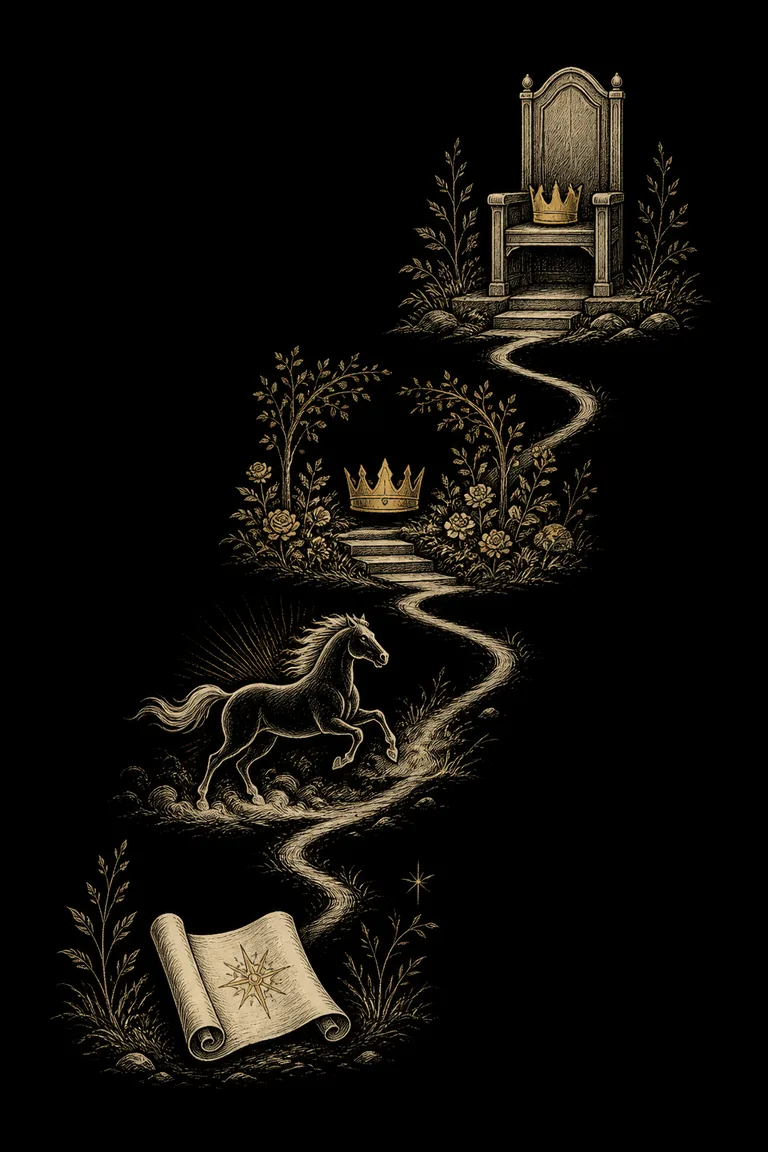
The 16 Tarot court cards are the Pages, Knights, Queens, and Kings of Cups, Wands, Swords, and Pentacles. They can represent people, but they can also describe a role, attitude, stage of learning, style of action, or quality the reader is being asked to develop.
Court cards feel difficult when readers search for one fixed identity behind each image. A more reliable method combines rank and suit. Rank shows how the energy is being handled, while the suit shows whether that energy concerns feeling, initiative, thought, or material life.
Take the next insight with you
Explore personalized Tarot guidance in Veritas, available for iOS and Android.
 Scan with your phone
What are court cards in Tarot?
Every Minor Arcana suit ends with four court cards. Together they show different relationships with the suit rather than a simple ladder from immature to superior. A Page may bring openness an experienced person needs, while a King can show authority that has become rigid.
Traditional decks often depict age, gender, and social hierarchy. Modern reading can respect the imagery without treating it as a literal identification system. Any person can embody any court. Look for behavior, responsibility, and context before appearance.
The four court card ranks
Page: learn and receive
Pages notice, study, experiment, and carry messages. They show an early relationship with the suit, honest curiosity, or news that opens a new line of experience. Their shadow includes inexperience, inconsistency, and fascination without follow-through.
Knight: move and pursue
Knights take the suit into motion. They show pursuit, advocacy, testing, travel, or a strong directional style. Their shadow is excess: charging ahead, romanticizing a quest, arguing for momentum, or mistaking activity for progress.
Queen: embody and relate
Queens hold inward authority and understand how the suit affects people and environment. They often show mature reception, stewardship, and relational intelligence. Their shadow can be indirect control, over-identification, or protecting a domain too closely.
King: direct and take responsibility
Kings organize the suit outward through decisions, standards, protection, and accountability. Their strength is responsible direction. Their shadow appears as domination, certainty without listening, status seeking, or using competence to avoid vulnerability.
Meet the court card inside a real question
Open a Tarot reading in Veritas and explore whether a Page, Knight, Queen, or King describes a person, a role, a next action, or a quality to practice.
How rank combines with suit
The Page of Cups learns through feeling, imagination, and emotional messages. The Page of Swords learns through observation, questions, and language. Both are Pages, but the field of learning changes. The Knight of Wands pursues inspiration and experience, while the Knight of Pentacles advances through repetition and dependable effort.
Queens and Kings also change by suit. The Queen of Cups holds emotional space and reads atmosphere. The Queen of Pentacles creates practical support. The King of Swords directs through judgment and standards, while the King of Wands directs through vision and confidence.
Court cards by suit
Cups courts
These roles work with emotion, intuition, relationship, imagination, and care. Ask how feeling is being received, pursued, held, or directed, and whether empathy has boundaries.
Wands courts
These roles work with desire, creativity, leadership, confidence, and motion. Ask who carries the spark, who pursues it, who sustains its atmosphere, and who gives it direction.
Swords courts
These roles work with thought, language, evidence, conflict, and decisions. Ask who is learning the facts, arguing a position, holding discernment, or establishing a standard.
Pentacles courts
These roles work with money, health, time, work, home, and skill. Ask how material knowledge is learned, practiced, maintained, and managed responsibly.
When a court card represents a person
A court may indicate a person when the question concerns people, the spread position names a participant, or several details fit a recognizable pattern of behavior. Describe the role before naming someone. “A person communicating with sharp curiosity” is safer and more useful than forcing the Page of Swords onto the youngest person present.
Court cards do not prove another person’s motives or private thoughts. They show the role visible within the reading. If a relationship question needs factual clarity, direct conversation remains more reliable than identifying a card as secret evidence.
When the court card describes you
In advice, a court often asks for a mode of participation. The Queen of Pentacles may recommend practical care and attention to capacity. The King of Cups may ask you to remain emotionally present while choosing a measured response. The Knight of Swords may support decisive speech or warn that speed is outrunning listening.
Use the rank as a verb. Learn like the Page, pursue like the Knight, embody like the Queen, or direct like the King. Then use the suit to define what is being learned, pursued, embodied, or directed.
Multiple court cards in one spread
Several courts may show a social situation with many roles, or an internal situation requiring different capacities. A Page beside a King can compare beginner openness with established authority. Two Knights may show competing directions. Queens from different suits may describe complementary forms of stewardship.
Look at gaze and orientation in illustrated decks. Are figures facing one another, turning away, or looking toward a numbered card? Visual relationships can help organize the story, but they should support the question rather than replace it.
Reversed court cards
A reversed court can show blocked, internal, excessive, or underdeveloped expression. A reversed Queen of Wands may describe hidden confidence, social comparison, or charisma used to control attention. Decide which modification fits the position and surrounding cards instead of assigning one negative personality.
Tarot is a symbolic reflective practice, not a scientifically validated forecasting method. Avoid diagnosing people or making medical, legal, financial, or mental health decisions from a court card. Use the image to clarify participation and choice.