Tarot Journal
Elemental Dignities in Tarot: How the Four Suits Interact
Elemental dignities compare the suits of neighboring Tarot cards to show which themes reinforce, temper, or complicate one another.
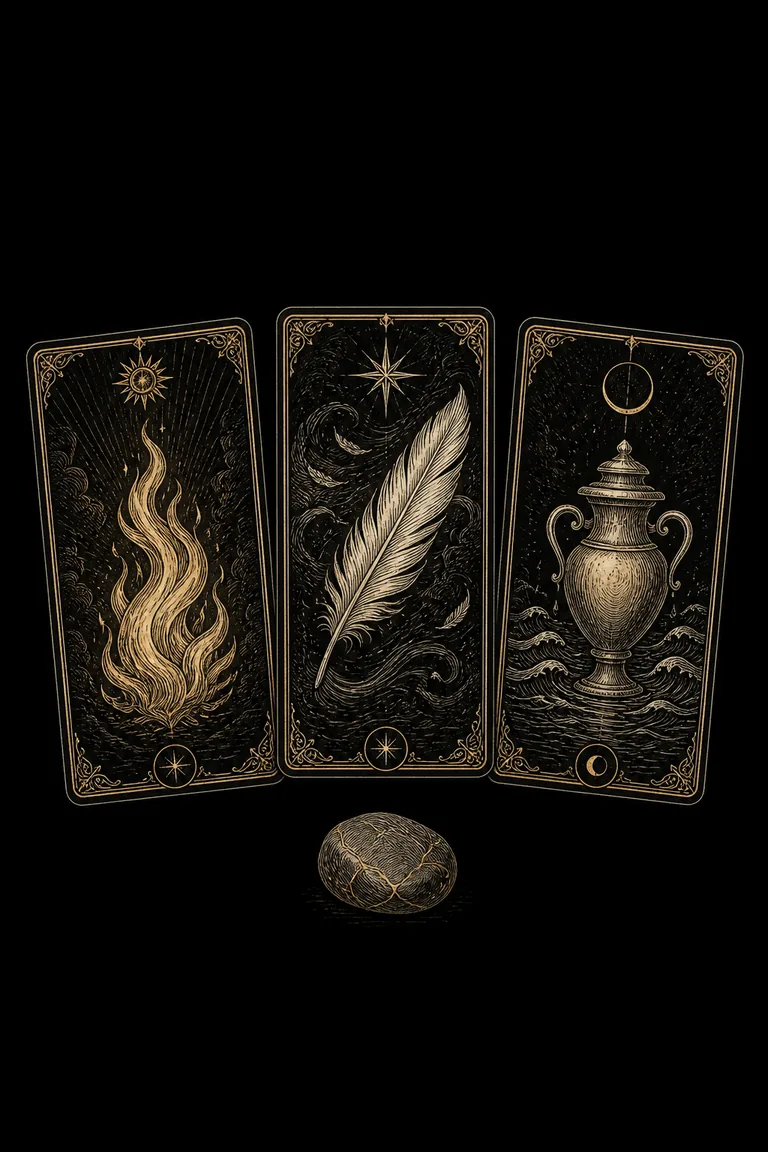
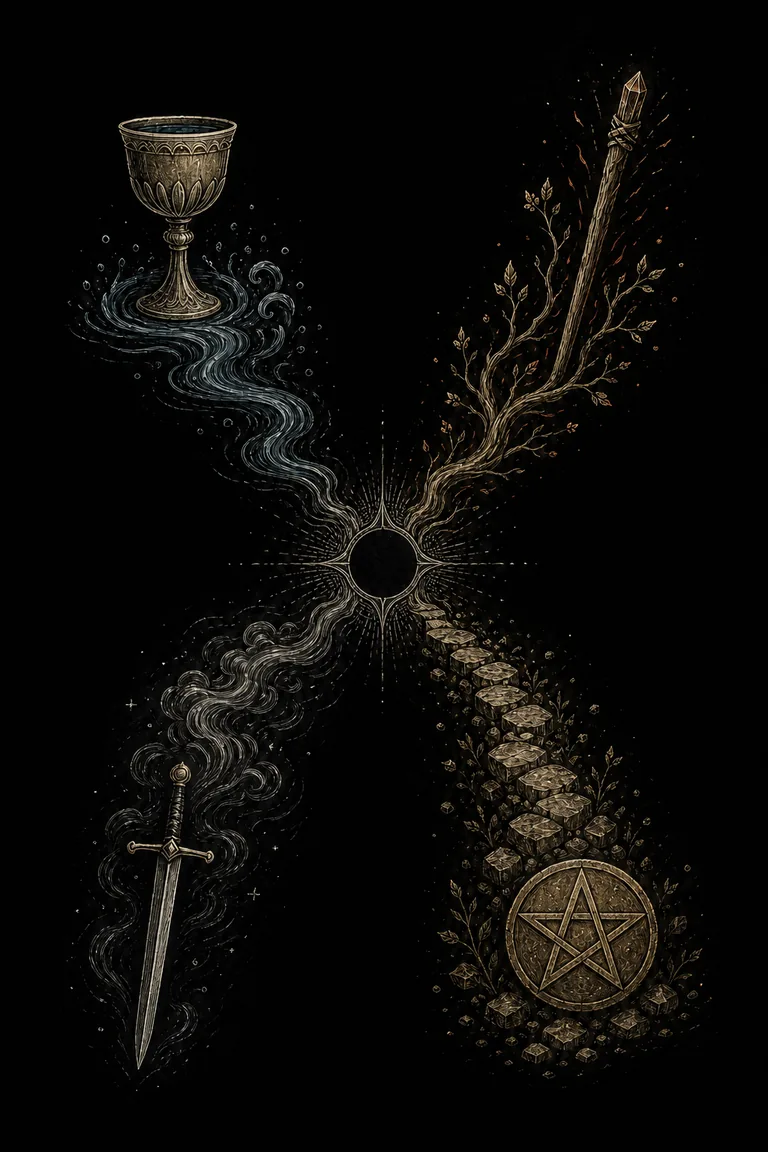
Tarot elemental dignities are a structured way to read card interactions. The basic suit correspondences are Wands with Fire, Cups with Water, Swords with Air, and Pentacles with Earth. Instead of changing a card into its opposite, the method asks whether nearby elements strengthen its expression, weaken it, or leave it relatively neutral.
A common Golden Dawn-derived rule set treats the same element as strongly reinforcing, Fire and Air plus Water and Earth as supportive, Fire and Water plus Air and Earth as contrary, and the remaining pairs as neutral. Schools differ on court cards, Major Arcana, spread geometry, and how much weight to give each relationship. Declare your version first, then use it as one layer of interpretation rather than a machine that produces a verdict.
Take the next insight with you
Explore personalized Tarot guidance in Veritas, available for iOS and Android.
 Scan with your phone
Elemental dignities at a glance
Where the method comes from
Elemental dignity rules are associated with the late nineteenth-century Hermetic Order of the Golden Dawn and its Tarot teaching commonly called Book T. In that system, a card becomes better or worse dignified through the cards beside it. Modern readers have simplified and adapted the rules in several ways. That history matters because elemental dignities are not a universal feature of every Tarot tradition, and a Marseille, intuitive, or position-led practice may handle interactions differently.
The four suit correspondences
Wands correspond to Fire and can emphasize initiative, desire, heat, creativity, and momentum. Cups correspond to Water and can emphasize feeling, relationship, receptivity, and imagination. Swords correspond to Air and can emphasize thought, language, conflict, and decision. Pentacles correspond to Earth and can emphasize resources, labor, the body, maintenance, and material conditions. These are reading conventions, not physical claims about the cards.
How elemental pairs interact
Fire and Air are supportive because air can feed a flame, while Water and Earth are supportive because water can make earth fertile. Fire and Water are contrary, as one may extinguish or evaporate the other. Air and Earth are also contrary in the traditional rule set. Fire with Earth and Air with Water are usually treated as neutral. Neutral does not mean meaningless. It means the method supplies no automatic boost or cancellation, so imagery, position, number, and question carry more of the analysis.
Strength does not mean good
Dignity describes force or ease of expression, not moral value and not a guaranteed outcome. Two Swords cards may strongly reinforce clarity, but they may also reinforce rumination or conflict. A Water card weakened by Fire is not automatically bad; the combination might show emotion being interrupted by urgent action. Translate strength into a specific verb such as accelerates, sustains, constrains, diffuses, or redirects instead of calling a card simply positive or negative.
A three-card reading example
Imagine the Eight of Wands, Queen of Swords, and Four of Cups in a left-to-right triad. Wands and Swords create a supportive Fire-Air pair, so rapid movement and clear communication reinforce each other. Swords and Cups form a neutral Air-Water pair under this rule set, so the Four of Cups is not automatically weakened. The reading might describe a fast, articulate proposal reaching someone who still needs emotional space. The cards do not prove that a message will arrive or reveal another person's private reaction.
How to use elemental dignities step by step
- Define the question
Use a question with a real decision, condition, or relationship rather than asking the elements to invent a topic.
- Choose the geometry
State which cards count as neighbors. In a line, compare adjacent cards; in a triad, decide whether the center is primary.
- Assign elements
Map the four suits first and record the correspondence system used for courts and Major Arcana, if included.
- Classify each pair
Mark the relationship as same, supportive, contrary, or neutral without interpreting yet.
- Translate the effect
Describe what becomes louder, easier, slower, conflicted, or less available, then test it against the whole spread.
Court cards and Major Arcana
The Minor Arcana suits provide the simplest assignments. Court cards can be treated by suit alone, or by blended rank-and-suit correspondences in systems that explicitly teach them. Major Arcana may receive elements through astrological correspondences, while some readers leave them outside the calculation. Do not switch methods after seeing the cards. If you are learning, use suits only until the base comparison feels consistent.
Elemental dignities and reversals
Some traditions use elemental dignity instead of reversed cards, while others use both. If both layers are active, keep their jobs separate. A reversal may describe blockage, internalization, excess, or an alternative expression according to your system. Elemental dignity describes interaction with neighboring cards. Combining them should clarify the reading, not multiply labels until any conclusion becomes possible.
Common mistakes
Common errors include treating every card in a large spread as adjacent, calling reinforcement favorable, erasing an ill-dignified card, assigning Major Arcana elements from memory inconsistently, and forcing natural metaphors beyond the declared table. Another mistake is letting elemental rules override a precise spread position. A card in an obstacle position remains an obstacle-related card even when its element is strongly supported.
Map the interaction before telling the story
Use Veritas to record the question, spread geometry, card elements, pair classifications, strongest theme, friction point, evidence, and next action.
A practical interpretation worksheet
- Name the central card
Identify the card or position whose expression you are evaluating.
- List its neighbors
Include only cards connected by the layout you declared before drawing.
- State the elemental effect
Use one plain phrase such as strongly reinforced, supported, contrary, or neutral.
- Return to the imagery
Check whether figures, direction, color, number, and position support the elemental hypothesis.
- Choose an observable test
Connect the reading to a conversation, record, deadline, boundary, or other evidence.
Limits and responsible use
Elemental dignities can organize symbolic comparison, but they cannot predict events, read minds, establish compatibility, or determine whether a person, contract, treatment, or investment is safe. A weakened card is not absent, and a strengthened card is not destiny. For high-stakes decisions, use direct communication, records, professional advice, and real-world safety criteria.