Tarot Journal
Intuition or Guidebook? How to Balance Both in Tarot
Tarot intuition becomes more reliable when it begins with what is visible, works alongside card foundations, and stays open to revision rather than claiming instant certainty.
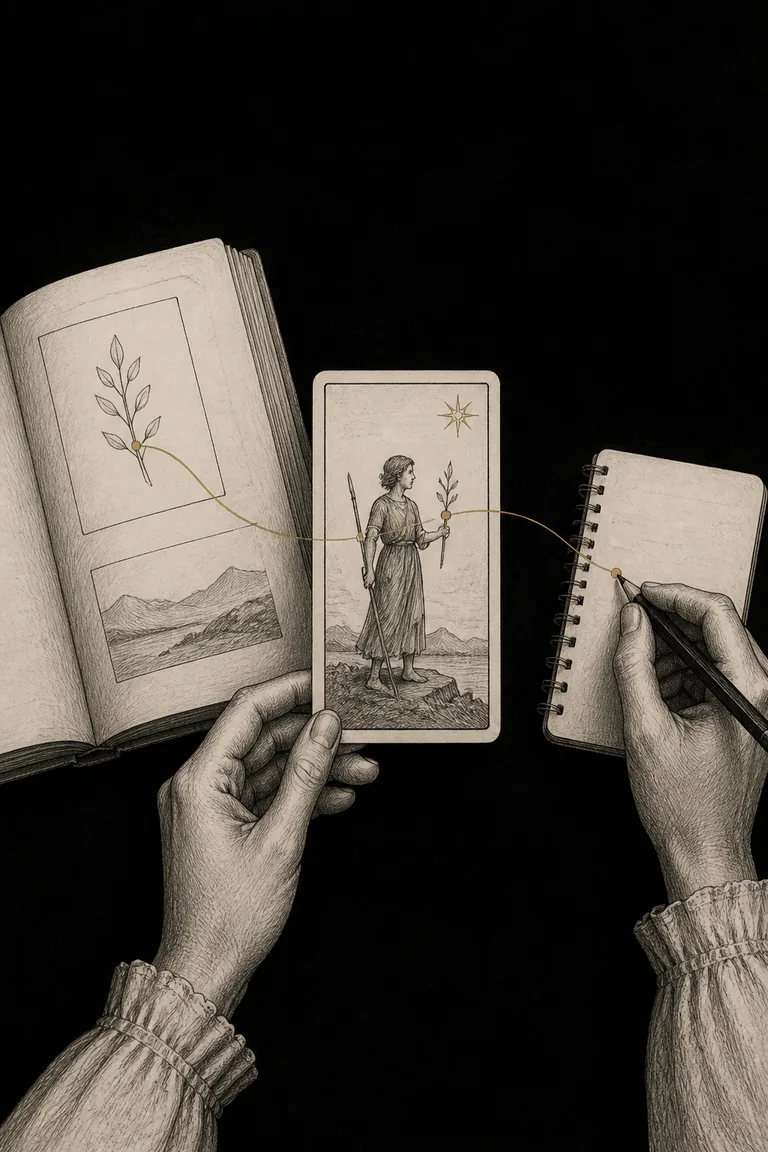
Tarot readers are often told to trust intuition or memorize traditional meanings, as though the two methods compete. In practice, a strong reading needs both. The card’s established structure keeps interpretation recognizable, while personal observation makes it responsive to the actual image, position, and question.
Intuition is not whatever thought appears first. It can include a quick visual association, a bodily response, or a connection to context, but the useful question is what supports that response and whether another interpretation fits the evidence better.
Take the next insight with you
Explore personalized Tarot guidance in Veritas, available for iOS and Android.
 Scan with your phone
What intuition means in a Tarot reading
In this context, intuition is rapid pattern recognition shaped by attention, experience, memory, and feeling. It may notice a figure’s posture before you recall a keyword or connect repeated water imagery across a spread. That response can be informative without being infallible.
Practice the balance on a real spread
Open a Tarot reading in Veritas, write one literal detail and one traditional foundation for each card, then combine them before checking a longer guide.
What a guidebook contributes
A good guidebook provides the shared architecture of the deck: suit, number, elemental pattern, archetype, and common range of expression. It protects a reading from becoming so personal that the same card can mean anything. The book is a starting vocabulary, not a script that must fit every question.
Use a three-pass reading method
Observe
Describe figures, direction, objects, weather, color, repetition, and your first response without assigning a conclusion.
Anchor
Recall or check the card’s established foundation, suit, number, and role in the deck.
Synthesize
Connect observation and foundation to the spread position, question, known facts, and reasonable uncertainty.
Start with the image, not a prediction
Suppose the Six of Swords shows figures moving away while carrying their swords. You might first notice distance, guardedness, or necessary transition. Those details fit the card’s common foundation of passage and mental movement. They do not prove where someone will go or what another person secretly intends.
Let the position limit the meaning
The same card changes emphasis in “resource,” “obstacle,” and “next action.” Intuition should answer the position rather than float above it. If your impression cannot be phrased as a response to that position and the original question, it may be an interesting association rather than the reading’s central message.
When to consult the guidebook
Write your first observations before opening the book. Then consult one reliable source when the card is unfamiliar, your interpretation feels unusually narrow, or you need to check a suit, number, reversal, or historical symbol. Add what genuinely changes the reading instead of copying every possible meaning.
Avoid guidebook dependence
Reading several entries until one confirms your hope creates the same problem as repeatedly drawing cards. Choose a primary reference, keep its system consistent, and close it after you have recovered the foundation you need. Fluency grows from applying a smaller vocabulary repeatedly.
Avoid intuition as unquestionable authority
A strong feeling is not evidence about another person’s private thoughts, fidelity, health, or future behavior. Ask what in the card supports the impression, what known fact connects to it, and what would make you reconsider. Ethical interpretation leaves room for consent, direct communication, and uncertainty.
Use combinations as grammar
When several cards appear, let intuition notice relationships before inventing a story. Direction, repeated suits, contrasting numbers, and changes in landscape can act like grammar. Establish each card first, then describe how one modifies or develops the next.
A practical example
In a “what supports progress?” position, the Eight of Pentacles may show a craftsperson absorbed in repeated work. Your observation is careful repetition; the foundation is skill through practice; the position asks for support. A proportionate synthesis is to schedule deliberate practice, not to predict guaranteed professional success.
How reversals affect the balance
If you use reversed cards, begin with the upright foundation. Then test whether the energy appears blocked, internalized, delayed, excessive, or redirected. Your visual response may suggest one option, but question and position still decide whether that option is coherent. A reversal does not require inventing a completely unrelated meaning.
Build intuition through review
A Tarot journal turns impressions into material you can examine. Record the detail that caught your attention, the foundation you used, confidence level, interpretation, and later result. Review both useful readings and misses. Pattern recognition improves when memory cannot quietly edit the evidence.
A simple practice without a reading question
Choose one card and spend two minutes describing only what is visible. Write three possible emotional tones, then check the guidebook foundation and note the overlap. Finally, create one grounded question the card could help explore. This trains flexibility without forcing a prediction.
Know when the balance is working
The reading should sound specific to the card, position, and question while remaining understandable to someone who did not feel your first impression. You should be able to explain the path from image to meaning and name what remains uncertain. That is disciplined intuition, not reduced imagination.
Tarot is a symbolic reflective practice, not a scientifically validated forecasting method. Neither intuition nor a guidebook can diagnose conditions, establish consent, reveal private facts, or replace medical, legal, financial, or safety guidance.