Tarot Journal
Tarot Landscape Symbolism: A Terrain Reading Guide
Tarot landscape symbolism becomes useful when you read terrain, distance, horizon, water, weather, and routes as visible conditions in a scene rather than fixed predictions.
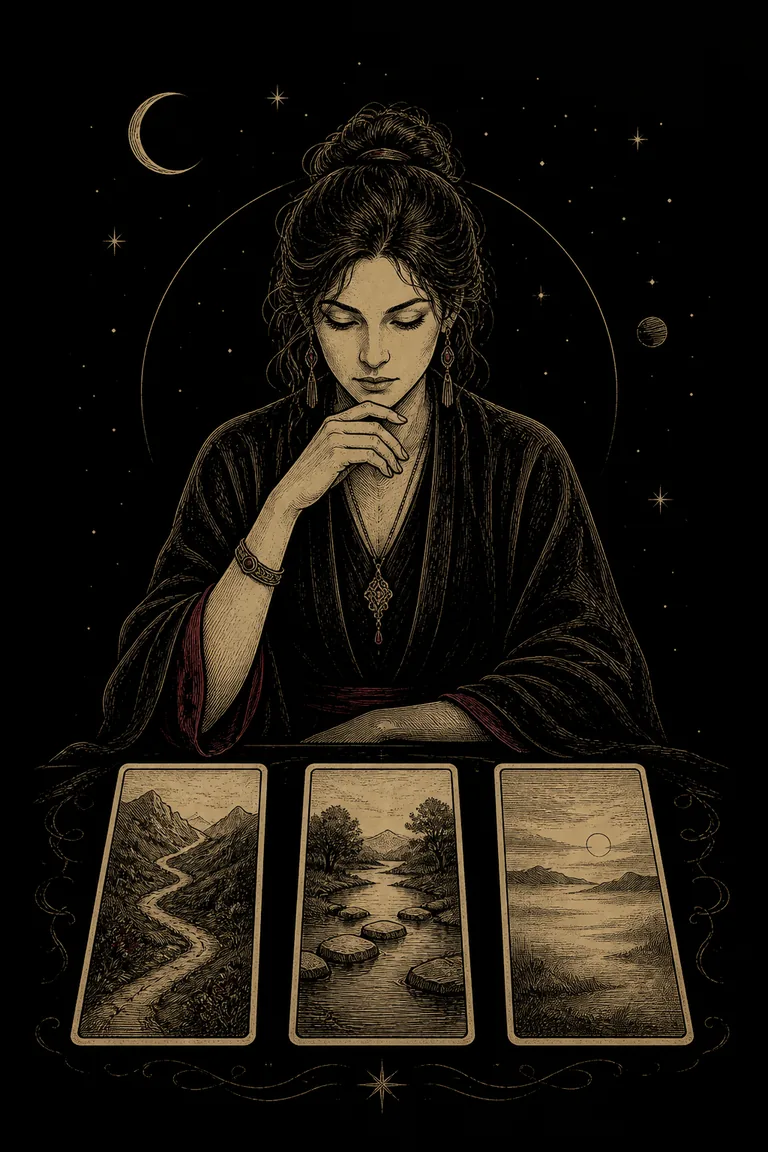
Landscapes in Tarot cards establish the ground on which a scene can happen. A steep path changes the effort required to move. A wide river separates places even when both banks are visible. A distant mountain can organize direction, scale, or delay, while an empty horizon may create exposure, freedom, uncertainty, or simply visual space. Meaning begins with the terrain and what the figures can actually do within it.
Read the land before naming an association. Record surface, slope, distance, route, water, weather, vegetation, visibility, and the figures relationship to each feature. Then compare the deck tradition, spread position, neighboring cards, and question. A storm does not automatically predict conflict, and a sunny field does not guarantee an easy outcome.
Take the next insight with you
Explore personalized Tarot guidance in Veritas, available for iOS and Android.
 Scan with your phone
Tarot landscape symbolism at a glance
Observation comes before symbolic meaning
A narrow trail climbs toward a ridge is an observation. Ambition, difficulty, escape, pilgrimage, and compositional depth are interpretations. Several may fit the same picture. The Tarot card symbolism guide separates visible evidence from a proposed meaning. Keep that boundary so the landscape supports the reading instead of becoming an unchecked dictionary.
A six-pass landscape method
- Inventory the terrain
Name plain, hill, mountain, valley, shore, desert, forest, cultivated field, or unclear ground without interpreting it.
- Trace the route
Follow roads, paths, rivers, shorelines, gaps, and barriers. Note whether a usable route reaches the apparent destination.
- Measure relative distance
Record what is foreground, middle distance, horizon, hidden, cropped, above, or below the figures.
- Read conditions
Notice surface, slope, weather, light, water state, visibility, season, and signs of cultivation or neglect.
- Offer two functions
Write one likely interpretation and one fair alternative that explains the same environmental facts.
- Test the whole scene
Use posture, gaze, objects, question, position, neighboring cards, guidebook, and later evidence to choose cautiously.
Mountains, hills, and vertical distance
Elevated terrain can create effort, overview, exposure, separation, refuge, or a long time horizon. The route matters more than the peak alone. Is the mountain being climbed, observed, left behind, or used as a distant backdrop? A clear switchback suggests a different problem from a sheer face. Height does not automatically mean achievement, spirituality, or superiority.
Rivers, seas, and changing water
Water can divide, carry, reflect, erode, nourish, or conceal. Check whether it is still or moving, shallow or deep, crossed or uncrossed, contained or flooding. A boat, bridge, ford, or visible bank changes the practical reading. Before calling water emotion, ask what it does in this exact scene. The behavior of the water is evidence; the emotional analogy is a hypothesis.
Forests, fields, and cultivated ground
Dense growth can reduce visibility and multiply possible routes. Open fields can expose figures while improving orientation. Cultivated land may point toward repeated labor, stewardship, ownership, harvest, or an artistic convention. Use the deck-specific plant method when individual species or crop condition matter, but do not assume every green landscape means growth.
Deserts, bare ground, and absence
Sparse terrain makes resources, shelter, distance, and scale easier to see. It can support readings about exposure, focus, scarcity, simplicity, endurance, or deliberate removal of distraction. Absence is not proof of deprivation. Compare what the figure carries, whether a route exists, and whether the deck uses empty backgrounds as a normal design choice.
Weather, sky, and visibility
Cloud, rain, wind, snow, mist, and changing light modify visibility and movement. Ask whether the weather is arriving, passing, distant, or already affecting the figures. A dark sky can increase contrast without predicting trouble. For readers who distinguish color poorly, brightness, edge clarity, cloud density, direction of marks, and the figures response provide a non-hue route through the image.
Horizon, scale, and point of view
A low horizon makes the sky dominant; a high horizon gives more space to the ground. An aerial view can reveal a route while reducing intimacy. A close viewpoint may hide the destination. These compositional choices influence what the reader knows. They can frame planning, uncertainty, perspective, or limited information without claiming that the card has disclosed unseen facts.
Worked example: a path toward mountains
Suppose a figure stands on a level road that curves toward distant mountains. One reading says the immediate next step is clear even though the long-term demand remains large. Another says the mountains are background scale and the real subject is the stable ground underfoot. The figures gaze, load, pace, card position, and adjacent cards decide which interpretation serves the question.
Worked example: water between two figures
Imagine two figures facing each other from opposite banks. The water may function as a boundary, a shared resource, a communication channel, or ordinary scenery. Check current, width, bridges, gestures, and whether either figure attempts to cross. In a relationship reading, translate the image into checkable questions about access and agreement rather than predicting separation.
Worked example across three cards
A spread moves from foggy ground to a marked path and then to an open horizon. A coherent story could describe uncertainty, orientation, and broader visibility. A rival explanation is that three artists or card scenes use unrelated landscape conventions. Connect the sequence only when direction, posture, repeated forms, and positions support it. The Tarot storytelling method helps make those connectors explicit.
Deck lineage changes the environment
Rider-Waite-Smith-derived decks often place scenic Minor Arcana figures in recognizable terrain. Marseille pip cards may create implied fields through symmetry, vines, borders, and empty space instead. Contemporary decks can move a traditional scene into a city, interior, ocean, or abstract plane. Compare the decks own visual grammar before importing a landscape meaning from another tradition.
Save a landscape evidence map
Use Veritas to record terrain, route, distance, water, weather, visibility, scale, figures, two possible functions, deck source, and the evidence that later supported or challenged your reading.
A practical journal protocol
Choose one card with a visible environment. Draw a simple line from the foreground to the horizon and mark every route, barrier, water edge, elevation change, and weather condition. Add one sentence about what the terrain permits and one about what it costs. Propose two functions and one ordinary artistic explanation. Revisit the entry after consulting the guidebook or comparing another card from the same deck.
Common landscape-reading mistakes
Common mistakes include calling every mountain a goal, every river emotion, every desert loneliness, every storm conflict, and every road a journey. Readers may ignore the usable route, treat distant objects as immediate, confuse weather with outcome, or apply one decks scenery to another. Inventory the environment first and retain a competing explanation.
Limits and responsible use
Tarot landscape symbolism is an interpretive visual practice. It cannot independently prove travel conditions, environmental hazards, weather, property boundaries, migration outcomes, physical safety, or another persons intentions. Use forecasts, maps, inspections, qualified advice, and direct communication for consequential decisions. For agency-centered prompts, see questions to ask Tarot.