Tarot Journal
Tarot Plant Symbolism: A Deck-Specific Reading Guide
Tarot plant symbolism becomes useful when you identify what the artwork actually shows, describe its condition and placement, and test its role in the card before assigning a fixed meaning.
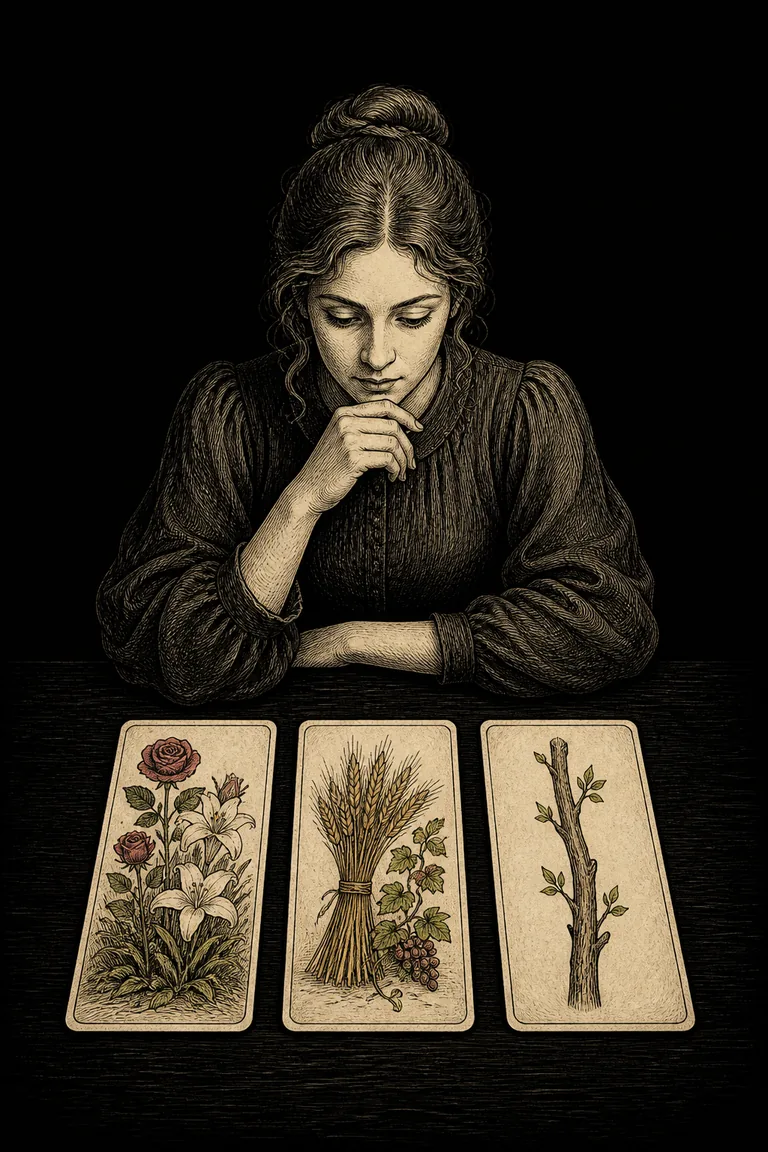
Tarot plant symbolism includes flowers, trees, fruit, grain, gardens, vines, leaves, and living wood. A plant can show cultivation, abundance, dormancy, exposure, harvest, enclosure, or simple decoration. Its function depends on the deck, card scene, and question, not on one universal botanical dictionary.
Begin with visible evidence: plant type if identifiable, life stage, condition, scale, placement, repetition, and relationship to people or objects. Then compare creator notes, deck lineage, neighboring cards, and spread position. A rose in a tended garden can do different work from a rose on a banner or garment, even when the species is the same.
Take the next insight with you
Explore personalized Tarot guidance in Veritas, available for iOS and Android.
 Scan with your phone
Tarot plant symbolism at a glance
Plant evidence versus plant association
A figure stands beside ripe wheat is an observation. Fertility, provision, labor, season, patience, and harvest are associations. Several may fit, and an agricultural detail can also establish place or status. The broader Tarot card symbolism guide separates visible evidence from proposed meaning. Keep that boundary before deciding what any plant represents.
A six-pass method for reading plants
- Identify cautiously
Name the plant only as precisely as the artwork supports. Flower or grain may be more accurate than a specific species.
- Record condition
Note whether it is budding, flowering, fruiting, cut, bound, cultivated, wild, dormant, damaged, or dead.
- Map placement
Ask whether the plant is held, worn, eaten, harvested, fenced, crossed, climbed, displayed, or left in the background.
- Find the visual job
Test whether it marks a stage, creates contrast, frames a person, establishes a setting, or links cards.
- Offer two functions
Write one likely reading and one fair alternative that also fits the visible scene.
- Check the source
Compare the guidebook, deck lineage, spread grammar, question, and later evidence before choosing.
Species and false precision
Botanical precision matters only when the image supports it. A stylized blossom may be a rose, lily, lotus, tulip, or ornamental form, and different editions can simplify the same detail. Record petal shape, leaves, fruit, and setting before naming a species. If a reading depends on an exact identification, verify the artist or publisher notes instead of treating resemblance as proof.
Condition is the verb of the plant
A seed, bud, open flower, ripe fruit, cut branch, and bare tree describe different stages. Condition can matter more than a memorized species meaning because it shows what the image is doing now. Ask what has been cultivated, what is ready, what is protected, and what lacks the conditions to continue. Avoid turning every green leaf into progress or every bare branch into loss.
Gardens, fields, and wild growth
A garden combines living growth with boundaries, selection, and maintenance. A field can foreground labor, season, shared resources, or scale. Wild growth may suggest conditions outside deliberate control, but it does not automatically mean freedom or disorder. Compare paths, walls, tools, water, human attention, and access before choosing a theme.
Worked example: roses and lilies in a garden
In the familiar Rider-Waite-Smith Magician, red roses and white lilies appear in a cultivated garden. One reading treats the paired colors and species as differentiated desires held inside deliberate practice. Another emphasizes the garden itself: potential is maintained through repeated attention rather than intention alone. The Tarot color symbolism method can test the palette without pretending red and white always carry the same meaning.
Worked example: grain and harvest
Suppose a seated figure is surrounded by mature grain. The grain can establish provision and a completed growing season, but it may also show dependence on land, labor, weather, or other people. In a work question, compare current resources with documented effort and maintenance. The image does not guarantee pregnancy, profit, food security, or a specific harvest date.
Worked example: living wood
Leafing staffs in a deck can make wood feel active rather than inert. One function is continued capacity inside a tool or burden. Another is artistic continuity across a suit. Track whether the leaves increase, disappear, or change condition across nearby cards. Use Tarot storytelling to decide whether that change advances the spread or remains background design.
Repeated plants across a spread
Repetition becomes meaningful when it creates a relationship. Track whether a plant moves from seed to fruit, wild ground to garden, living branch to cut wood, or background ornament to something a figure handles. Also test the ordinary explanation that one deck repeats a studio motif. Compare plants with animals, people, tools, and direction instead of letting one detail dominate the whole reading.
Rider-Waite-Smith and Marseille lineages
Rider-Waite-Smith-derived decks often give plants a narrative place inside scenic Minor Arcana and Major Arcana compositions. Marseille-derived pip cards may use leaves and flowers as patterned structures around suit emblems, where rhythm, enclosure, and symmetry can matter more than literal species. The Rider-Waite-Smith versus Marseille guide explains why a method should follow the deck rather than assume one visual grammar.
Myth, folklore, and creator intention
Plants carry different meanings across religious art, heraldry, medicine, agriculture, myth, and local custom. A pomegranate or laurel may support a named reference when the deck signals it, but similarity alone does not import every story attached to that plant. Cite the exact source, distinguish historical evidence from modern association, and keep a competing scene-based reading available.
Save a plant-symbol audit
Use Veritas to record the plant, visible condition, placement, human relationship, two possible functions, deck source, spread context, practical question, and later evidence.
A practical journal protocol
Choose one card with a plant and spend sixty seconds listing facts without interpretation. Add one sentence about life stage, one about setting, and one about relationship to the main figure. Propose two meanings and one ordinary artistic explanation. Revisit the entry after checking the guidebook. A Tarot journal shows which botanical associations remain useful across decks and which belong to one image.
Common mistakes
Common mistakes include guessing a species from a rough drawing, treating every flower as romance, equating fruit with guaranteed abundance, ignoring cultivation and damage, importing folklore the deck does not reference, and using season as a literal deadline. Another mistake is reading decoration as narrative only after an outcome makes the detail feel important.
Limits and responsible use
Tarot plant symbolism is an interpretive visual practice, not a validated method for diagnosing health, confirming fertility, identifying an herb, predicting weather or crops, locating food, or guaranteeing love, money, pregnancy, recovery, or timing. Use the image to form questions that can be checked through records, conversation, observation, or a reversible action. For agency-centered prompts, see questions to ask Tarot.