Tarot Journal
Tarot Pathworking: A Grounded Guided Practice
Tarot pathworking is a structured imaginative journey through one card, followed by a deliberate return to the printed image, written verification, and ordinary grounding.
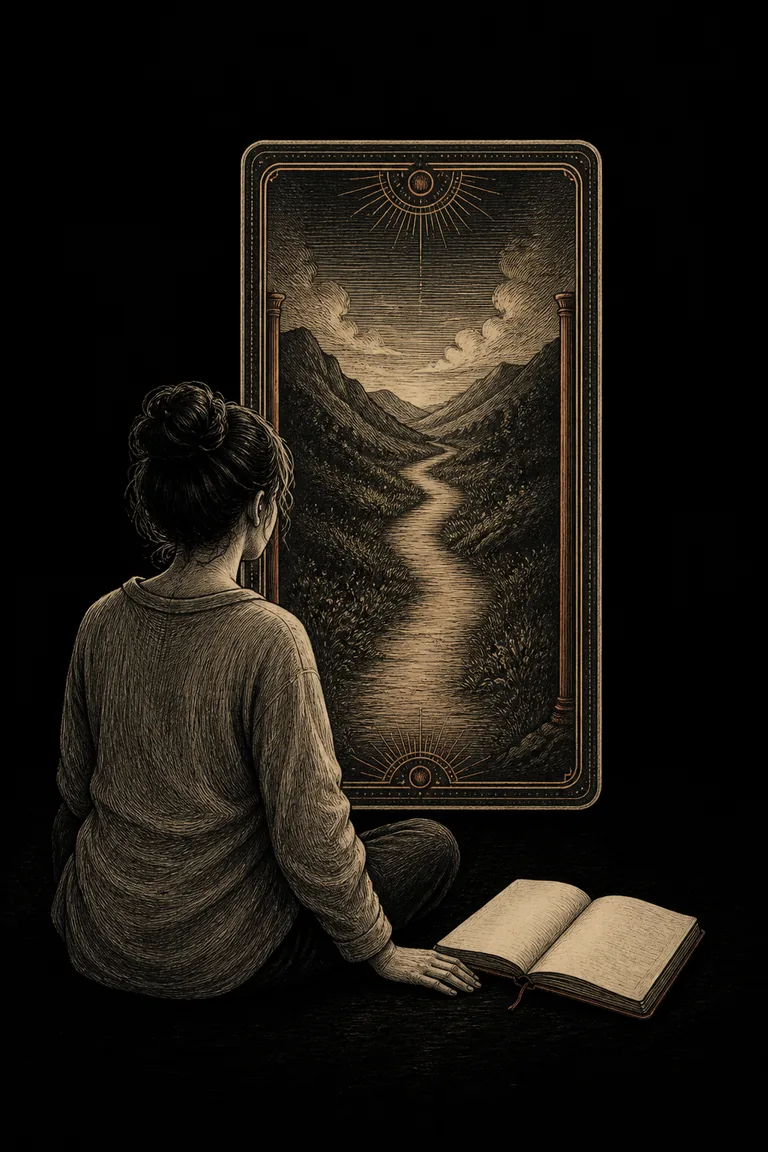
Tarot pathworking treats a card as the starting frame for a longer visualization. You study the image, imagine entering its scene, observe what your mind adds, retrace the route, and compare the experience with the physical card. The method can deepen familiarity with composition and symbol, but vividness does not make an imagined figure, voice, or event externally true.
Use the fifteen-minute method below for a low-stakes study card. Decide the stopping time before beginning, keep the physical card and room easy to see, and finish by writing visible evidence separately from imagined additions. Open your eyes and stop immediately if the exercise becomes distressing, disorienting, compulsive, or difficult to leave.
Take the next insight with you
Explore personalized Tarot guidance in Veritas, available for iOS and Android.
 Scan with your phone
Tarot pathworking at a glance
What Tarot pathworking means
In broad modern use, pathworking is an immersive guided-imagery practice organized around a symbolic route. Tarot readers often use a Major Arcana image as a threshold, then imagine moving through its landscape. Formal Hermetic Qabalah uses the term more specifically for journeys along paths of the Tree of Life with declared correspondences, ritual structures, and school-specific sequences. A simple card exercise should not be presented as equivalent to that full tradition.
A fifteen-minute Tarot pathworking method
- Frame the session for two minutes
Choose one card, write the purpose and stopping time, and identify one detail that will mark the entrance and exit.
- Observe for three minutes
Describe the actual foreground, background, figures, objects, directions, colors, and open routes.
- Enter for four minutes
Imagine crossing one visible threshold and explore slowly without forcing speech, prophecy, or a destination.
- Return for two minutes
Retrace the same route, cross the original threshold, open your eyes, and name five objects in the room.
- Verify and write for four minutes
Compare memory with the printed card, label additions, record alternatives, and choose one grounded action.
Choose a card with a usable route
Beginners usually benefit from a card with a clear foreground, middle distance, and exit. A road, arch, shoreline, gate, room, or seated figure gives the imagination a stable frame. Choose the card deliberately rather than drawing for a prediction. Major Arcana images often contain a strong scene, but a scenic Minor Arcana card can work just as well. Avoid a card that currently evokes panic, trauma, or an urge to obtain urgent instructions.
Prepare an exit before entering
Keep the card within reach, use a gentle timer, sit somewhere physically supported, and decide exactly how the session ends. Your exit might be the same gate, path, or edge of the card used at entry. The point is not to close a supernatural portal. A defined return prevents an open-ended fantasy from replacing the agreed exercise and gives you a simple sequence to follow if attention wanders.
Observe the printed card first
Write checkable details before closing your eyes. Count visible figures and objects. Note which way bodies face, whether a door is open, where the horizon sits, and what is absent. This baseline protects the later comparison. If you cannot tell whether something is a mountain, cloud, or fabric fold, record the uncertainty rather than choosing the most dramatic possibility.
Enter the image without demanding a message
Picture the card at a comfortable scale and imagine stepping only as far as the first stable point. Notice distance, temperature, sound, and movement if they arise, but do not strain to manufacture a complete scene. An imagined character may seem to speak. Treat the words as your own associative material. You can ask neutral questions such as what detail needs another look, while refusing commands, diagnoses, predictions, or claims about another person.
Keep choice inside the visualization
You do not have to approach every figure, open every door, or continue a scene that feels unsafe. You may pause, step backward, change to observer perspective, or end early. A successful pathworking is not measured by intensity, duration, unusual imagery, or emotional release. Maintaining the ability to choose and return is more useful than producing an impressive story.
Return by the same route
When the timer sounds, turn toward the entrance, retrace the route, and imagine the scene returning to the size of the printed card. Open your eyes, look around the actual room, feel the chair and floor, and name ordinary sensory details. If the image lingers, do not interpret the persistence as a sign. Shift attention to water, movement, daylight, conversation, or another familiar activity.
Verify before interpreting
Compare the remembered scene with the card line by line. You may have added a staircase, changed a facial expression, heard water where none is shown, or ignored an open path. Mark each difference as an imagined addition. The additions can still be useful for reflection, but their source category matters. Write at least one alternative meaning and one detail that contradicts your first story.
Keep the journey auditable
Use Veritas to save the card, purpose, entry and exit, visible evidence, imagined additions, body response, alternatives, grounded action, and review date.
How to journal a pathworking
Use separate headings for printed detail, imagined scene, emotion, conventional card meaning, personal association, alternative reading, and real-world evidence. Write in past tense so the record does not become an instruction. A useful closing line might name one conversation to clarify, one task to divide, or one assumption to check. Avoid declaring that a guide ordered a breakup, purchase, medical choice, confession, or risky act.
Pathworking versus Tarot meditation
Tarot meditation can remain mostly observational and may use only a brief visualization before returning to the card. Pathworking gives imagined movement and route more space, so it needs a stronger entry, exit, and verification structure. If your goal is simply to learn symbolism, begin with the shorter Tarot meditation. Use pathworking only when you can maintain the distinction between an image in mind and evidence in the world.
Pathworking and the Tree of Life
In Hermetic Qabalah, practitioners may connect twenty-two paths with Hebrew letters, Major Arcana cards, astrological or elemental attributions, colors, divine names, and sephiroth. Correspondence systems and card numbering differ between traditions and decks. Study the source system before attempting to reproduce it, and name the lineage or table you use. The beginner method here is secular card-based imagery, not an initiation or authoritative Tree of Life curriculum.
Working with a difficult card
Do not enter a distressing image to prove courage. Keep your eyes open, shorten the exercise, study formal composition, choose a gentler card, or stop. If visualization intensifies panic, paranoia, dissociation, intrusive thoughts, traumatic memory, or loss of sleep, discontinue it and seek appropriate mental health support. Tarot practice is not exposure therapy and should not replace professional care.
How often to practice
One session a week leaves time to compare notes with ordinary life. Repeating the same card after two or four weeks can show which additions persist and which depended on mood. More sessions do not produce more truth. Pause if you feel compelled to pathwork before routine decisions, chase the same reassuring scene, or interpret every later coincidence as confirmation.
Limits and responsible use
Tarot pathworking cannot reveal hidden facts, verify spirits, recover reliable memories, read another person's mind, diagnose health, establish consent, or guarantee an event. Imagination can be vivid, coherent, and emotionally important without being external information. Use direct communication, records, medical and mental health care, legal advice, financial evidence, and safety planning for consequential choices. The practice is most useful when it improves attention and reflection while leaving reality free to disagree.