Astrology Journal
Mars Return Chart: Calculation and Interpretation
A Mars return chart is cast for the exact instant transiting Mars reaches its natal apparent geocentric longitude, with every crossing, location choice, and calculation setting preserved.
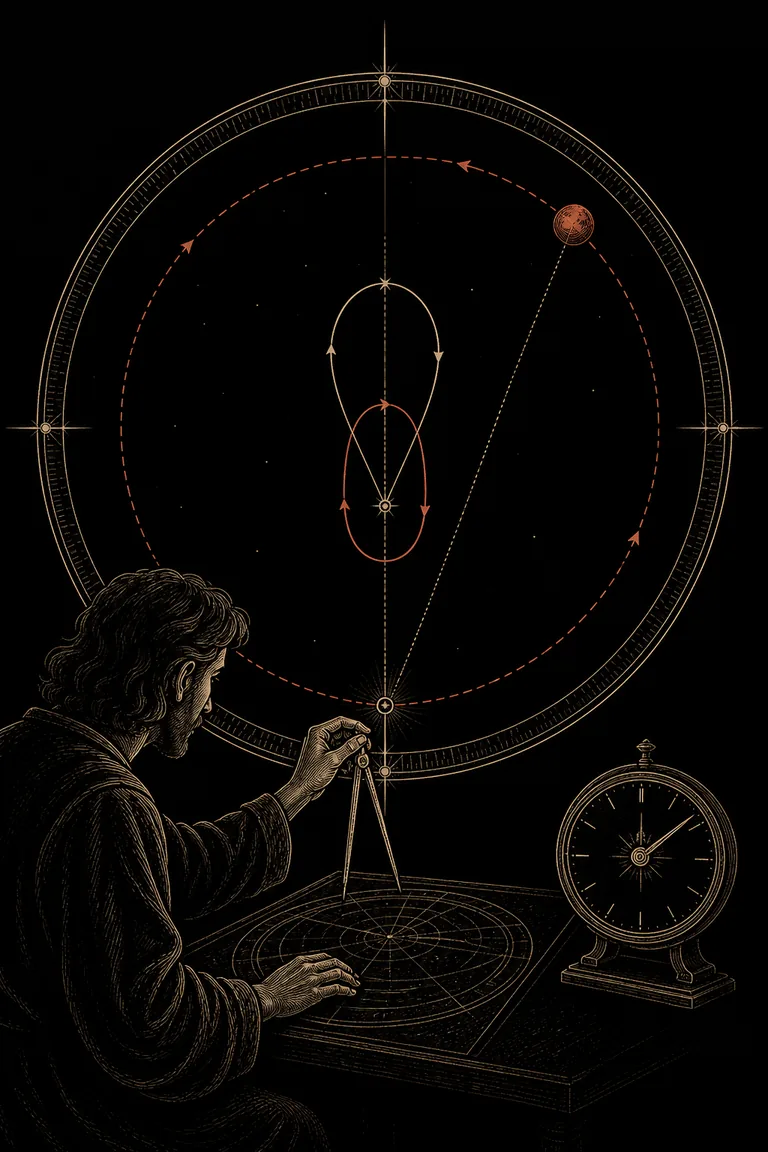
A Mars return occurs when transiting Mars returns to the same zodiacal longitude it held at birth. It is not merely Mars entering the natal sign or coming within a wide conjunction. The calculation solves an exact longitude equality, then casts a chart for that timestamp and a declared location.
Mars takes roughly 687 days to orbit the Sun, so returns are often described as arriving about every twenty-two to twenty-three months. Actual geocentric crossings are irregular because Earth and Mars move, Mars changes apparent speed, and retrograde motion can produce three exact passes. Use the orbital period only as a search estimate, never as the return timestamp.
Take the next insight with you
Explore personalized Astrology guidance in Veritas, available for iOS and Android.
 Scan with your phone
Mars return meaning at a glance
What you need to calculate it
Save the birth date, exact time and time-zone conversion, birthplace, natal Mars longitude, tropical or sidereal zodiac, ayanamsha if sidereal, apparent or geometric position setting, ephemeris version, and search interval. Use the same settings for natal and return positions. A wrong time zone can shift houses and angles even when Mars itself moves slowly. See birth charts without a birth time before relying on angles.
How to find the exact return
- Calculate natal Mars
Record the full 0 to 360 degree longitude and all chart settings.
- Estimate the search window
Start near the natal date plus roughly 687 days, then scan a generous interval.
- Bracket equality
Find consecutive timestamps where the wrapped longitude difference crosses zero.
- Refine the time
Interpolate for a first estimate, then use a reliable ephemeris solver to exactitude.
- Continue scanning
Do not stop until the surrounding retrograde loop is clear and every crossing is stored.
A transparent interpolation example
Illustrative first estimate before ephemeris refinement
Natal Mars longitude = 223.400 degrees
00:00 UTC transit = 223.100 degrees; 24:00 UTC transit = 223.700 degrees
fraction = (223.400 - 223.100) / (223.700 - 223.100) = 0.5
first estimate = 12:00 UTC
The example assumes smooth direct motion inside one day. It is not a substitute for a high-quality ephemeris. Longitude wraps at 0 degrees, and a station can make linear interpolation unreliable. Refine the timestamp numerically, state the tolerance, and verify the result independently. Do not round to the nearest day and call it exact.
Retrograde triple passes
If Mars crosses the natal longitude, stations retrograde, crosses it backward, then stations direct and crosses it again, save all three exact timestamps. Label signed daily motion and the station dates. Do not select only the most convenient pass or merge the interval into one vague return date. The three charts share one return sequence but can differ in angles, houses, Moon position, and other contacts.
Which location should you use?
The exact Mars longitude match is global, while houses and angles depend on place. Some astrologers use the birthplace; others use the location occupied at the return. Choose and record the rule before viewing competing charts. If travel is uncertain, compare both as clearly labeled variants instead of quietly choosing the more attractive result.
How to read a Mars return chart
Begin with return Mars by sign, house, speed, retrograde status, angularity, and aspects. Then inspect the ruler of the Mars sign, the Ascendant and its ruler, repeated angular planets, and tight configurations. Use one declared aspect family and orb policy. The guides to Mars sign meaning and astrology aspects provide the base vocabulary.
Compare the return with the natal chart
Use a biwheel to separate return-to-return aspects from return-to-natal contacts. Record which natal houses receive return planets and whether return angles touch natal planets. If the birth time is uncertain, exclude natal houses and angles. A tight contact can focus reflection, but it does not cause or guarantee an external event. Compare the technique with ordinary astrology transits.
Work, conflict, desire, and physical effort
A Mars return can organize questions about initiative, workload, competition, boundaries, anger, sexual agency, exercise, and tactical priorities. Phrase claims as choices or conditions you can observe. The chart cannot prove another person's desire or hostility, guarantee a promotion or victory, diagnose injury, prescribe training, or justify aggression. Direct communication and qualified advice take priority.
Save every pass and every setting
Use Veritas to record the exact Mars return timestamps, signed motion, location rule, chart settings, limited interpretations, chosen actions, and evidence found at review.
How to review the return
Before later events are known, save three to five specific interpretations, what would support them, what would count as a miss, and a fixed review date. Separate events from choices made because of the reading. For a triple pass, review each chart and the full sequence without retroactively moving every event to whichever pass appears to fit.
Common errors
Frequent errors include matching only the sign, adding exactly 687 days without checking longitude, confusing the roughly 687-day orbit with other Earth-Mars cycles, missing retrograde crossings, mixing tropical and sidereal data, changing location after interpretation, and using wide orbs. Interpretive errors include predicting conflict, surgery, accidents, athletic success, sex, or career wins from one placement.
Limits and responsible use
Mars returns are symbolic astrological techniques, not scientifically validated forecasts. A return chart cannot diagnose illness, assess injury risk, determine consent, expose enemies, predict violence, guarantee performance, or replace medical, legal, financial, safety, or mental health support. If anger, coercion, pain, or danger is present, respond to direct evidence and seek appropriate help.