Astrology Journal
Nodal Sesquisquare in Astrology: Timing and Calculation
A nodal sesquisquare occurs when the transiting North Node is 135 degrees from its natal longitude, creating two exact three-eighths-cycle orientations on the zodiac.
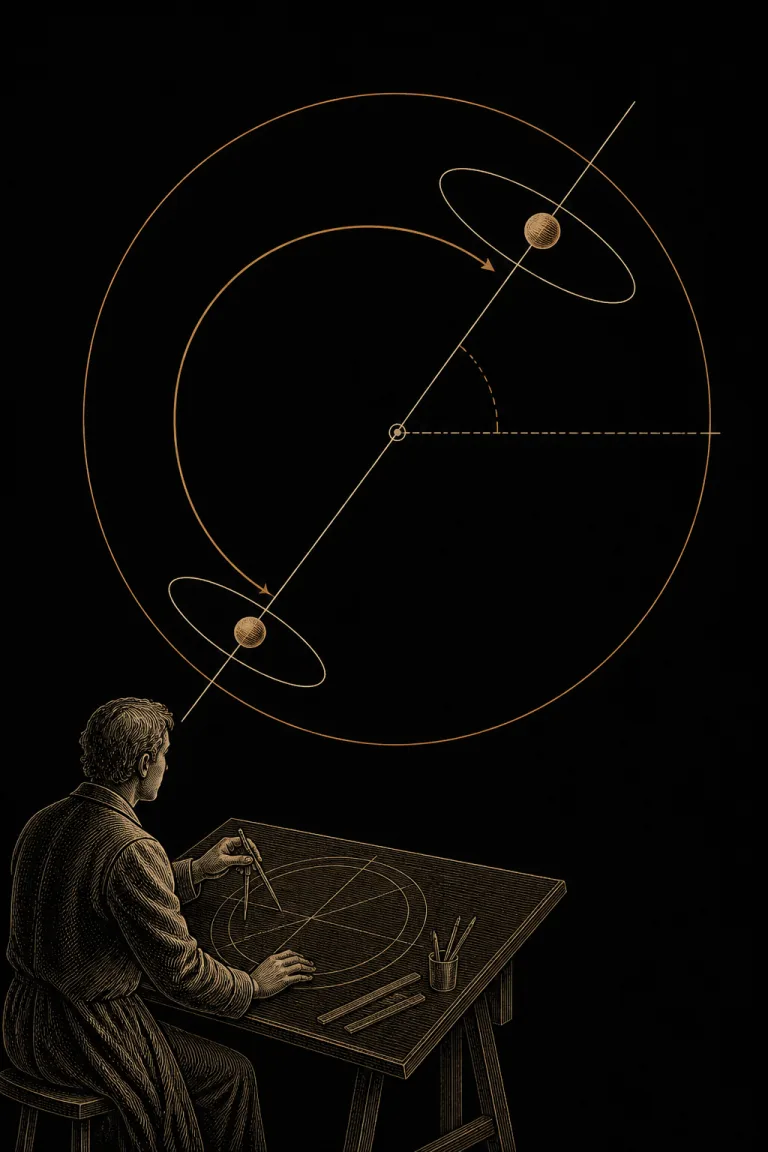
In astrology, a nodal sesquisquare is an exact 135-degree relationship between the transiting North Node and the natal North Node. The aspect is also called a sesquiquadrate. Because the lunar nodes form an axis, the two North-to-North targets are 135 degrees and 225 degrees. At either target, transiting North Node is simultaneously 45 degrees from natal South Node.
The geometry and timing can be calculated, but the meaning remains symbolic. A software aspect label, rounded age, or exact timestamp does not prove pressure, crisis, karmic correction, or a destined event. A reproducible record states the node convention, zodiac, reference frame, target orientation, timestamp, signed motion, orb, ephemeris source, and every exact pass.
Take the next insight with you
Explore personalized Astrology guidance in Veritas, available for iOS and Android.
 Scan with your phone
Nodal sesquisquare at a glance
What makes a sesquisquare 135 degrees
A sesquisquare spans three eighths of a circle: 3 × 45° = 135°. It can also be described as a square plus a semisquare. Astrologers differ on how much weight or orb to give this minor aspect, especially between calculated points. For timing, solve the exact longitude first. Any interpretive window around that instant is a separate choice that should be stated rather than hidden.
Sesquisquare versus semisquare
This article owns the 135-degree North-Node-to-North-Node relationship. The nodal semisquare guide owns the 45-degree North-to-North phase. Both calculations expose a complementary cross-axis relationship because natal South Node is exactly opposite natal North Node. Name the two points compared so a 45-degree software label is not mistaken for the other cycle phase.
The simultaneous cross-axis semisquare
When transiting North Node is 135 degrees from natal North Node, it is 45 degrees from natal South Node. At the other orientation, 225 degrees North-to-North again produces a 45-degree shortest separation to natal South Node. Software may display the sesquisquare, the semisquare, both, or neither depending on point and orb settings. The underlying axis geometry is the same regardless of the label shown.
The two 135-degree orientations
Normalize natal North Node minus 135 degrees and plus 135 degrees on a 0-to-360-degree circle. With a continuously retrograde mean node, the minus-135 target usually arrives about three eighths of a cycle after a return. The plus-135 target requires 225 degrees of retrograde travel, about five eighths of a cycle. Record orientation because the same 135-degree shortest separation can occur at two distinct places in the cycle.
Approximate age windows
Three eighths of 18.6 years is about 6.98 years and five eighths is about 11.63 years. Search centers therefore recur near ages 7.0, 11.6, 25.6, 30.2, 44.2, 48.8, 62.8, 67.4, 81.4, and 86.0. These are search aids, not personal deadlines. Exact dates depend on natal longitude, ephemeris, node convention, and the irregular local motion of the true node.
Mean node versus true node
The mean node smooths oscillation and moves retrograde continuously. The true node follows modeled short-period variation and may briefly move direct. Use the same convention for natal and transiting positions. If two programs disagree, compare mean or true node, tropical or sidereal zodiac, reference frame, UTC conversion, coordinate precision, and ephemeris before assigning meaning to the discrepancy.
How to calculate a nodal sesquisquare
- Save the natal node
Record exact North Node longitude, node convention, zodiac, reference frame, birth timestamp, and ephemeris source.
- Calculate both targets
Normalize natal North Node minus 135 degrees and plus 135 degrees to the 0-to-360-degree circle.
- Name the orientation
State which North-to-North target is being solved and identify the simultaneous semisquare to natal South Node.
- Open a search window
Start near the relevant 7.0-year or 11.6-year cycle offset instead of treating a rounded age as exact.
- Bracket and refine
Find timestamps on opposite sides of zero signed angular distance, then refine the crossing with an ephemeris or numerical solver.
- Keep every pass
True-node oscillation can cross a target more than once, so retain every exact timestamp and signed motion state.
Circular-longitude example
Suppose natal mean North Node is 18°20' Scorpio, equal to 228°20' zodiac longitude. The first retrograde sesquisquare target is 3°20' Cancer, or 93°20'. If transiting mean node is 4°08' Cancer and moving retrograde at 3 arcminutes per day, it has 48 arcminutes remaining. The first estimate is sixteen days later, after which an ephemeris should refine the exact timestamp.
Illustrative first estimate before ephemeris refinement
First sesquisquare target = 228°20' - 135° = 93°20'
Remaining retrograde distance = 94°08' - 93°20' = 48 arcminutes
48 arcminutes ÷ 3 arcminutes per day = 16 days
Use signed circular distance
Ordinary subtraction fails near 0° Aries. Compute a signed shortest distance such as normalize(transiting longitude - target longitude) into a range from -180° to +180°. A sign change across two timestamps brackets a crossing when motion is continuous. Verify the surrounding samples because true-node direction can reverse, and do not use an absolute difference alone to infer whether the node is applying or separating.
Why the true node can create repeated passes
A mean node target is normally crossed once per orientation. True-node oscillation can create a retrograde pass, a direct return, and another retrograde pass. Treat all exact hits as one phase window and preserve them before reviewing experience. Selecting only the timestamp that fits a memorable story introduces hindsight bias and makes the calculation impossible to audit.
Birth time and data limits
The lunar node changes slowly enough that an uncertain birth time usually shifts longitude much less than it would shift the Ascendant or houses, but the timestamp still belongs in a reproducible record. If the birth date, calendar, timezone, or location is uncertain, compare a plausible range. The birth chart without birth time guide explains how to preserve uncertainty rather than manufacture precision.
A grounded interpretation framework
If you use this aspect symbolically, compare the current phase with themes documented near earlier instances of the same orientation. Ask what demanded sustained adjustment, what was completed, what evidence challenged a chosen direction, and what changed afterward. Record counterexamples and ordinary periods as carefully as striking ones. The geometry supplies a date for review, not a diagnosis or cause.
Do not confuse the node phase with a transit to a planet
A nodal sesquisquare compares transiting node longitude with natal node longitude. It is not the same as a transiting node sesquisquare to the natal Sun, Moon, ruler, angle, or other planet. Those are separate aspects with different targets. Save exact point names in the record, and use the astrology aspects guide when comparing aspect geometry more broadly.
Save a reproducible sesquisquare record
Use Veritas to preserve natal node longitude, mean or true setting, both 135-degree targets, chosen orientation, simultaneous cross-axis semisquare, exact UTC passes, signed motion, orb, source, observations, and counterexamples.
A review protocol
Write the calculation before reading old journals. Define a fixed review window, then compare equivalent windows around previous instances and control periods outside them. Code entries by predeclared themes, include events that do not fit, and separate direct records from reconstructed memory. For broader cycle context, compare the nodal return, nodal square, and nodal opposition.
Common calculation mistakes
Frequent errors include calculating only one orientation, confusing 135 degrees with the simultaneous 45-degree cross-axis relation, mixing mean and true nodes, subtracting across 0° without normalization, relying on age alone, dropping repeated true-node passes, omitting UTC and zodiac settings, and calling a broad orb exact. A correct aspect label without saved inputs is not a reproducible result.
Limits and responsible use
Astrology is a symbolic interpretive practice and is not established evidence that a nodal sesquisquare causes conflict, loss, illness, relationship change, career events, or psychological pressure. Do not use this timing to delay care, diagnose a condition, accuse someone, make financial or legal decisions, or predict danger. Use direct evidence and qualified professional guidance for consequential choices.