Astrology Journal
Nodal Trine in Astrology: Timing and Calculation
A nodal trine occurs when the transiting lunar node axis reaches a 120-degree relationship to the natal node axis, producing two distinct trine orientations within each nodal cycle.
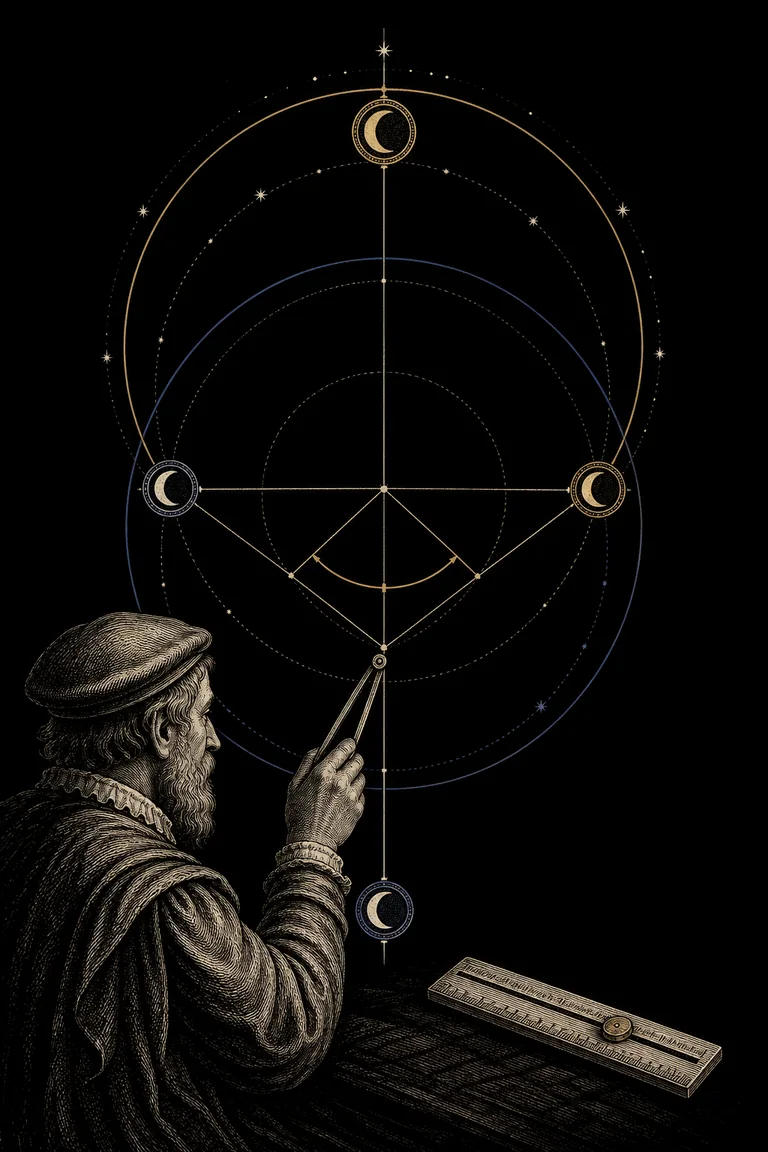
A nodal trine in astrology occurs when the transiting North Node is 120 or 240 degrees from the natal North Node. Because the South Node is always opposite the North Node, a trine to one end of the natal axis is simultaneously a sextile to the other. The two trine phases are often estimated near 6.2 and 12.4 years after a nodal return, repeating about every 18.6 years.
Those offsets are search windows, not exact dates. A reproducible calculation names the orientation, keeps natal and transiting positions on the same mean or true node convention, measures circular longitude, and saves every exact crossing. Astrologers may describe trines as flowing, but the geometry cannot guarantee ease, agreement, talent, luck, or a particular event.
Take the next insight with you
Explore personalized Astrology guidance in Veritas, available for iOS and Android.
 Scan with your phone
Nodal trine at a glance
Nodal trine versus return, opposition, and square
A nodal return matches the natal axis orientation. A nodal opposition reverses it. A nodal square places the axes 90 degrees apart. The trine uses 120 degrees, so it is a separate phase rather than a loose name for any supportive node contact.
Why a nodal trine also contains a sextile
If transiting North Node is 120 degrees from natal North Node, it is 60 degrees from natal South Node. The same axis relationship can therefore be described from either end. State the exact pair being compared. Otherwise “North Node trine the nodes” can hide whether software measured North-to-North, North-to-South, or an aspect to another point entirely.
The two trine orientations
Normalize natal North Node minus 120 degrees and plus 120 degrees on a 0-to-360-degree circle. With the continuously retrograde mean node, the minus-120 target normally occurs first after a return and the plus-120 target later. True-node oscillation can briefly reverse local motion, so verify longitude rather than inferring orientation from age alone.
When nodal trines happen
One-third of a rounded 18.6-year cycle is about 6.2 years. Approximate windows therefore fall near ages 6.2, 12.4, 24.8, 31.0, 43.4, 49.6, 62.0, 68.2, 80.6, and 86.8. Exact timing depends on natal longitude, mean or true nodes, ephemeris, and nonuniform true-node motion. These figures are search centers, not fixed birthdays.
Mean node versus true node
The mean node smooths short-period oscillation and moves retrograde continuously. The true node models the oscillation more closely and can briefly move direct. Use the same convention for natal and transiting positions. When programs disagree, compare node type, tropical or sidereal zodiac, reference frame, timezone, and coordinate precision before comparing interpretations.
How to calculate a nodal trine
- Save the natal node
Record exact North Node longitude, mean or true setting, zodiac, reference frame, timestamp, and ephemeris source.
- Calculate both targets
Normalize natal North Node minus 120 degrees and plus 120 degrees to the 0-to-360-degree circle.
- Name the orientation
State which North-to-North trine target is being approached and note the simultaneous sextile to the opposite node.
- Open a one-third-cycle window
Search around the appropriate 6.2-year offset instead of assuming an exact age.
- Bracket and refine
Find timestamps on opposite sides of zero signed angular distance, then shorten the bracket with an ephemeris or solver.
- Keep every pass
True-node oscillation can cross a target more than once, so retain each timestamp and motion state.
A circular-longitude example
Suppose the natal mean North Node is 18°20' Virgo, equal to 168°20' zodiac longitude. The first retrograde trine target is 48°20', or 18°20' Taurus. If the transiting mean node is 48°50' and moving retrograde at 3 arcminutes per day, it must decrease by 30 arcminutes. The first estimate is ten days later, after which an ephemeris should refine the exact time.
Illustrative first estimate before ephemeris refinement
First trine target = 168°20' - 120° = 48°20'
Remaining retrograde distance = 48°50' - 48°20' = 30 arcminutes
30 arcminutes ÷ 3 arcminutes per day = 10 days
Why one trine can have several exact passes
The mean node normally crosses each target once. The true node can oscillate across the same longitude and produce a short direct pass between retrograde passes. Treat these as one trine season and save every exact timestamp. The stationary motion guide explains the value of tracking signed motion even though the node is a calculated point.
Birth time, houses, and angles
Birth-time uncertainty changes slow nodal longitude less than it changes the Ascendant, Midheaven, and houses. Calculate the node aspect only to the precision supported by the data, then omit or qualify houses and angles when time is uncertain. The birth chart without birth time guide offers a reliability hierarchy.
How astrologers interpret a trine phase
Astrologers may use a nodal trine to compare current choices with a direction associated with the natal node axis. Because trines are traditionally described as flowing, a reader might look for habits or support that reduce friction. A useful counterquestion is whether low friction reflects genuine alignment, unexamined repetition, privilege, or avoidance. Geometry does not grade the decision.
What to examine in the event chart
The trine between one end of each node axis and the simultaneous sextile between the other ends are guaranteed by definition. Other planets, angles, houses, and aspects depend on the exact timestamp, place, settings, and birth data. Declare orbs and prioritize exact contacts to the nodal degrees. Use the astrology aspects guide instead of collecting loose supportive contacts.
A practical review protocol
Choose one ongoing behavior relevant to the chart question. Record what currently happens with little resistance, who benefits, what evidence supports the interpretation, and what cost may remain hidden. Define one reversible test and one observation that would challenge the story. Review after the final exact pass rather than treating each approach as a new prediction.
Save a reproducible nodal trine
Use Veritas to record the natal node, both 120-degree targets, orientation, simultaneous sextile, mean or true setting, every crossing, motion state, chart settings, observations, alternatives, and review date.
Common calculation mistakes
Frequent errors include using 60 degrees when the intended North-to-North contact is 120, forgetting the second trine orientation, mixing mean and true nodes, relying on sign alone, mishandling the 0-degree boundary, rounding before refinement, losing UTC during conversion, and reporting only one true-node pass. A screenshot without coordinates and node convention is not reproducible.
Limits and responsible use
Nodal-trine astrology is a symbolic practice, not a scientifically validated predictor of compatibility, talent, health, spiritual development, career opportunity, relationships, money, travel, or timing. Do not use it to replace medical, legal, financial, or safety advice. Keep the node symbolism proportional to documented circumstances and reversible choices.