Astrology Journal
North Node Conjunct Ceres Transit: Timing and Meaning
North Node conjunct Ceres transit is a temporary longitude match between the selected moving North Node and natal asteroid 1 Ceres, with the South Node simultaneously opposite.
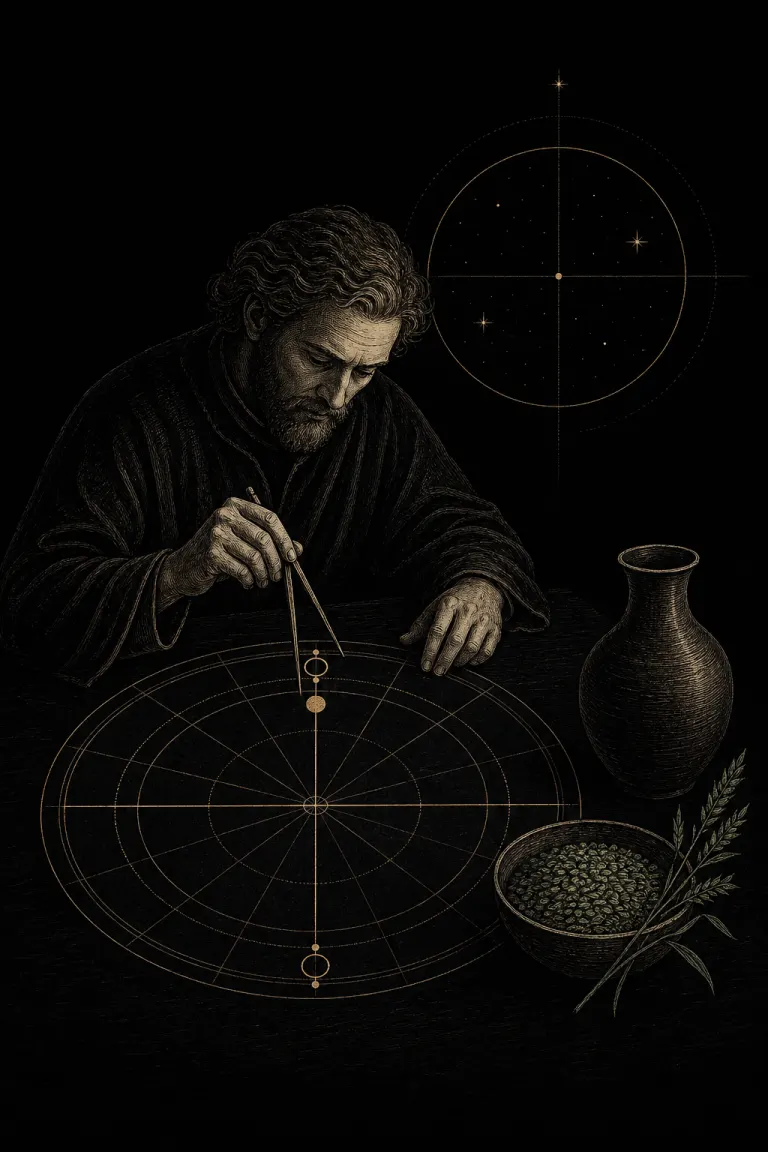
North Node conjunct Ceres transit occurs when the selected moving North Node reaches the natal longitude of asteroid 1 Ceres. Because the lunar nodes form one axis, the South Node opposes natal Ceres at the same moment. Astrologers may use the interval to review care, nourishment, separation, return, labor, resources, and the agreements that make support sustainable.
Calculate before interpreting. Verify that the natal factor is asteroid Ceres, record its longitude, choose mean or true node, state the zodiac and orb, and find every exact pass. This transit cannot diagnose illness, predict pregnancy or fertility, determine custody, guarantee reunion, foretell loss, or assign anyone a destined caregiver role.
Take the next insight with you
Explore personalized Astrology guidance in Veritas, available for iOS and Android.
 Scan with your phone
North Node conjunct Ceres transit at a glance
Confirm that the chart point is asteroid Ceres
Use asteroid 1 Ceres rather than a similarly named hypothetical point or a generic nurturing label. Record the source and natal longitude. The Ceres guide covers its modern symbolic use through care, nourishment, separation, return, signs, houses, and aspects. That natal context remains distinct from the temporary nodal contact.
The conjunction is an exact longitude match
If natal Ceres is 18 degrees 14 minutes Virgo, exactness occurs when the selected North Node reaches that same coordinate in the same zodiac. A narrow orb may define an observation window, but the entire window is not exact. The aspects guide separates application, exactness, and separation.
Mean and true nodes can produce different dates
The mean node smooths the nodal motion. The true node includes short oscillations and can cross one longitude more than once. Neither setting is automatically superior. Choose one, label it, and search the full interval for every pass. If you compare both, keep two separate timelines rather than merging their orb entries and exact contacts.
The South Node opposition belongs in the interpretation
At every exact North Node conjunction to Ceres, the South Node opposes Ceres. A symbolic review can compare new support arrangements with familiar duties, receiving care with performing it, or a current resource need with an inherited pattern. The lunar nodes guide treats both ends as one axis, not a good point fighting a bad one.
A reproducible timing workflow
- Verify natal Ceres
Record asteroid 1 Ceres, its longitude, zodiac, reliable house if available, and calculation source.
- Choose the node
Select mean or true North Node and keep that setting fixed through the study.
- Define the window
State a narrow observation orb and reserve exact for the matching longitude.
- Find every pass
Record application, all exact contacts, motion, separation, and the simultaneous South Node opposition.
- Log facts separately
Track care tasks, food, money, time, agreements, separations, returns, capacity, and outcomes without symbolic labels.
- Review after separation
Compare expectations with the dated record, quiet periods, contradictions, and ordinary explanations.
Care requires consent and capacity
Ceres symbolism can make care sound automatically virtuous. A more useful review asks who requested help, who agreed, what skill and time are available, how costs are shared, and when the arrangement will be reviewed. Care without consent can become control. Care without capacity can become neglect, resentment, or unsafe work. The transit does not require self-sacrifice or authorize decisions for another adult.
Separation and return are not predictions
Mythic associations with Ceres often bring separation and return into interpretation. Use them as questions about transitions, access, grief, handoffs, seasonal routines, or renegotiated contact. Do not predict bereavement, disappearance, estrangement, custody outcomes, adoption, or reunion. When a real separation matters, use direct evidence, documented agreements, and appropriate professional support.
Food and body themes need firm boundaries
A Ceres transit cannot diagnose an eating disorder, allergy, digestive condition, pregnancy, infertility, or nutritional deficiency. It cannot tell someone what to eat or whether to stop treatment. A symbolic journal may record meals, access, routines, labor, and feelings about care, but health decisions belong with evidence-based guidance and qualified clinicians.
House, sign, and natal aspects add context
After fixing the coordinate, use Ceres sign, reliable house, ruler, and close natal aspects as context. A sixth-house Ceres might focus the review on daily service, health routines, and workload, while a fourth-house placement may focus home resources and private support. Compare the sixth house and fourth house guides without treating a house as a promised event.
Birth time can change the house, not the conjunction date
Ceres zodiacal longitude is usually stable across a day, while house position and angles can be sensitive to birth time. If the time is unknown, calculate the longitude but label the house uncertain. The birth-time guide helps preserve what remains reliable instead of forcing false precision.
Worked timing example
Suppose natal Ceres is 18 degrees 14 minutes Virgo. You choose the true North Node and a one-degree observation orb. Record orb entry, every exact crossing created by nodal oscillation, and final separation. At each exact pass, the South Node is 18 degrees 14 minutes Pisces. Maintain a second timeline for actual care requests, schedule changes, food access, expenses, handoffs, refusals, and outcomes.
Relationship and family reflection
In relationships, the contact can organize a review of caregiving, household labor, money, meals, privacy, time, and how support is requested. It cannot identify a parent-child bond, soulmate, pregnancy, reunion, or abandonment. Ask what each person can offer, what they may decline, how invisible labor is counted, and what happens when capacity changes.
Work, service, and resource distribution
At work, Ceres themes may focus staffing, mentoring, food service, care work, leave, benefits, emotional labor, or resource allocation. Check policy, compensation, workload, safety, and decision authority. Astrology cannot prove exploitation, predict promotion or dismissal, or replace employment, medical, financial, or legal advice.
Natal Ceres and the transit are different records
Natal Ceres is a stable chart factor within the selected model. The nodal conjunction is temporary. Do not turn one interval into a permanent identity as caregiver, provider, deprived child, or abandoned person. Compare North Node conjunct Moon and North Node conjunct Chiron to keep the contacted factor and its limits specific.
Save a settings-explicit Ceres transit record
Use Veritas to record natal Ceres, node setting, zodiac, orb, every exact pass, South Node opposition, care requests, consent, capacity, resources, handoffs, dated facts, alternatives, and final review.
A practical transit journal protocol
Before orb entry, write one expected care theme and one ordinary alternative explanation. During the interval, log exact dates and observable changes without assigning a mythic story. After final separation, classify entries as supportive, contradictory, ambiguous, or quiet. Keep only conclusions that survive comparison with the record.
Responsible limits
North Node conjunct Ceres transit is an astrological timing framework, not scientific proof of pregnancy, fertility, illness, nutrition, custody, bereavement, reunion, abandonment, compatibility, or destiny. Do not use it to pressure care, control food, stop treatment, override consent, or make unsafe legal or financial decisions. Visit the <a href="/astrology">Astrology journal hub</a> and let direct evidence, qualified advice, and immediate safety needs lead consequential choices.