Astrology Journal
North Node Conjunct Mercury Transit: Timing and Meaning
North Node conjunct Mercury transit is an exact longitude contact between the moving lunar node and natal Mercury, best studied through declared settings, every pass, and dated communication evidence.
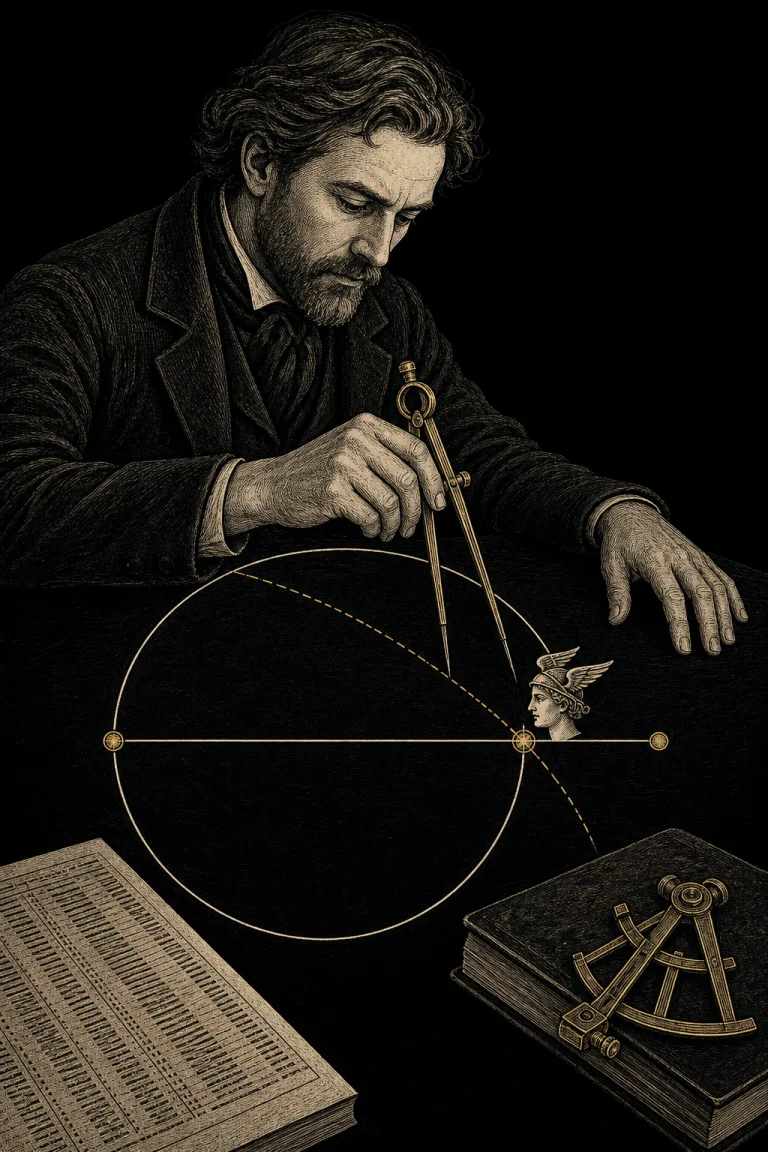
A North Node conjunct Mercury transit occurs when the selected transiting North Node reaches the same zodiac longitude as natal Mercury. At that moment the transiting South Node is exactly opposite Mercury. The calculation is precise, but the interpretation remains symbolic. Astrologers may use the period to review communication, learning, questions, decisions, documents, routes, and the way information moves through daily life.
Reliable timing requires the natal Mercury degree, zodiac and reference frame, ephemeris, mean or true node setting, declared orb, and every exact crossing. The true node can move back and forth across one degree, so a single date from an app may omit part of the sequence. This contact does not guarantee a message, contract, exam result, trip, diagnosis, or destined conversation.
Take the next insight with you
Explore personalized Astrology guidance in Veritas, available for iOS and Android.
 Scan with your phone
North Node conjunct Mercury transit at a glance
What the conjunction actually measures
The calculation compares two longitudes: transiting North Node and natal Mercury. Exactness occurs when their normalized angular distance is zero. The lunar node guide explains the axis as two opposite points rather than separate bodies. This article owns the Mercury target; it is not a general article about every node contact or every Mercury transit.
Natal data and Mercury accuracy
Mercury moves quickly enough that the correct birth date and a reliable planetary ephemeris matter. Birth time usually changes Mercury far less than it changes the Moon or Ascendant, but it still determines houses and can matter near a sign boundary. If time is unknown, keep house claims out and calculate the possible Mercury range for that date. The unknown birth time guide shows how to label that uncertainty.
Mean node and true node are different models
The mean node smooths short-term oscillation into a steady retrograde path. The true node follows the calculated wobble and may briefly turn direct. Neither setting is universally mandatory. Declare which one you use and do not switch settings to obtain a preferred date. If comparing software, match zodiac, node model, ephemeris, time zone, and displayed precision first.
When the transit can occur
The lunar nodes complete a cycle in roughly 18.6 years, but Mercury occupies a different natal longitude for every chart. Use the cycle only to open broad search windows. Exact dates depend on the selected node model and natal degree. A broad scan should find the first contact, after which later windows can be located near one nodal cycle apart and refined independently.
A reproducible calculation workflow
- Record natal Mercury
Save its unrounded longitude, sign, data source, zodiac, reference frame, software, and birth-time quality.
- Choose one node model
Declare mean or true North Node and preserve that choice throughout the search and report.
- Open a broad window
Scan enough time to catch the contact before narrowing around every possible crossing.
- Measure signed distance
Normalize transiting-node longitude minus natal-Mercury longitude across the zero-degree zodiac boundary.
- Find every zero crossing
Bracket each sign change or local contact, refine the timestamp, and retain repeated true-node passes.
- Verify the opposite point
Confirm that the transiting South Node is 180 degrees from natal Mercury and save the complete record.
Signed longitude example
Suppose natal Mercury is at 2 degrees 18 minutes Gemini, or 62 degrees 18 minutes absolute longitude. The conjunction is exact when the chosen North Node reaches the same value. Circular normalization is essential near 0 degrees Aries: 359 degrees 59 minutes and 0 degrees 01 minute are two arcminutes apart, not nearly 360 degrees apart. Keep full precision for the search and round only for display.
Example exact-contact check
Natal Mercury: 2°18' Gemini = 62°18' absolute longitude
Transiting North Node: 62°18'
Normalized distance: 0°00' = exact conjunction
Transiting South Node: 242°18' = exact opposition
Applying, exact, separating, and repeated passes
Node motion is usually retrograde, so applying and separating labels should come from adjacent timestamps rather than sign-based intuition. The true node may cross Mercury, turn, and cross again. Preserve each exact timestamp and motion state. Treat repeated crossings as one observation period with phases, not independent promises. The transits guide provides the broader moving-point method.
Choose the orb before reading events
There is no universal orb for node transits. A narrow orb keeps the review close to the actual geometry; a wider orb creates a longer observational window. Choose before searching messages, meetings, or decisions so hindsight does not define the rule. Record orb entry, every exact pass, and final exit, then compare the period with an ordinary baseline.
Mercury topics without literal prediction
Natal Mercury can symbolize attention, language, questions, learning, interpretation, categorization, negotiation, writing, short routes, and exchange of information. A node conjunction can prompt review of which channel or idea receives attention and which habit needs revision. It cannot reveal a hidden message or prove that every conversation is cosmically directed.
Sign, house, rulership, and natal aspects
Mercury's sign describes symbolic style, while a reliable house locates the contact in a life area. Mercury-ruled Gemini and Virgo, plus the natal houses they govern, may add context. Existing natal aspects describe Mercury's role in the chart, but they do not all become exact at the node contact. Use the Mercury sign guide and aspects guide to keep these layers distinct.
Communication, agreements, and relationships
A grounded relationship review might ask which conversation is overdue, what was assumed rather than stated, and whether both people understand the same agreement. Save the actual words, date, channel, and response. Do not use the transit to predict contact, reunion, confession, betrayal, or another person's mental state. Direct questions and consent provide usable evidence.
Learning, work, documents, and travel
At school or work, the period may be used to audit a question, brief, handoff, study method, contract, schedule, route, or information system. Check source quality, scope, owner, deadline, version, and acceptance criteria. Astrology cannot guarantee an exam result, publication, signed deal, job offer, safe journey, or correct diagnosis. Use qualified expertise and primary documents for material decisions.
Build a clean Mercury transit record
Use Veritas to save natal Mercury and data quality, node model, zodiac, ephemeris, orb, every exact pass, the South Node opposition, dated communications, decisions, outcomes, and a review date.
A three-phase observation protocol
Before orb entry, record a baseline for active questions, communication load, unresolved documents, learning goals, short journeys, and decision habits. During the transit, log dated evidence without forcing a story. After final exit, compare clarity, errors, delays, agreements, and practical consequences with the baseline. This is more useful than collecting only striking coincidences.
How this differs from Sun and Moon contacts
The Sun contact centers conscious direction and visibility. The Moon contact centers habits, care, privacy, and regulation. This Mercury contact owns information, questions, language, learning, routes, and decisions. Similar calculation steps do not make the three search intents interchangeable.
Common mistakes
Common errors include using a rounded Mercury degree, mixing mean and true nodes, dropping repeated passes, forgetting circular normalization, treating the South Node opposition as separate confirmation, assuming an eclipse, and choosing an orb after finding a memorable message. Another error is using Mercury symbolism to diagnose cognition, health, or another person's honesty.
Limits and responsible use
Astrology is a symbolic interpretive practice, not a scientific forecasting, diagnostic, or treatment method. This transit cannot establish causation or replace medical care, mental-health support, legal review, financial evidence, educational assessment, direct communication, or safety planning. Visit the <a href="/astrology">Astrology journal hub</a> and keep conclusions proportional to the data.