Astrology Journal
North Node Conjunct Sun Transit: Timing and Meaning
A North Node conjunct Sun transit occurs when the transiting North Node reaches the natal Sun longitude; accurate work records the node convention, every exact pass, the opposite South Node, and the limits of symbolic interpretation.
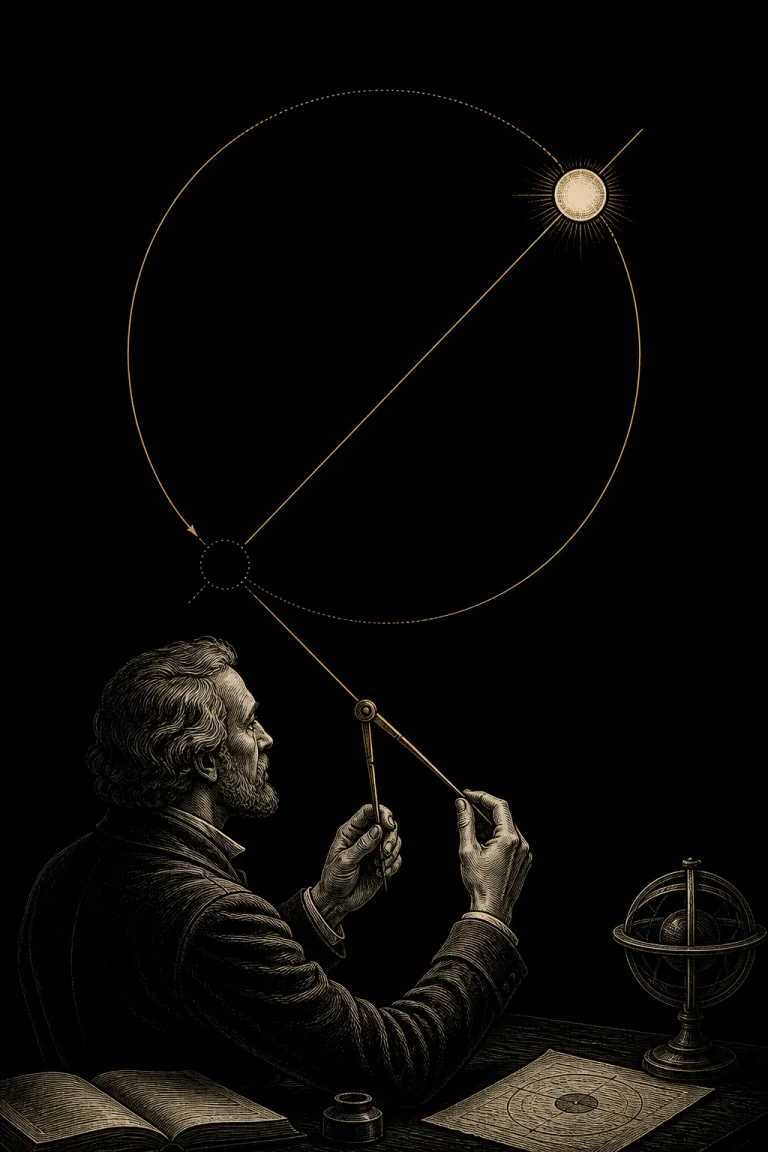
A transiting North Node conjunct the natal Sun is an exact 0-degree longitude contact between the moving North Node and the birth-chart Sun. At the same moment, the transiting South Node is exactly opposite the natal Sun. Because the nodal axis completes a cycle in roughly 18.6 years, the conjunction is uncommon, but an age estimate cannot replace an ephemeris calculation.
Astrologers often use this transit to reflect on identity, visibility, purpose, and participation. Those are symbolic themes, not guaranteed events. A reproducible reading saves the natal Sun longitude, mean or true node setting, zodiac, reference frame, exact timestamps, motion state, orb, and every crossing. It also distinguishes this transit from a natal Sun-node conjunction, an eclipse, and a nodal return.
Take the next insight with you
Explore personalized Astrology guidance in Veritas, available for iOS and Android.
 Scan with your phone
North Node conjunct Sun transit at a glance
What the calculation actually compares
The natal Sun is a fixed target copied from the birth chart. The transiting node is a moving geometric point where the Moon's orbit crosses the ecliptic. The conjunction is exact when their circular zodiacal longitudes match. The nodes are not planets or physical bodies. The North Node and South Node guide covers broader natal symbolism; this article owns the transit timing and review intent.
Transit, natal aspect, and eclipse are different
A natal Sun conjunct North Node describes positions at birth. This article concerns a later transiting node contacting the natal Sun. An eclipse requires a new or full Moon near the transiting nodal axis; a node crossing the natal Sun does not by itself create an eclipse on that date. Keep these geometries separate even when an astrology program displays them together.
Why the South Node opposition is simultaneous
The South Node is always defined 180 degrees from the North Node. If the transiting North Node equals the natal Sun longitude, the transiting South Node equals the point opposite the natal Sun. This is one axis condition, not two independent confirmations. Interpretive language may contrast approach and release, but the calculation itself only establishes an opposition at the other end of the same axis.
How often the conjunction occurs
The nodal axis returns through the zodiac in about 18.6 years. That makes ages separated by roughly 18 or 19 years useful search windows, not exact dates. The first conjunction after birth depends on where the node began relative to the natal Sun and can occur at any age within the cycle. Later conjunctions repeat about one cycle apart. Search an ephemeris rather than adding a fixed age to the birthday.
Mean node versus true node
The mean node smooths short-period variation and moves retrograde continuously. The true node follows the oscillating solution more closely and can briefly move direct. Either convention can be used if it is declared and applied consistently. They can produce different exact timestamps and pass counts. Before comparing two programs, verify mean versus true node, tropical versus sidereal zodiac, and geocentric reference settings.
A seven-step calculation method
- Save the natal Sun
Record its full zodiac longitude, birth-data quality, zodiac, reference frame, software, and source.
- Choose one node
Declare mean or true North Node and use the same convention throughout the search and final chart.
- Open a broad window
Scan the complete nodal cycle when the first occurrence is unknown, then use roughly 18.6-year spacing for later windows.
- Measure signed distance
Normalize transiting-node longitude minus natal-Sun longitude across the 0-degree boundary.
- Bracket every zero
Find adjacent timestamps where the signed distance changes sign, then refine each interval.
- Record motion and passes
Keep every true-node crossing, including brief direct or stationary behavior, instead of selecting one convenient date.
- Verify the axis
Confirm that the transiting South Node is opposite the natal Sun and save UTC plus display timezone.
A circular-longitude example
Suppose the natal Sun is 29°50' Pisces, or 359°50' of zodiac longitude. A transiting North Node at 0°05' Aries is only 15 arcminutes ahead, not almost 360 degrees away. If a short ephemeris interval shows retrograde motion toward 359°50' at 3 arcminutes per day, the first estimate is five days after the observation. The speed is illustrative. Refine against an actual ephemeris because node speed changes.
Illustrative first estimate before ephemeris refinement
0°05' Aries = 360°05' for this local subtraction
360°05' - 359°50' = 15 arcminutes
15 arcminutes ÷ 3 arcminutes per day = about 5 days
Exactness and orb
Exactness is the timestamp of minimum angular separation. An orb is a chosen observation window around that point. State the orb instead of presenting a broad season as exact. A narrow research log might record one degree and highlight the exact pass; another astrologer may use a different threshold. Consistency matters more than claiming one universal orb. The astrology aspects guide explains declared aspect rules.
Why the true node can create several passes
Although the nodal trend is retrograde, the true node can oscillate and briefly reverse apparent direction. A target near a loop can therefore be crossed, recrossed, and crossed again. Treat the timestamps as one transit season and record the motion state at each pass. The stationary motion guide provides a broader method for separating an exact crossing from a slow interval.
Birth time and natal Sun precision
The Sun moves roughly one degree per day, so an uncertain birth time can shift its recorded longitude by a meaningful fraction of a degree. Houses and angles may change much more. If the birth time is approximate, calculate a Sun-longitude range across the plausible interval and report a transit window rather than false minute-level precision. The chart without birth time guide explains how to qualify house and angle claims.
Houses, rulership, and other transits
The conjunction is guaranteed by the search. Houses, angles, dispositors, and other planetary contacts depend on the chart and timing. Use a reliable birth time before emphasizing the natal Sun house or the transit house. Keep tight simultaneous contacts separate from background transits, and state their orbs. The transits guide helps prevent one exact contact from absorbing every event in a long period.
A grounded symbolic interpretation
Astrology commonly links the Sun with identity, vitality, visibility, authorship, and purposeful action, while the North Node is framed as unfamiliar participation or development. Turn that vocabulary into questions. Where are you being more visible by choice? Which role requires practice rather than performance? What responsibility comes with being recognized? Which existing evidence supports the direction, and what would disconfirm it? The Sun sign guide covers the Sun without reducing identity to one placement.
Identity, visibility, and consent
Visibility is not automatically beneficial. Public work, leadership, disclosure, and self-presentation carry different risks depending on safety, employment, family, health, and culture. A useful transit review includes consent, audience, boundaries, capacity, and exit options. Do not use the conjunction to pressure someone into exposure, announce a calling, or treat privacy as avoidance.
Save a reproducible Sun-node transit
Use Veritas to record the natal Sun longitude and uncertainty, node convention, every exact timestamp, motion state, orb, reliable houses, observed facts, alternative explanations, one bounded experiment, and a review date.
A practical review protocol
Choose one role in which identity and participation are genuinely active. Write the current facts, the audience involved, one skill still needed, one boundary, one reversible action, and one measure of effect. Review before the first pass, between passes if there are several, and after the final pass. Keep ordinary causes, feedback, and changing circumstances beside the symbolic notes.
Compared with a nodal return and opposition
A nodal return matches the transiting North Node to the natal North Node. A nodal opposition matches it to the natal South Node. This transit instead matches the transiting North Node to the natal Sun. Their cycles are related because the same moving axis is used, but their natal targets and primary search intents are different.
Common calculation and reading mistakes
Frequent errors include confusing transit with natal aspect, calling any node-Sun contact an eclipse, mixing mean and true nodes, matching only the sign, ignoring the 0-degree boundary, rounding the natal Sun too early, losing UTC during conversion, reporting one true-node pass, and using exact houses with an uncertain birth time. Interpretively, the largest mistake is converting symbolic visibility into promised fame or compulsory life purpose.
Limits and responsible use
North Node conjunct Sun transit astrology is a symbolic practice, not a scientifically validated prediction or diagnostic method. The transit cannot prove destiny, karma, identity, health, leadership ability, another person's intentions, career success, relationship outcomes, or spiritual rank. Explore the <a href="/astrology">Astrology journal hub</a> for reproducible methods, and make consequential choices through current evidence, consent, direct communication, and qualified professional advice.